
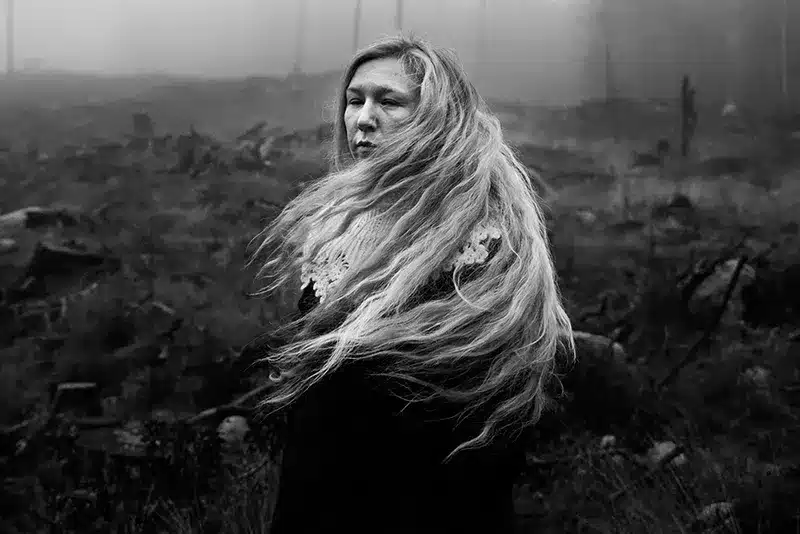

Gloom, glorious gloom, permeates the musical catalogue of singer-songwriter Fågelle (Klara Andersson), and new album Bränn min jord overflows with it. There are screams, cries, and field recordings. There is a sense throughout that we are swinging between mourning and desperation. Most importantly, there is Fågelle, coolly confident and unpredictable as a composer and performer. Even in the record’s most sedate moments, there is always something simmering within her. As Bränn min jord moves from start to finish, it’s thrilling to find out what those somethings are and how they burst forth from the depths of Fågelle’s mind to the sonic surface.
As the album begins, it is slow, stark. Beneath a sparse piano line and Fågelle’s tense murmurs, subtle and ineffable environmental sounds seep into the moody opening track “Riv mig”. They soon take shape as rhythmic elements, driving the track forward until it breaks through some invisible barrier with crashing drums and searing guitars. Fågelle’s voice climbs to a tormented height as she finishes her last full verse.
“Och en dag ska jag lossna och aldrig landa mer,” she cries: “One day I will break free and never land again.” The embers of the song quickly fade away, leaving a silence broken through with a distorted scream that leads directly into the ominous glory of “Innan malen hittat in”, on which Stefan Isebring brings into play a self-built hurdy-gurdy. This, alongside wordless, kulning-adjacent shouts, gives the song thrilling depths, evoking the Swedish forests in which Fågelle produced much of this album—gloom, glorious gloom.
Heavy though it hangs, the gloom shapeshifts with abandon as the album proceeds. One kind of intimacy marks the purely acoustic “Lars tröstesång”, a short mourning verse. Another kind carries through Fågelle’s angst as she sings over the constantly changing instrumentation of “Det blev våra liv”. Samples of film, bees, and whistling make for an eerie interlude on “Raset”, which comes to a hard stop before the electric simmering of the title track, a bittersweet reverie on drowning, burning, shame, and obsession.
Unquestionably, the emotional climax is “Satans jävla fan”, in which Fågelle fully lets go of the audible catch in her throat, the clench in her jaw, and cries out over a growling bassline and uncannily glitchy synths. It’s the wailing that has been building throughout the album, and to hear it in its true freedom is tremendously cathartic. The rest of the album feels like an aftershock, with “Det djur som är du” a strong, final pushing away of emotional debris, and the final track “Avslutning” sounding a restorative kind of decay as a brass ensemble’s performance of a hymn breaks down into electronic distortion.
In Bränn min jord, Fågelle experiments with melancholy text and instrumental eclecticism to fascinating ends. Her inventive sense of ambience invigorates her hefty lyrics, imbuing them with an emotional life that makes even her most opaque poetics real. She is an artist who knows well the creative value of solitude and the importance of release, and Bränn min jord is a solid representation of each.