
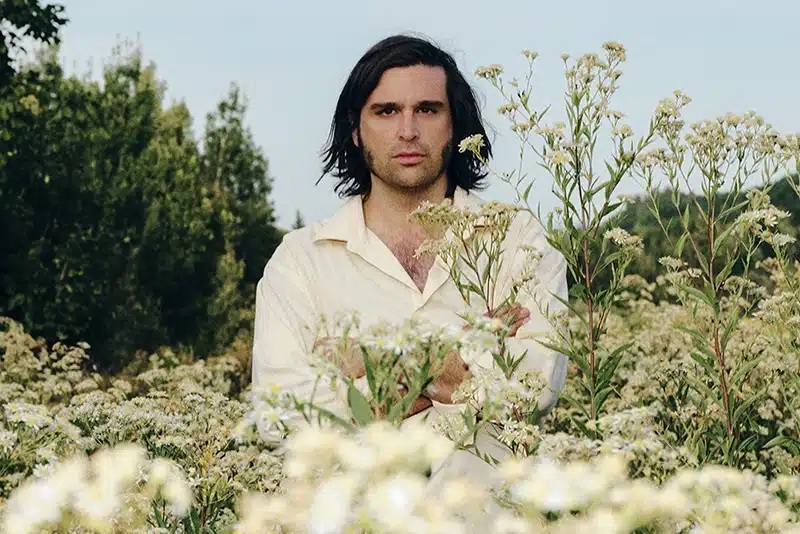
Within the somewhat unusual confluence of synthesizers and a small orchestral ensemble, Canadian artist Flore Laurentienne produces music rooted in the landscape of his country and inspired by the vastness of the St. Lawrence River. The music is bright, simple, and powerful. Led by Minimoog player Mathieu David Gagnon, Flore Laurentienne are comprised of a string quartet, two keyboardists and a percussionist and their new album, Volume III, highlights the concept of beauty in chaos, and like the press materials suggest, the message is one of light: “It is the seed in the ground that becomes a plant and then a flower, blooming at its peak and then inevitably wilting so that the cycle can begin again.”
Following in the footsteps, needless to say, of Volume I (2019) and Volume II (2022), this new record draws inspiration from the counterpoint of Johann Sebastian Bach, the progressive leanings of King Crimson, and the ambient beauty of minimalist/krautrock pioneer Hans-Joachim Roedelius. While the sheer beauty of the performances is a unique and vital component of the group’s sound, it’s easy to see how the inspiration of nature has seeped into these compositions.
The opening track “Fleurs” brings the bright strings front and center (featuring a dreamy synth break in the middle). “Regate” features a crisp synth sequence that forms the song’s spine, while piano and lush strings luxuriously wrap around the electronic base. The cinematic air of Flore Laurentienne’s music has been used to great effect, as three of Gagnon’s pieces appear in the César-nominated film Nino, and the piece “Petit Piano” from Volume I accompanies a Louis Vuitton 2026 ad campaign.
Also on Volume III, “Fleuve VII” and Fleuve VIII” are offered as continuations of a “Fleuve” sequence that first appeared on previous records. This conceptual connection showcases Gagnon’s innate ability to weave overarching themes throughout the ensembles’ discography while preserving the theme of nature. The gradual buildup of piano on the Erik Satie-like “Fleuve VII” is meant to simulate a sunrise, while the contrasting “Fleuve VIII” uses futuristic yet eloquent synthesizers as the instrumental foundation.
Not satisfied with staying in prescribed lanes, the closing track on Volume III, “(A Travers les) Chablis” takes cues from jazz and mesmerizing experimental avenues, as a muted drum solo dreamily weaves around the mix and haunting, sustained strings ebb and flow with the dramatic feel of an inspired film score. Flore Laurentienne goes for beauty in chaos, depth over complexity.
Volume III sees Flore Laurentienne continue to combine analogue and electronic instruments in a way that constantly complements them, never competing, creating an experience that feels intimately familiar and personal yet contains the vastness of Earth’s beauty.