
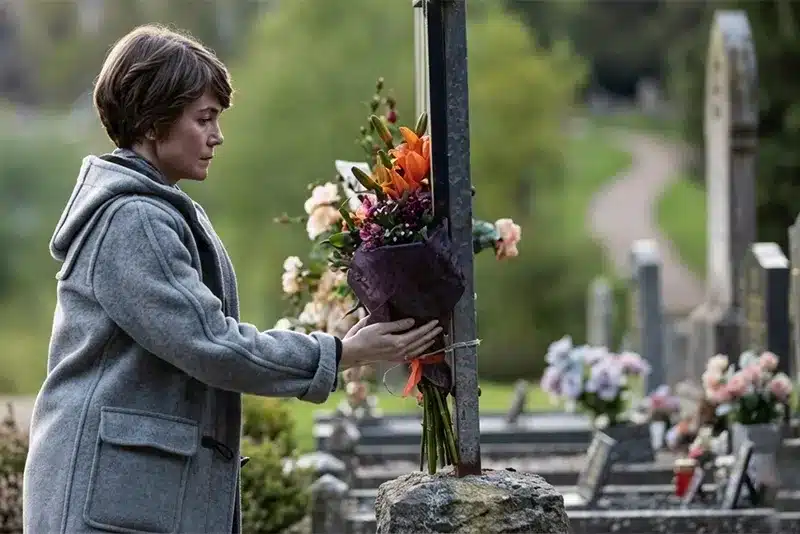

“You have to leave the cut open,” says crane operator Benat (Josean Bengoetxea), regarding the stems of flowers and the proper care for a bouquet; “Over time, the wounds heal.” This metaphor extends to the heart of Flowers, a film that quietly meditates on the nature of grief and what that can mean for different people.
Artfully directed by Jon Garaño and Jose Mari Goenaga, the Basque-language film follows the separate lives of three women whose paths irrevocably intertwine when each experiences the loss of a loved one in different ways. Spanning five years, these women find that time doesn’t make grief disappear; instead, grief continuously evolves, morphing into different forms and changing each person, affecting them for the rest of their lives.
Ane (Nagore Aranburu) works at a construction site, and when we first meet her, her life seems empty and bare. Her marriage is unfulfilling, her job even more so. Things begin to change for Ane when she receives flowers from an unknown sender. The flowers awaken something in Ane: excitement, possibly, or a sense of purpose. Her search for the mysterious sender explores the disconnect she feels with her husband.
Meanwhile, Ane’s coworker, Benat, has his own struggles at home. His wife, Lourdes (Itziar Ituno), and his mother, Tere (Itziar Aizpuru), are constantly at odds over Tere’s interference with their lives and the pressure she puts on Lourdes to have a child.
Shared tragedy brings Ane, Lourdes, and Tere together in a fortuitous set of events, and throughout their journey through grief, flowers remain a symbol of how loss can change through time. The flowers mean something different to each character at different points in their lives, connecting them to love and to understanding one another. Memory also plays an integral role in Flowers, moving viewers to contemplate what death really means for a person’s spirit.
Nagore Aranburu portrays Ane with elegance and subtlety. Her feelings are so subdued that at times it’s difficult to discern what she’s thinking. The tendency to keep her feelings to herself partly prompts Ane to become swept up in Flower‘s tragic events. The breakthrough performance, however, is delivered by Itziar Aizpuru, who portrays the widowed Tere. She’s fierce and proud, but grief is etched in her face, and her eyes convey her longing to keep remembering the deceased.
Lourdes is a more complicated character, as someone who wants to forget, to push her grief aside so that she may move on. There are times when Lourdes is somewhat unlikable for her refusal to face the facts. Itziar Ituno plays those nuances perfectly. I wish more time were spent on her character. The emphasis on Ane at times makes Lourde’s grief seem less important, and I would love to explore Lourdes’s mindset as she deals with her loss.
Garano and Goenaga maintain a minimalist approach in conveying their story about loss. The cinematography is simple and stark, focusing on a few key images that repeat throughout Flowers. Through this simplicity, the characters’ emotions are brought to the forefront, and the focus on these women’s lives really makes the film shine. The realism presents the story as ordinary, and this timeless feeling of grief becomes a universal story that transcends language and culture. At times, the imagery can be a bit on-the-nose: flowers wilting and dying, and arrows pointing the way to move forward, but they’re so beautifully shot that you can simply sit back and soak in their symbolic meanings.
The music also follows the rule that “less is more”. There are a few moments when Pascal Gaigne’s orchestral score underscores the climax of a scene, driving emotions such as longing, fear, and mystery, but more often than not, the silence is more profound, as the subdued noises only serve to heighten each character’s feelings. The silence not only aids the characters but also gives the viewer time to meditate on the film’s meaning and emotion, making it a participatory experience and making the story less voyeuristic and more a shared reflection on the human condition.
Flowers stands out as the directing team’s most mature effort to date, and is the most successful at representing their artistic style and vision. Take their 2010 film, 80 Days, which also stars Itziar Aizpuru and features Pascal Gaigne’s score. Like Flowers, this film is quiet and meditative, meandering through the lives of two women as they explore their identities in old age, but it often lingers on scenes for their own sake, eschewing meaning for atmosphere.
In Flowers, the directors imbue the film with their slow, thoughtful style; they have also learned to use these tools to convey character depth and growth and to move the story forward even as it pauses to reflect. For example, the pervading silence symbolizes stifled communication, and the lingering focus on flowers prompts viewers to constantly reconsider what they might mean at any given moment.
Too often, films in the grief genre try to impart a treacly message at the end: words of wisdom about the importance of moving on or about how death can teach us to live more fully. Flowers takes the opposite direction, observing that there is no end to grief, and sometimes all you can do is simply let it run through you. Ane, Lourdes, and Tere pass flowers to one another like a baton, and by the end of the film, each woman has begun a new cycle of grief. All we can be sure of is that as long as someone remembers the deceased, the cycle will continue.
The DVD, distributed by Music Box Films, includes “The Making of Flowers”, a short documentary on how the film was made. Like the film, the documentary is minimalist, offering a few interviews but mostly focusing on behind-the-scenes clips. Also included are a Q&A with the filmmakers and a press conference from the San Sebastian film festival. These informative features provide insightful commentary on the film and its themes, and are well worth a watch.