

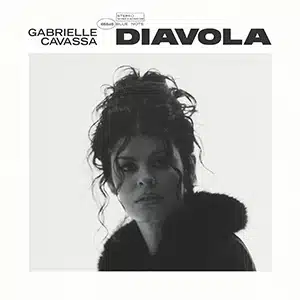
Jazz fans know the vocalist Gabrielle Cavassa from her work with saxophonist Joshua Redman on his 2023 album Where Are We, his first for the legendary Blue Note label, as well as his first to feature a singer. On that album and on the road with Redman, Cavassa found fresh ways to approach standards like “Stars Fell on Alabama” and “Do You Know What It Means to Miss New Orleans” and pop songs by Jimmy Webb and Sufjan Stevens.
Cavassa’s voice has a dramatic quality and the vulnerability of Billie Holiday, but without the mimicry of Madeline Peyroux. It balances on a knife-edge between jazzy nostalgia and indie originality. Her new album, Diavola, then comes on Blue Note, with Redman on some tracks, a crack modern jazz band (Jeff Parker on guitar, Larry Grenadier on bass, pianist Paul Cornish, and Brian Blade on drums), and label head Don Was producing. It sounds great: stripped down to the essentials, airy yet full, perfectly recorded, and featuring an eclectic blend of standards, pop songs, Italian songs (representing the California-born singer’s heritage), and originals, too.
Happily, it is not an attempt by Blue Note to chance upon another Norah Jones-esque bestseller, though it is appealing and genial. Better, Diavola is an exquisite, personal project that presents a rare voice in an honest and exposed way. Cassava is the kind of singer who tells a story intimately and can really sing. Throughout Diavola, she delivers breathtaking performances that are supported by minimalist creativity.
The story goes that Redman’s manager heard Gabrielle Cavassa perform at a wedding in New Orleans, her adopted home. It is also true that in 2012, the singer competed in the “Hollywood rounds” of the 11th season of American Idol (where she was eliminated). Listening to Diavola, it is hard to imagine Cavassa banging out Kool & the Gang’s “Celebration” or an Idol classic like Whitney Houston‘s “I Have Nothing” on television. The bulk of the new album leans toward the tradition in jazz and bossa nova of “under singing”.
“To Say Goodbye”, for example, is an Edu Lobo song written for a collaboration with Sergio Mendes in 1970. Cavassa sings the beautiful melody over a lazy Latin groove from Gredadier’s bass and Blade’s whispering drums as guitarist Jeff Parker plays simple, evenly sustained chords that hypnotically stretch for one bar each. Her own “Bossy Nova” adds the singer’s acoustic guitar, while Parker plays clean, resonant single-line melodies around the vocal. Cavassa floats over the band, both conversational and forward in the mix so that you can hear every little crack, insinuation, and quaver in her delivery.
Parker’s role on Diavola is critical. He can be a “conventional” jazz guitarist at times, but more often, here, he is the essential voice in steering the album away from the typical. In “Be My Love”, a ballad written for the 1950 movie The Toast of New Orleans (and a huge hit for Mario Lanza), Parker creates an electronic drone with layers of harmonics pitched just above Gabrielle Cavassa’s vocal range. He doesn’t play common chordal accompaniment but, rather, notes that slide in and out of the impressionistic drone, some just slightly dissonant, others tracing a degree of chordal movement. You’ve never heard a “standard” played this way before.
Somewhat more conventional is the duo of Parker and Cavassa taking on the Burt Bacharach/Hal David classic “Raindrops Keep Fallin’ on My Head”. Parker introduces it with another guitar wash, but then he shifts to a folk-adjacent set of mid-tempo arpeggios for the melody. Bass and drums enter, soulful and simple, allowing the vocal to play with the melody that we know so well. Redman adds a searching solo on tenor saxophone over a set of provocative chords, generating a gentle version of the famous Wayne Shorter solo on Steely Dan‘s “Aja”. The performance additionally brings to mind another great Blue Note vocal track: Cassandra Wilson’s transformation of “Tupelo Honey” from her Blue Light ‘Til Dawn.
There are two songs that channel Gabrielle Cavassa’s heritage, sung in Italian: Luigi Tenco’s “Angelo” and “La Notte Dell’addio”, a 1960s pop song. Both offer band members the spotlight. Grenadier’s full-toned bowed acoustic bass frames the former before Parker joins and takes a tuneful turn. The latter is a spare duet with pianist Paul Cornish. Neither of these tracks will capture your attention as successfully as Cavassa’s title composition, a haunting and personal story orchestrated for the full band.
“Diavola” is, in many ways, the most successful and fully realized example of Cavassa’s art and her possibilities as a singer who is doing something interesting with the notion of “jazz singing”. The lyric is much more like a Joni Mitchell song than Rogers and Hart, but it is equally true that her band here—without even a hint of breaking into a “jazz solo” — does things that only jazz musicians can. It is excellent.
Listeners looking for a straighter jazz feel can’t deny that “Prisoner of Love” (a hit for Billy Eckstine) is a fluid winner, while both Cornish and Redman take strong solos over the reharmonized “Could It Be Magic” by Barry Manilow. In many ways, the real magic trick of Diavola is that Gabrielle Cavassa (and her band and producer Don Was) manages all these bits of musical transformation without any of them seeming gimmicky or forced.
Somewhere in the huge gap between the poles of competing on American Idol and recording with musicians like Joshua Redman, Jeff Parker, Brian Blade, Larry Grenadier, and Paul Cornish, there is an artist like Gabrielle Cavassa. Blue Note knows she is something special, not only talented, artful, and interesting but also just 31 years old and, well, glamorous. May she forever lean decidedly in the direction of the wonderful and rich music on this outstanding recording.