
Time is not a flat circle. Humankind will hopefully find a way to break free of the devastating traditions of war, colonialism, environmental degradation for the sake of capital, and alienation of people from their own lives. Still, the future doesn’t come without a confrontation with the past. If I’m sounding like a TikTok Hegel, that’s only because Gorillaz’s Damon Albarn, the songsmith extraordinaire of these turbulent times, also propagates this philosophy, albeit with panache to spare and a crackerjack virtual band behind his complex vision (likely some weed also).
Gorillaz is the Guinness World Records-certified bestselling virtual band of all time and the preeminent insider commentators on contemporary pop culture. A lovechild of Albarn and comic artist Jamie Hewlett, Gorillaz were conceived in London in 1998, while the two were cohabitating and, in their own words, doing drugs and watching too much MTV.
Barely 30 and already a generational legend as frontman for the Britpop icons Blur, Albarn, a curious man of acerbic wit, had grown tired of his own image. He had ideas for new melodic directions and world-spanning narratives that didn’t fit in with his quintessentially English bunch. Unimpressed by much of the pop culture of his time, he began contemplating a satirical project to turn some of the industry’s weaknesses on their head. Add Hewlett’s formidable drawing talent and some snarky opinions on popular culture to the mix, and 2D, Russel, Noodle, and Murdoc were born.
Three years of Blur outtakes, a myriad collaborations with artists as disparate as Ibrahim Ferrer and Talking Heads’ Tina Weymouth, and globetrotting recording sessions between London and Jamaica, birthed the eponymous Gorillaz in 2001. The album served as an overflowing melting pot of genres and cultural messagery, fronted by the digital quartet presented as “real” band members.
A cartoon ghost rapping over monkeys recreating the “Thriller” dance in “Clint Eastwood”? Why not? Trip hop-ish, pill-popping, melodica-laced melancholy on the streets of London in “Tomorrow Comes Today”? You’ve got it. Hypomanic road trip through pop culture pastiche in “19-2000”? Absolutely. The setup may have appeared mad, but it was also aesthetically and thematically novel for the domain of the “popular”. Gorillaz was fresh to a fault and suitable for an enormous range of listeners.
The audience worldwide ate it up. Gorillaz sold over seven million records, and their first tour, featuring Albarn and the live band obscured behind a screen projecting Hewlett’s visuals, made headlines globally. The rest is history. Still, what kind of history are we talking about here?
This is the question of all questions Albarn and his cohorts have decided to probe in 2025, marking the band’s 25th anniversary. A quarter of a century, eight albums, and 38 million units sold later, Gorillaz is among those rare bands everyone knows about and recognizes, regardless of age or demographic. One sold-out tour after another, folks aged 7 to 77 soak up Albarn’s every orchestral whim, coupled with Hewlett’s zesty cartoons, with the same unfeigned enthusiasm.
Most impressively, despite relentless experimentation and indulgent hodgepodge, apart from occasionally being labeled as gimmicky, Gorillaz never received overly negative criticism. Both the brand and the content remained strong.
Albarn’s collaborators to date outnumber Marvel’s lore peddlers; Hewlett’s and his multimedia ventures include holograms, documentaries, video games, interactive websites, augmented reality apps, and even a fictional band autobiography called Rise of the Ogre. Together, they produced a video web series, held a music festival, and onboarded one of the Powerpuff girls as a band member during rambunctious Murdoc’s “imprisonment”. The list is, astonishingly, far from exhaustive. The mythology has been, and still is, insanely detailed.
A quarter of a century in, it is universally accepted that Gorillaz is, pardon my French, an interesting band. This lazy adjective, at once loaded and curiously meaningless, doesn’t say much about a cultural product so diverse that it can be approached from virtually any discursive vantage point. So, after the fanfares pipe down, stripped of pizazz and Albarn’s preternatural ability to dish out pop bangers in his sleep, what remains? What is it that Gorillaz might be remembered for another quarter of a century from now, or longer?
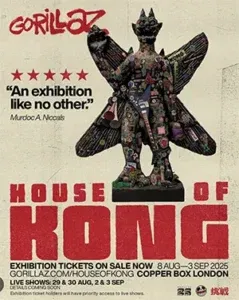
This is what their major retrospective, House of Kong, boldly sets out to elaborate on. First staged from the 8th of August to the 3rd of September 2025 in East London’s Copper Box, it propelled a full late-summer month of reminiscence for Gorillaz fans in the UK. Midwifed by Swear, the multimedia studio behind Banksy’s Dismaland, House of Kong, typically for its creators, was presented as more than “just an exhibition”.
An immersive, interactive blitzkrieg of pictures, sounds, videos, trinkets, and even smells, it comes as close as possible to embodying the digital ephemera that is the world of Gorillaz. It also playfully reveals the depths of Gorillaz’ ethos and the project’s richly disparate purposes, past and present.
As a curated overview of the band’s visual identity, House of Kong presents itself as a customarily meticulous fantasy born of Albarn’s and Hewlett’s manic synergy. Upon entering, visitors are treated to four separate sections dedicated to the creation of Gorillaz’ imagery, each of them showcasing Hewlett’s commitment to detail. Scribblings, storyboards, quotes, video clips, and sculptures all come together to tell a tale of how 2D, Russel, Murdoc, and Noodle came to “life” as a band.
Inscriptions such as Albarn’s 1990s anti-pop-idol maxim REJECT FALSE ICONS, loom around the corners, as visitors are given a mysterious “package” to be taken to a “special location”. The story takes off, and the exhibition, described by Swear’s founder Stephen Gallagher as an “audio-visual installation”, turns into something appropriately idiosyncratic for a band that wears more fascinators than the average socialite at the races. The rest can’t be spoiled, but the promise of a full hour of this wacky narratology easily sold out the $35 tickets instantly.
Riding on the heels of the UK’s success, House of Kong Los Angeles opens for three weeks between the 26th of February and the 19th of March at Rolling Greens DTLA. Given that Gorillaz is one of the few English bands to become a household name in the US, it was only natural for the hype to spread overseas. Exclusive shows to stir up the imminent release of their ninth album, The Mountain, were scheduled for the 22nd and 23rd of February at the Hollywood Palladium. A career-first performance on Saturday Night Live will follow on the 7th of March.
You probably guessed that most of the $49.50 tickets for House of Kong Los Angeles were snapped up within hours as well. Such is popularity: it snowballs and compounds, except for most acts, there’s a hard limit to how much attention they get, and especially how much cultural cachet they get to wield. Then again, most acts aren’t a quartet of quirky cartoon renegades wielded by a tireless illustrator-slash-creative director and the most prolific-slash-impressive pop music composer alive. It would be naive to downplay Hewlett’s and Albarn’s vision here, not with the coolest merch and most collab-friendly tunes around.
Nevertheless, that’s just the surface part, the “fun” aspect of the Gorillaz oeuvre, strong enough to draw hordes of new fans to their events even 25 years on. Creative to a fault and deliciously engaging, House of Kong offers more than mere cool pictures and props, though. It outlines the conceptually transformative nature of the band’s appearance, in line with the transformation of (pop) culture itself, and hints at the politics beneath it all. We’ll get to that.
It is no coincidence that House of Kong is narrated by the art historian and curator Kate Bryan. Despite amusing tomfoolery and merch-friendly drawings, one would fall prey to reductionism in describing Gorillaz as a “cartoon band” or a mere “pop experiment”. In reality, this is one of the most ambitious bands to ever enter our collective consciousness.
Riding on Hewlett’s formidable power of cultural mimesis and Albarn’s inexhaustible capacity for (re)invention and social commentary, Gorillaz is most richly enjoyed as a screwball Gesamtkunstwerk and a mirror to the “western” society as we know it today. Hewlett’s multimedia thus intertwines with Albarn’s stories where it truly matters, weaving a compelling yet digestible historicity of the contemporary anglophone world.
Inspired by manga, western comics, and pop surrealism, Hewlett’s idea for the band fermented at the turn of the century, following the emergence of the Internet in every household, and at the cusp of the era of hyperconnectivity. His urban and punk aesthetics imbued 2D with melancholy, Russel with aloofness, Murdoc with liberal chicanery, and Noodle with combative resistance against the system. The original incarnation was Y2K-coded, desolate, and a clear signifier of a freshly postmodern society that didn’t know how to define itself anymore. Its subjects didn’t know how to exist amidst others.
As new albums came, so did the aesthetic tweaks, partly to accommodate Albarn’s thematic adventurousness, partly to chase the continuously shifting cultural zeitgeist of our accelerationist existence. Demon Days, arguably Gorillaz’s magnum opus, arrived in 2005, marking the height of the George Bush and Tony Blair years, signalling total darkness. Here, Hewlett turned toward a macabre cinematic look, merging 2D art with CGI and opting for a Fincheresque palette of muted, desaturated colors, drenched in moribund yellow hues.
The “band member” characters also changed to reflect the darkening mood of Demon Days. Melancholic inertia gave way to anger and fear, embodied in the militancy of the videos for “Dirty Harry” and “El Mañana”. In that sense, the images and “narrative arcs”, such as Noodle’s violent fight against the powers of the capitalist overlords, always followed the melodies and lyrics closely.
The cinematic approach doubled down and expanded on 2009’s Plastic Beach, another hugely popular and most overtly satirical Gorillaz record. Hypersaturated and futuristic, it landed with strong sci-fi and dystopian overtones, wrapped in glossy 3D. The account of the iconic “secret floating island in the South Pacific”, composed entirely of debris and broken artifacts of a failed civilization, saw a more stylized version of the band, including a “cyborg Noodle”, made with the “remains of her DNA”, and “Hulk Russel”, whose body mass grossly increased after eating radioactive fish.
The sparsely instrumental The Fall, which Albarn composed on his iPad because why the hell not, marked the end of “phase one” both visually and narratively in 2011. The world had imploded, the civilization had obliterated itself (more accurately, its Self), and ended up a sort of spoof on a Cormac McCarthy novel. The final thing to do was to imagine a minimalist, digital music backdrop to a US road trip.
History, however, doesn’t play drum to our fiddle; Albarn and Hewlett may have seen 9/11, the Bush and Blair era, the rise of the smartphone, and the financial crisis of the 2000s as the “end” of the world, but the neoliberal telos of people’s complete subjugation to the interests of the elites didn’t end there. Six years on, and Donald J. Trump, reality TV star accused of sexual “misconduct” by half a dozen women (by 2026, the number rose to more than 28), unironically entered the presidential race in the US. So a new phase of the Gorillaz vision begins, one that reconciles the human needs for subsistence and, yes, joy, with the inevitable realization that history never really ends.
After a lengthy break and inevitable rumors of a split, 2017’s Humanz arrived as a reinvention of the Gorillaz ethos in a society in decline. Albarn described it best as “a party at the end of the world”. While not as thematically coherent as the first three releases, Humanz unified images of the apocalypse and its aftermath, at times a fever dream of serenity, at times an unhinged projection of the war on and for humanity.
Over the years, Hewlett’s commitment to exploring the latest technological and pop trends evolved the images to a 3D/2D hybrid, not unlike a Pixar animation on mushrooms (at best). Plumpier faces and meatier, more vividly realistic surroundings accompanied the dominantly hallucinatory stories.
Exceptionally, Humanz propositionally abandons Gorillaz’s flirtation with dialectical materialism and rebellion against the establishment, plunging into a morbid jouissance. The world as the New Deal and pre-Thatcher generations knew it is definitely done in, but we live on. What then? In an interview for Radio X, Albarn called Humanz an “emotional response to politics”, and this introspective, darkly exhilarating record came as an admission of grappling with powerlessness and a pervasive sense of dejection.
The solution was cautiously celebratory and subtly satirical. Club culture with synths and strobes took over from orchestral and minimalist styles, favoring slicker R&B and deeper beats. On the side of appearances, visualizers such as the video for “Saturnz Bars” play with horror lore, placing disheveled characters in a haunted house that can be read as a metaphor for anything from the surveillance state to celebrity culture.
If there was a “Gorilla” to thrive on this simmering anxiety, it was the satanic Murdoc, who took on a new role as an occultist and conspiracy theorist. The rest of the band members were simply skeptical of what would become of them, dancing drenched in ominous neon.
Not everything remains bleak, though. To the contrary, what followed, and what dominates the Gorillaz chronicles of the present day, is rebirth in joy. Invigorated by the chirpy-sounding (if not narratively chirpy) synthpop of the 1980s and old school funk and soul, 2018’s The Now Now marks a definitive shift in tone and theme. The simplest, cleanest, and most straightforward (least convoluted?) of Gorillaz albums, it sidelines apocalyptic symbolism in favor of bright, vibrant colors and plenty of sunlight.
As Albarn, the fortuitous inventor of today’s collab-first hype culture of pop, scaled back on guests to reclaim the vocals, Hewlett opted for simpler, relaxed backdrops and reenergized band members. The outcomes range from 2D skating around Santa Monica, followed by an ecstatic Jack Black in the “Humility” video, to a bare-bones disco-on-the-dancefloor visual for “Tranz”… although the latter collapses into an acid trip.
It wasn’t long before the COVID pandemic hit and shook the world, but not even such an unprecedented catastrophe could shake Gorillaz’s enthusiasm for facing the world with a defiant smile, doing what they do best: collaborative multimedia. Going back to their creative roots, in early 2020, they launched Song Machine, a music video web series chock full of iconic guests. As a culmination of yet another wild experiment, Song Machine, Season One: Strange Timez (2020) was released as a 17-track mishmash of all things Gorillaz, meaning all things pop music.
Robert Smith, Beck, Elton John, Fatoumata Diawara, Slaves, Peter Hook, St. Vincent, Kano, and more contributed to the spectacularly diverse set of tunes, each of which seemed to honor the guests’ original band or genre. No musical stone was left unturned, while the multimedia storytelling found ways to merge the isolation of the pandemic with real spaces such as US highways and desert roads, or London.
The simplified storytelling couldn’t stay that way long, though, and in 2023, 2D, Russel, Noodle, and Murdoc (now fully Trumpian as a cult guru) take off for Los Angeles, where they hang out the shingle to mock the faux spiritual self-improvement obsession of Hollywood acolytes. The result was Cracker Island, a musically clean yet visually charged album that plays to Albarn’s musical strengths both as a solo driver and background enabler, while also propelling Gorillaz’ symbolism into a new era, that of self-discovery.
Exposing self-care cults for what they are, a liberal sham, is one side of the battle for the restoration of the human soul. This fight has intensified in recent years, with the economic crises since the start of Russia’s attack on Ukraine and the rise of the so-called “artificial intelligence”, in which software models based on the illegitimate takeover of people’s written work drive unemployment and environmental degradation.
Nevertheless, the other side of this philosophical fight is (more) personal. It is a reckoning with oneself in the face of hardship and loss, an anchoring of the soul as a means of overcoming adversity. Assuming that personal stability is a necessary precondition for collective betterment, after more than 20 years of a record-breaking career of staggering complexity, it was high time for Gorillaz to look into themselves and share their newest, loving, bizarre journey with the rest of the world.
This time, the rub was that the spiritual journey was fully – and somewhat unwillingly – taken by Damon Albarn and Jamie Hewlett themselves. The four Gorillaz characters may have dramatically escaped the pursuit of the Los Angeles Police Department after more of Murdoc’s swindling to find themselves in Jaipur (where the band was touring in 2023), but the two humans became attached to India, too.
The year before, Hewlett flew to India unexpectedly to help transport his mother-in-law back home to Paris after she suddenly took ill on holiday. The attempt took months, but the experience, in Hewlett’s words, brought much more than mere trauma. In love with the country, he invited the ever-globetrotting Albarn for a trip in May 2023. The two eternally inquisitive white boys quickly took to the local folklore and religious customs. Workings of the soul certainly come in short supply among Protestants.
Unfortunately, mere months after the trip, both Albarn and Hewlett lost their fathers weeks apart. The profound loss would have caused many to withdraw and grow reticent, but not this odd couple. Instead, drawing from Bharat’s wealth of spiritual symbolism, they went full throttle to celebrate life through transformation and rebirth.
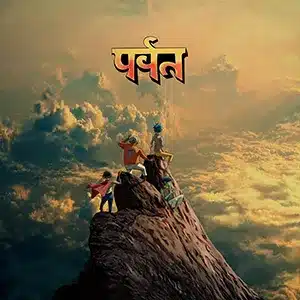
This is how The Mountain, Gorillaz’s newest deep dive into eclecticism, came to life. Boisterous and deeply emotional (though I suspect one could, technically, describe much of Albarn’s work this way), it marks yet another triumph of reinvention for the tireless Englishman. To honor the album’s topic of death, Albarn incorporated old unused vocal takes from Gorillaz collaborators who are no longer with us, among them Dennis Hopper, Mark E. Smith, Bobby Womack, and more. Presenting death and loss as a pivotal component of the lived experience itself might sound intimidating, but here, the results are spectacular.
Hewlett, of course, is right there with his abundance of Hinduism-inspired multimedia: song titles written in Devnagari scripts, characters adorned with traditional Indian robes, Russel sporting a Jea Band Jaipur outfit (of course, they are featured on the album), a short film released on the 27th of February… is a mere beginning of the list of quirky visual complements.
So we reach the present day, more than a quarter of a century later, with nine LPs and virtually thousands of drawings, animations, and much more under Albarn’s and Hewlett’s belt. Looking at the score and, let’s say it, legacy of Gorillaz, only makes sense at this point, especially knowing – as Albarn and Hewlett do – the board shows insane numbers. This is a band that has never had an album called “mediocre,” let alone “poor”, that sells out the largest venues across the globe as easily now as in 2006, and that keeps enticing new generations of fans with no help from TikTok.
Gorillaz is also a band uniquely aware of our collective history and the circumstances that shape us. Perhaps more than anything else, this fixation on reality is what drives the tension in Hewlett’s ludicrously detailed work. Digesting the most complicated social phenomena via cartoons is surely ironic. It is also devilishly tricky work, in which shooting off innumerable signifiers must blend in with artificiality, a purported naivety of comic books with flamboyant neotenic visages and eye-watering color palettes.
Hewlett showcases this delicately balanced vision of historical progression seamlessly in House of Kong. Ultimately, this trip down memory lane is plain fun and suitable for the aforementioned wide range of audiences, many of whom enjoy Gorillaz casually as a quirky pop phenomenon. This is certainly fine. After all, one doesn’t exist outside of “culture”, and Gorillaz, with the baggage of Albarn’s superstardom and Hewlett’s conceptual shenanigans, couldn’t escape the mainstream if they tried. That they don’t even pretend to is a good thing, all things considered.
If a cartoon can seem like a superficial cultural mode of production, looking at the details and how they are arranged reveals the much deeper symbolism of a dialectical history within the Gorillaz method. The chronicles of the misbegotten quartet of characters over the years, across videos, the band’s interactive portal, shows, and “interviews”, are part satire, part counterculture, but never anything less than politically charged.
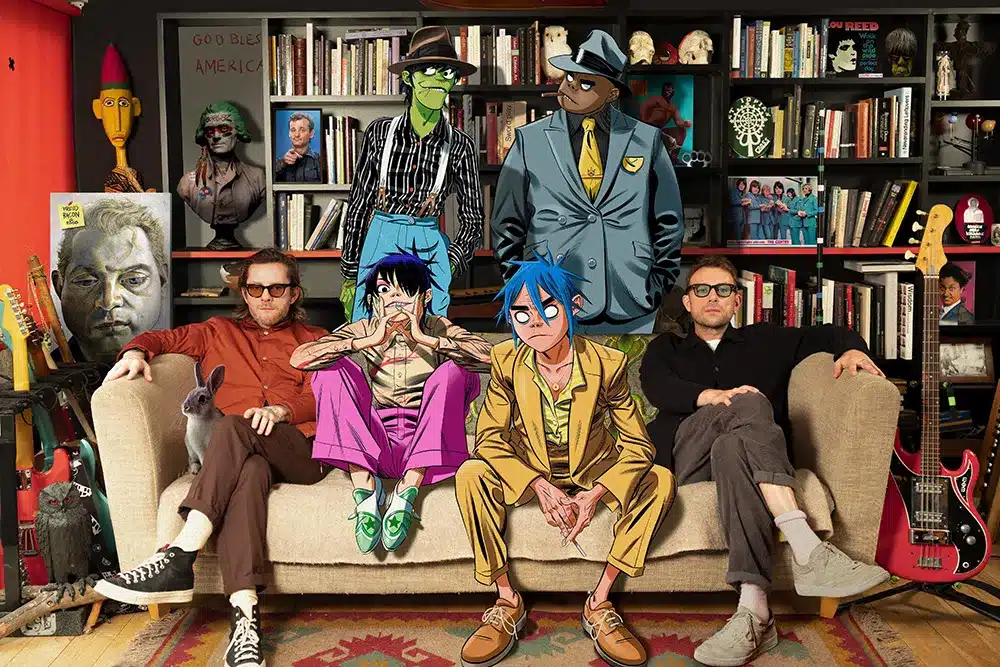
Observe any of the drawings more closely, and carefully constructed ties to a dominantly political history of the world at large emerge. The band’s famous Song Machine PR photo is a good example: blandly dressed Albarn and Hewlett sit on a plain eggshell sofa with 2D, Murdoc, Russel, and adult Noodle by their side. Russel and Murdoc are rocking fedoras, the former in a cigar and a double-breasted suit, the latter in suspenders and a pinstripe shirt; 2D and Noodle are wearing slicker, more up-to-date cuts. Behind them lurks a vast, cluttered library with artifacts of modern culture.
Some of the images are fun-loving curios and (likely) hint at Albarn’s and Hewlett’s aesthetic preferences: Lou Reed, the Gentry, and Bill Murray pictures, a painting roughly reminiscent of Lucien Freud’s works, skulls, and taxidermied owls to honor Hewlett’s macabre sense of humor, and an Orthodox Ethiopian cross to mark Albarn’s long-term dabbling in spirituality. They all add to the deliberate stuffiness of Gorillaz’ mythology. These guys like to mash it up.
Moving beyond quirks and PR, some of the imagery paints a more sinister picture. In this case, the bust of George Washington sits in the top-left corner. Its opulent white marble is covered in a mix of the Joker’s colors and indigenous face paint, with a Native American braid hanging from behind his right ear. Above the bust, “God Bless America” is smeared across the wall in what seems like blood. Not so funny anymore, is it?
These tongue-in-cheek, mischievously remixed pointers to the flows of history are ubiquitous in Hewlett’s and Albarn’s work throughout the ages. At House of Kong, a sticker-covered, skateboard-friendly, looming statue of the Mesopotamian demon Pazuzu greets you at the very entrance. For The Mountain promo visuals, Noodle shows up with a simple raised fist, and 2D wears a t-shirt of Pikachu with something closely resembling a Che Guevara beret. The examples are countless, and they all serve to remind us of the richness of civilization’s history and the ways in which it has been, or is being, destroyed and repurposed for sinister ends.
When taken in attentively, this whirlwind of symbolic production becomes shockingly overwhelming. This, in fact, is Gorillaz’s primary goal: to expose the mishaps and oversights of the West’s cultural history beyond ambiguity. Colonialism, suprematism, capitalism, and moral relativism are all sucked into their chaotic universe to be confronted. To succeed in this Herculean undertaking, the duo’s quasidocumentaristic pastiche and collage arrangements must take root in the present by chasing the ever-accelerating centrifuge of the postmodern condition.
Like our atomizing, collapsing sense of time and social identity, so do Gorillaz’ expansive images and symbols collapse on themselves, making sense of the House of Kong slogan, “somewhere between order and chaos”. The abundance of detail, colors, and stimuli is crafted to emulate the hyperstimulated consumerist society that gave birth to the term “pop” as we know it today.
It is a society uncertain of anything, let alone its foundations or historical direction: a floating, malleable wasteland of manufactured microidentities and desires resting on purchasing power. On the axis of this wasteland, Gorillaz set up shop.
However, the crucial difference between our reality and the universe of Gorillaz is that Hewlett and Albarn leave no room for “post-truth”, “alternative facts”””, and metastasizing historical revisionism in their work. Their world is one of confusion, but not of doubt.
If this sounds spiritually or even religiously charged, rest assured that Albarn never missed an opportunity to point to these two as means of moving past our modern plague, possibly reaching salvation. That’s exactly what the music, Albarn’s sovereign domain, brought to the table to complete the historic creative odyssey that is Gorillaz: a sense of possibility, a belief in overcoming. Put simply: hope.
His stories are tightly woven accounts of the hilarious atrocity that is contemporary society, but they never fall short of imagining a better one. Modern life is rubbish, indeed, but the world doesn’t end with Albarn’s legendary evocative whimper. On the contrary, it invites a rebuilding of its tenets through the radical concepts of solidarity and love. That most of Gorillaz’s releases are concept albums serves to articulate specific issues and underline the messages.
Now, The Mountain and House of Kong arrive as a culmination of years of work, the roads crossed, and the story arcs written, enticing us to finally step out of our own shadows and see how much we still have to live for, despite the persistent horrors we all dwell in. After all, one has to have a sense of humor about misfortune, else you’ll find yourself staring at an abyss from which there is no return. Idealistic and, yes, romantic as Gorillaz have always been, they still know us well and offer the most salient advice.
Whoever you are, wherever you are, you won’t be able to fight against the monsters ravaging our lives without a pure heart and a spark in your eye. Laugh, dance, but stay alert and toughen up. The revolution is yet to happen, and Albarn and Hewlett are far from done with telling our story.