
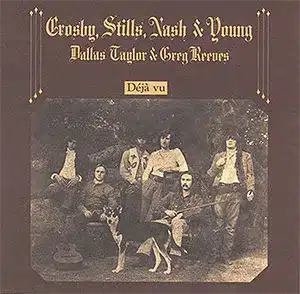
In the first 20 years of rock history, from 1955 to 1975, four songs have unique historical importance that transcends their chart positions and sales numbers. These are songs that mark the beginning of one era and the end of another style’s dominance. They are Elvis Presley’s “Hound Dog”, the Beatles’ “She Loves You”, Bob Dylan’s “Like a Rolling Stone”, and Graham Nash’s “Teach Your Children”, which was recorded by Crosby, Stills & Nash on their 1970 album, Déjà Vu.
These four songs, in the context of their time, provide object lessons that illustrate how popular music evolves in America. When properly understood, the history of popular music in America is not simply a chronicle of hits. It demonstrates an ongoing interaction of styles.
When Elvis Presley sang “Hound Dog” on October 28, 1956, on The Ed Sullivan Show, it was nothing less than a cultural earthquake. That one song, that one performance, had a greater effect on the history of popular music than any other single song or any other single performance. Nothing was ever the same after “Hound Dog”. Among other things, Chuck Berry’s rock anthems like “Johnny B. Goode” would not have had the success that they had without Elvis.
Pop music, primarily characterized in the 1950s by crooners and quartets singing love songs, did not simply disappear. On the contrary, rock ‘n’ roll seems to have stimulated the career of pop’s greatest singer, Frank Sinatra. The 1960s, rock ‘n’ roll’s first great decade, was also Sinatra’s greatest decade. Dean Martin also had a huge hit, “That’s Amore”, in 1964, right in the middle of Beatlemania.
When cultural revolutions occur, they seldom result in the complete disappearance of the older style. Rather, the new style usually repositions and redefines the older style. Thus, the long-term effect of rock ‘n’ roll was to relegate pop to television. While rock stars put out one gold record after another, pop singers dominated television. Crooners like Perry Como, Dean Martin, and Andy Williams had long-running television shows, where they found receptive audiences.
Things were also never the same after the Beatles‘ “She Loves You”, but in a different way. Beatlemania had such intensity, in part, because the Beatles burst onto the scene in 1964 on The Ed Sullivan Show. This was truly the winter of America’s discontent. At a time when Americans were still grieving the assassination of President Kennedy, the Beatles helped to release that grief. They were British, and although they had hard times growing up in postwar Britain and when they were paying their dues in Hamburg, American audiences do not know or care about any of that.
That’s why it was okay for the Beatles to be witty and irreverent. Their upbeat, even joyous, songs brought much-needed cheer into fans’ lives, as in the refrain “You know you should be glad.” By doing so, they in effect gave Americans permission to feel glad, too. Indeed, Americans may have needed the Beatles more than the Beatles needed them.
Among other things, the Beatles’ success made American duos like Jan & Dean and the Everly Brothers sound a little anemic. They established the composition of rock groups as consisting of lead guitar, rhythm guitar, bass, and drums, which were needed to give songs energy and force. This is what the Beach Boys had, and with all due respect to Brian Wilson’s genius, Beatlemania helped to make them a success.
Beatlemania had quite different social implications in Britain than in America. Coming from Liverpool, the Beatles were sometimes perceived as provincial upstarts. That is a story from another opera, as the saying goes.
Elijah Wald wrote about Dylan’s epoch-making performance of “Like a Rolling Stone” at the Newport Folk Festival on July 25, 1965, Dylan Goes Electric!: Newport, Seeger, Dylan, and the Night That Split the Sixties. To say that the song “split” the 1960s is perhaps a snappy marketing term, but it does suggest the impact of the song on the history of rock ‘n’ roll. Nevertheless, it was also in 1965 that Sinatra released his great live album, Sinatra at the Sands, which was not affected by Dylan or anyone else.
It makes historical sense to say that “Like a Rolling Stone” broke the dominance of folk music, understood broadly as a cultural complex comprising hootenannies, social activism, and acoustic guitars. Very rarely is the end of a style’s dominance more vividly displayed than in the video of the performance. In it, we see that the song causes Pete Seeger great distress because he cannot understand the lyrics.
Just as “Hound Dog” had the long-term effect of repositioning pop music and relegating it to television, “Like a Rolling Stone” repositioned folk music. It relegated folk music to mostly live performances and diminished record sales. Peter, Paul, and Mary’s deeply sarcastic song “I Dig Rock and Roll Music” expresses the folkies’ resentment of rock ‘n’ roll’s rising dominance.
Just as pop music did not disappear after “Hound Dog”, folk music did not disappear, either. It had a few minor representatives, such as Phil Ochs and Arlo Guthrie. Joan Baez, a major star of the folk music scene, became increasingly involved in political activism. As for Seeger, his career continued and even prospered. He went on to perform with Bruce Springsteen and other greats. Nevertheless, the hold of folk music over most young music fans had been broken.
The Code that Bridges the ’60s and ’70s
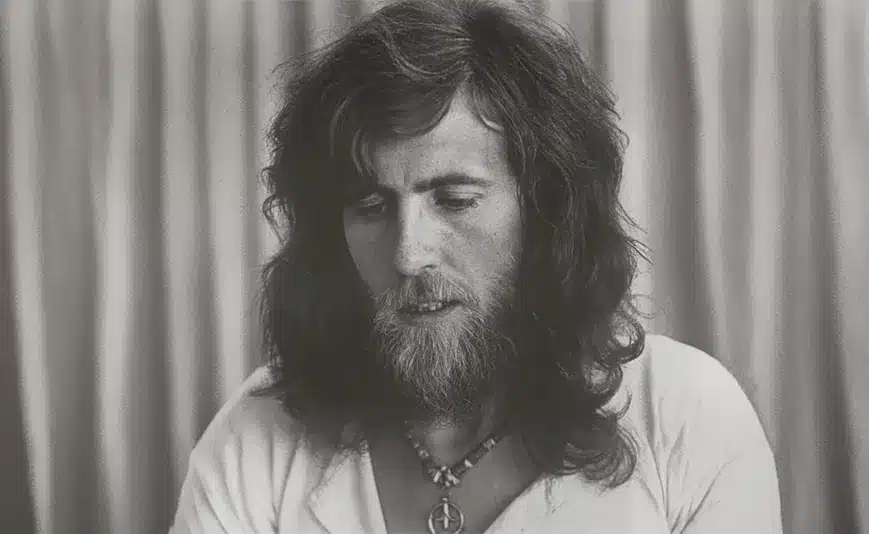
All that brings us to Graham Nash‘s “Teach Your Children”, which was released in May of 1970, and thus at a key historical moment. The Beatles’ “Let It Be” single was released two months earlier. In effect, “Let It Be”, which welled up from Paul McCartney’s fertile imagination, announced the end of the 1960s. After all, nothing was more foreign to the ethos of the go-go ’60s than letting it be. Among other things, “Let It Be” can be considered a response to the Rolling Stones’ “Satisfaction”. Therefore, in the spring of 1970, an urgent question arose: If the agony and the ecstasy of the ’60s are over, what are the ’70s going to be like?
“Teach Your Children” provided the answer. It begins with these one-syllable words: “You who are on the road / Must have a code you try to live by”.
The song is addressed to the crisis-weary survivors of the 1960s, the people who had been on the road, both literally and metaphorically. Steppenwolf had glorified being on the road in “Born to be Wild”, and Paul Simon had made it the key experience of a generation in “Looking for America”. Also, of course, Dennis Hopper’s 1969 road-trip film, Easy Rider, was the classic counterculture road movie.
“Teach Your Children” makes a statement to its audience that was startling for its time. It says that you “Must have a code.” Nothing was further from the ethos of the 1960s than having a code. It was the era of doing your own thing: sex, drugs, and rock ‘n’ roll. This was unfettered individualism of the kind that kids who had grown up in the suburbs during the conformist 1950s could not have dreamt of, and it seemed endlessly enticing.
Tom Wolfe’s 1968 book, The Electric Kool-Aid Acid Test, chronicles the way Ken Kesey and the Merry Pranksters made up their lives not just day by day but moment by moment. Everything was in flux and subject to change. A code was unthinkable and unimaginable for them.
The third, culminating element in the song’s opening is the crux of the matter. What is the point of having a code? It is something that you can “live by”. Living through the 1960s meant not just taking in rock ‘n’ roll but also surviving the riots and the assassinations. Individual experiences and individual moments were so intense that the very continuity of life seemed suspended. All this is epitomized by the Doors’ “The End”, a devastating response to the tenor of the sixties. When Esquire published its history of the 1960s in January 1970, it titled it “Smiling Through the Apocalypse”.
The very idea of experiencing the continuity of life, of living, was called into question by the 1960s, and not just by the politically motivated assassinations of John F. Kennedy, Malcolm X, Martin Luther King, Jr., Robert F Kennedy, and Medgar Evers. Death struck from the heart of the counterculture in the form of the Tate-LaBianca murders committed by the Charlie Manson family and the murder of a spectator at a Rolling Stones concert by the Hells Angels at the Altamont Racetrack in California in 1969. After these traumas, it was undeniable that doing your own thing could lead to horrifying consequences. People—even some long-haired deadheads—had had enough.
Rebellion Against Rebellion
This was the cultural situation to which “Teach Your Children” responded. By the 1970s, the flower children were starting to have children of their own. This is a major reason why they needed a code. “Teach Your Children” is primarily a reassuring song, and the sweet harmonies of Crosby, Stills, and Nash’s voices gave deep comfort.
Indeed, the song does some healing work. It acknowledges the flower children’s alienation as “their father’s hell,” yet it balances that acknowledgment with a key revolutionary moment: “Know they love you.” Let us pause for a moment to consider just how revolutionary this line was. This plain line—once again consisting of simple one-syllable words—affirms family continuity, which was anathema to the kids in the 1960s, who told each other not to trust the establishment or anyone over 30.
The line advocates reconciliation, not rebellion, and is thus in open opposition to a whole series of 1960s songs about alienation. Examples range from Dylan’s “The Times They Are-a Changin’” to “We Gotta Get Out of This Place” by Eric Burdon and the Animals. This is nothing less than rebellion against the idea of rebellion as a lifestyle. “Teach Your Children” is thus a revolutionary song in its modest, yet powerful way.
“Teach Your Children” also mediates between the ’60s and the ‘seventies’70s in the use of triple rhymes in the lyrics. In the first three lines of his masterpiece “Visions of Johanna”, Dylan rhymed “quiet / defy it / deny it.” Then, in the next three lines, he rhymed “loft / cough / soft.” Sensing the possibilities of such triple rhymes, Nash had put together “why / cry / sigh” in both the fifth and sixth stanzas of “Teach Your Children.”
The use of triple rhymes then became a standard feature in the work of ‘seventies’70s-era singer-songwriters who could pull it off. Kris Kristofferson’s “Sunday Morning Coming Down” is just one example. Dylan’s influence extended even to Garth Brooks, who cleverly used triple rhymes in “Friends in Low Places.”
“Teach Your Children” is so important that it has a lengthy epilogue, which is significant for rock history in general. In October of 1971, the biggest hit of the seventies, Don McLean’s “Miss American Pie”, was released. It spent four weeks at number one on the charts starting in January 1972, and stayed on the charts for a total of 19 weeks. It’s an angry putdown of the Stones’ “Jumping Jack Flash” – another way songwriters in the ’70s responded to the legacy of the ’60s. Bruce Springsteen’s early songs, up to and including “Born to Run”, also respond to the legacy of the 1960s.
More generally, in the early 1970s, the fragile synthesis of styles in rock, which can be thought of as consisting of acoustic guitars on one hand and electric guitars on the other, fell apart after Dylan did structural damage to it in “Like a Rolling Stone”. In February 1971, Carol King released Tapestry, which became a mega hit. It sold a whopping 25 million copies worldwide. Its pared-down sound, which mostly features Carol and her piano, positioned her in opposition to the 1960s. It contains her lament about the era’s obsession with movement: “Doesn’t anybody stay in one place anymore?”
In the 1970s, it became possible to make hits by using the piano as a lead instrument. To some extent, the singer-songwriter movement repositioned the electric guitar, replacing it with the quieter, more intimate piano. It was not just Carol King who used the piano to such good effect, but also Elton John and Billy Joel.
Other singer-songwriters such as Carly Simon, who affirmed the importance of marriage and fidelity in “That’s the Way I’ve Always Heard It Should Be”, as well as James Taylor, John Denver, and Joni Mitchell, followed the initiative of Dylan’s Nashville Skyline. Their quiet sound was created by acoustic guitars and pianos.
Also at this time, heavy metal, the other pole of rock ‘n’ roll, made itself known with sound and fury. In historical terms, it could be said to express the repositioning of the electric guitar by showing how it could dominate arenas. In November of 1971, Led Zeppelin released Led Zeppelin IV, a huge hit that was the stylistic antithesis of Tapestry, which was also released in 1971, as we know. As opposed to Carol King and her piano, it featured Robert Plant screaming over the raucous chords of Jimmy Page’s electric guitar.
Also in 1971, Grand Funk Railroad released Survival (a defiant title in the aftermath of the 1960s) in April, and Black Sabbath released Master of Reality in August. Heavy metal was well and truly launched, and a major style of the ‘seventies’70s, as well as the next several decades, was established.
Despite the epoch-making achievements of the legendary stars of the 1960s, the argument can be made that the 1970s, ushered in by “Teach Your Children”, was the best decade in rock music history. A brief survey suggests why. In the 1970s, and in no other decade, if you had had the time and money, you could theoretically have seen live performances by the mighty triumvirate of American rock ‘n’ roll—Elvis Presley, Bob Dylan, and Bruce Springsteen—all in the same week. America had those legends, as well as heavy metal and the singer-songwriters. Britain had the Stones, the Who, Led Zeppelin, and Traffic, not to mention art rock groups like Procol Harum.
Clearly, “Teach Your Children” alone did not liberate all that talent and inspire all of Crosby, Stills, and Nash’s hits. However, it is fair to say that the song helped to make peace between the 1960s and the 1970s. By rebelling against rebellion, it created the hinge between two great decades of rock music.