
For longer than the 44 years he was a member of the shape-shifting post-punk band Einstürzende Neubauten, Alexander Hacke has been recording as a solo artist, with his earliest released music put to tape when he was 14 years old. Since then, he has composed film soundtracks, played as part of a country band, and released albums that truly defy genre tags. Along the way, he has incorporated drones, noise, balloons, dobros, field recordings, and bludgeoning goth-metal hellscapes. Then there are the Hackedepicciotto albums, the collaborations with his wife of 20 years, violinist, keyboard player, vocalist, and poet Danielle de Picciotto, whose work both solo and in collaboration is every bit as varied as his.
Together, they combine drone, metal, dark ambient, and barren soundscapes into records where categorizations often fall short. Their latest, Lichtung, is no exception. Following a period of constant moving, as well as Hacke’s recent decision to leave Neubauten, the couple settled on the outskirts of Berlin, nearer to the countryside, naming this release after their new home. The album’s lyrics are also sung entirely in German, Hacke’s native language, and this decision, as well as the ability to be settled, has perhaps given the album a reflective quality.
The opening title track suggests as much. Vibes, violin, a bass pulse, and the sound of waves develop over the song’s eight minutes. There’s a foreboding lushness here that’s not far removed from more overtly intense work such as “Awake”, from a decade ago, but certainly more restrained. “Wiederbelebung” uses de Picciotto’s keyboard line as its melodic framework, but quickly adds guitars and sampled rhythms on top, before their vocal harmonies appear, sounding like an incantation.
Hackdepicciotto’s Bandcamp page features an adorable video of this track, depicting De Picciotto playing piano, painting, or showing off dolls before focusing the camera on Fred and Wilma Flintstone toys or Hacke ironing a hat. It’s a visual of the couple as homemakers, even if the music foreshadows a storm.
However, what may sound unsettling to some ears is challenged by tracks such as “Zeitenwende”, which is positively uplifting. The lyrics, which address not being able to escape the past and recognizing a truly uncertain present, also convey the ability to confront the present’s many challenges. With the music’s wavering buoyancy, as it seems to climb hills and navigate deep rivers toward a safe pace, it feels like a song of acceptance, and therefore, of inner peace. It’s music of certainty and of sunlight.
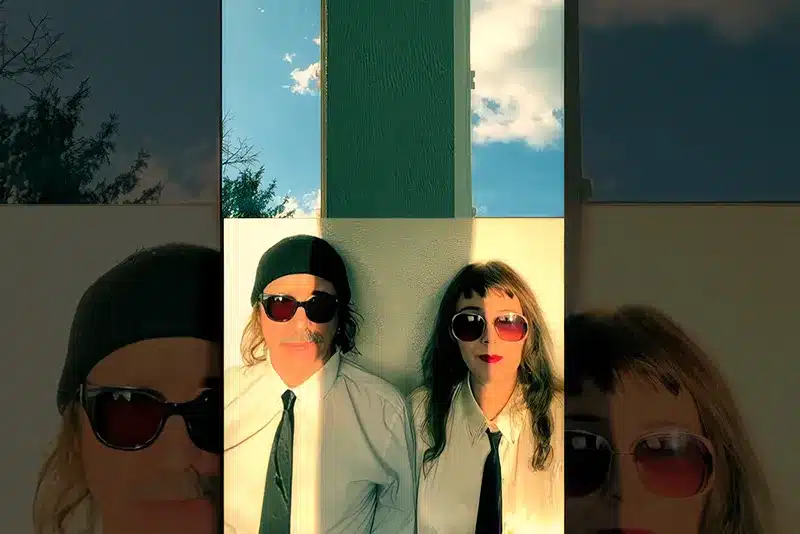
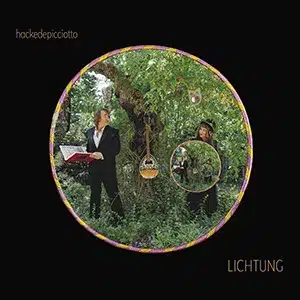
The album’s cover art features an iris frame of the couple next to a tree, a lute tied to its trunk, Hacke with an open book and de Picciotto with a circular mirror showing the same photo in miniature; the press photos show them together, skipping through a field or staring straight at the camera, surrounded by trees. None of this should give anyone the impression the two have gotten “soft” in their new digs. Rather, they have allowed their bucolic surroundings to bring a bit of light into the murk for an album that shifts, becoming less foreboding with each listen.