
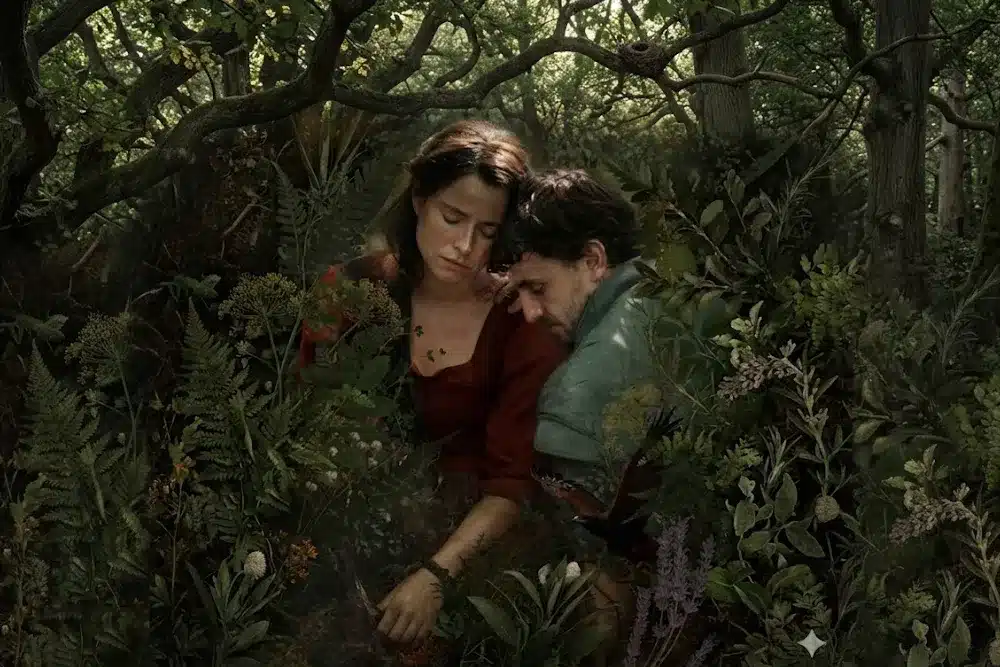

Chloé Zhao’s Hamnet might be best viewed through the lens of cultural memory, mourning, and the politics of representation. Rather than reproducing the death of William Shakespeare’s son, which inspired Hamlet, the film foregrounds the invisible labor, grief, and historical silences that shape artistic legacy. By contextualizing Hamnet within early modern English history and contemporary cinema, Zhao reveals how personal tragedy becomes public memory and why this matters for today’s audiences.
Chloé Zhao’s adaptation of Maggie O’Farrell’s award-winning novel, published in 2020, itself rooted in historical fact, departs sharply from the conventions of biographical cinema. The film examines the aftermath of the death of Shakespeare’s son, who died of the plague in O’Farrell’s novel (his actual cause of death is not verified).
Zhao approaches Shakespeare from outside the familiar artistic myth, lingering on lives suspended between the living and the dead. Rather than expanding the legend of the great artist, she constructs an interior narrative guided by the quiet architecture of mourning. Shakespeare is stripped of his historical iconography and reframed as a father crushed by loss. The threshold between Hamnet’s death and Shakespeare’s literary metamorphosis also ignites the cultural circulation of the Amleth legend in Scandinavia, inspired by Shakespeare’s Hamlet, for Hamlet is not only the expression of personal grief but the Anglican rewriting of the Jutland revenge myth.
This approach opens a space that binds the story not merely to a private tragedy but to the historical thresholds Shakespeare inhabited. His dramas belong to the first phase of the English “century of revolutions”, stretching from the defeat of the Spanish Armada at Gravelines to the Glorious Revolution. In other words, Shakespeare’s England remains a transitional zone — not yet a fully consolidated state. The Elizabethan era marks an expansion from a land-bound kingdom toward a maritime and commercial horizon, a momentum that would eventually flow into the Industrial Revolution.
History in Zhao’s film recedes almost to the point of invisibility, creating a stark contrast with the quiet sorrow of the characters. On the brink of vast transformations, the fracture occurring within a small home becomes an interior sign of a broader collapse.
In Stratford, Shakespeare wrestles with bereavement and the limits of expression; writing and performance have not yet become public mediums but press inward as weight. As Golden Age England opens toward coastal economies and imperial horizons, the domestic tragedy becomes the collision point between historical velocity and personal ruin.
Here, Shakespeare is no national icon but a provincial figure without a proper outlet: writing has not yet found the stage, the stage not yet become public, and the public not yet solidified into an “English nation”. Zhao parallels Shakespeare’s expressive crisis with the structural transformation of early modern England, positioning the artist’s mourning as a kind of pre-historical silence.
Hamnet Tracks a Lost Soul
At the core of the story lies an implicit question: Who has the right to narrate a life? The dead child, Hamnet, is remembered by his parents not as someone properly mourned but as someone missing. His absence has an infernal, liminal quality. Because he never bids farewell to mother or father, his ghost persists around the family as the spectral presence of a lost son. Hamnet does not quite vanish nor fully materialize; he lingers as a shaded continuity shared with the house itself.
The rift between Shakespeare’s lived experience and Hamnet’s “other” existence never closes, because mourning has not run its course. Hamnet and Agnes (Anne Hathaway) remain faint figures in the shadow of history, but the film refuses to aestheticize this faintness; it treats it instead as a problem of political representation.
Throughout history, the “great man narrative” has organized cultural memory by centering genius, production, and art around the male subject. Hamnet subverts this by placing at the center not the rising career of the male genius (Shakespeare) but the material and emotional reality left behind. Its politics reside precisely there: it makes visible not the genius but the cost of genius. Sorrow becomes the substance from which art emerges.
Agnes, therefore, is not simply “the wife” but the custodian of memory, the regulator of mourning, and the narrative’s core. The son’s death becomes Shakespeare’s literary fertility, and the film draws an ironic line between personal ruin and public art. In most cultural treatments, this transformation is romanticized; Zhao turns instead to the bodily and emotional price.
Three layers surface from this reversal: history writes the man, the film writes the woman; grief becomes the raw material of artistic production; care, domestic continuity, and mourning are relegated to invisible labor, pushed to the footnotes of history.
One of Hamnet‘s sharpest moves is to reveal lives outside Shakespeare. He no longer functions merely as a person but as an authority, a canon, a narrative hub. Agnes represents those positioned beyond that hub. In this sense, Hamnet becomes a history of the unrecognized. Cultural memory is built on selecting whose suffering, whose labor, and whose story will be carried forward. At its core, Hamnet is not romantic or psychological, but social and political — summoning silent figures back to the surface of memory.
Will, who refuses to share his grief and devotes himself to the theater, appears to Agnes as indifferent, self-absorbed, and concerned only with his plays. During a performance of Hamlet, however, Agnes recognizes that her husband, too, has been mourning — expressing the unspeakable through theatrical form. The parallel between losing a child and staging Hamlet becomes the film’s decisive break.
In the climactic performance, Agnes glimpses her son on stage—not as a symbol but as the very remainder of an unfinished farewell. Hamnet looks at his mother, completes the delayed goodbye, and withdraws. The curtain falls only after mourning is resolved: Shakespeare converts loss into drama; Agnes seals loss with a gaze.
The son’s absence thus finds a place in both the memory of the home and the cultural record. What emerges is not the glory of genius, but the cost that made genius possible.
Zhao’s Hamnet makes visible not the brilliance that feeds the Shakespeare myth, but the labor, mourning, and invisible costs that linger in its shadow. In this way, the film aligns itself less with the narrative of genius than with a politics of memory: who is remembered, who is forgotten, and who ultimately pays the price?