
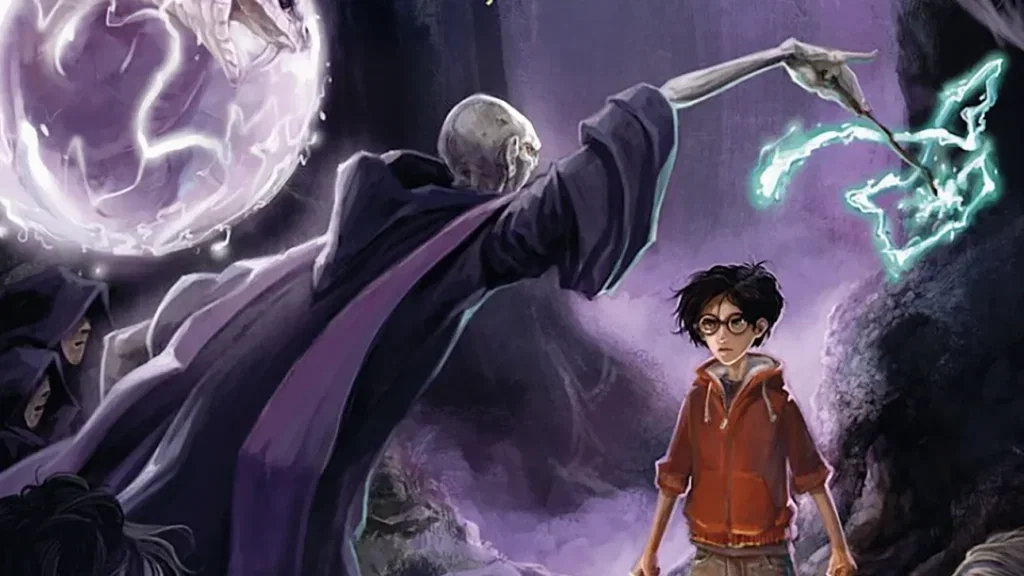
J.K. Rowling’s Harry Potter is ultimately concerned with self-sacrificial love and death, and here, I’d like to place that claim in conversation with some provocative ideas of the thunderous 19th c. German philosopher, Friedrich Nietzsche. We can understand and critique these ideas better when they are couched in narrative form.
Let’s consider a few grand Nietzschean themes: first, a morality ‘beyond good and evil’; second, amor fati (the love of fate); and, finally, the Übermensch (Overman). J.K. Rowling’s saga of self-sacrificial love and death reckons with these themes by presenting them in her characters and showing how she critiques (mis-)interpretations of these Nietzschean doctrines.
Contents
Harry Potter‘s Magic
The Harry Potter series traces Harry’s maturation and epic crusade against the greatest Dark sorcerer of all time: Lord Voldemort. Voldemort attempted to kill Harry when he was just a baby because of a prophecy made shortly after Harry’s birth:
The one with the power to vanquish the dark lord approaches. … Born to those who have thrice defied him, born as the seventh month dies … and the Dark Lord will mark him as his equal, but he will have power the Dark Lord knows not … and either must die at the hand of the other for neither can live while the other survives … – Harry Potter and the Order of the Phoenix
His attempt failed, however, because Lily Potter offered and laid down her own life in exchange for her son’s during Voldemort’s attack, the Dark Lord’s killing curse backfired, demonstrating the unparalleled power of self-sacrificial love in the Potter-verse. This nearly destroyed Voldemort. In the resultant fallout, Voldemort “wrapped [his and Harry’s] destinies together more securely than ever two wizards were joined in history” (Harry Potter and the Deathly Hallows, 2007).
Prior to this fateful encounter, however, determined to evade death, Voldemort took steps to ensure his immortality. To do this, he created seven Horcruxes. A horcrux fundamentally perverts the natural relationship between soul and body.
Hermione tells us in 2005’s Harry Potter and the Half-Blood Prince, “it is the complete opposite of a human being … The fragment of soul inside [a horcrux] depends on its container, its enchanted body, for survival. It can’t exist without it.” It is “an object in which a person has concealed part of their soul,” and a soul is split by committing “the supreme act of evil”—murder—which renders the soul radically unstable.
In short, after hearing the prophecy, in Harry Potter and the Half-Blood Prince, Voldemort, like “tyrants everywhere … leapt into action, with the result that … he made you [Harry] the person who would be most dangerous to him.. Voldemort embarked upon this dark road toward immortality in the pursuit of ‘greatness’ and with no regard to good or evil.
The Harry Potter series culminates in the climactic final confrontation between Harry and Voldemort. While Voldemort’s anti-moral quest for domination results in his own undoing, Harry triumphs precisely because he freely sacrifices his own life out of love for others.
Nietzsche, Precis

Morality Beyond Good and Evil
Nietzsche is famous for having declared to the (post-)modern world that God is dead. In the vacuum that God has left, Nietzsche calls upon men to take up a new standard of morality. Ivan famously voices this in Dostoevsky’s The Brothers Karamazov: “If [God] doesn’t exist then man is master of the earth … there would be nothing immoral then, everything would be permitted.”
The strongest dictate ‘right’ and ‘wrong’ based upon their desires—something Thrasymachus argued for in Book I of Plato’s Republic. A morality without God is a morality beyond good and evil: it requires that humans become gods—and it demands that these new god-persons “create values” and “determine the Whither and the For What of man.”
For Nietzsche, this requires a kind of moral experimentation. As he considers the “philosophers of the future”, he wonders: “Does their passion for knowledge force them to go further with audacious and painful experiments than the softhearted and effeminate taste a democratic century could approve?” Such experimentation clearly involves a certain “strength of the will, [a] hardness, and the capacity for long-range decisions”—only persons possessed of such qualities could truly be called ‘great’.
Amor fati
Nietzsche regarded the precept of amor fati as “my formula for greatness in a human being”—and a truly great person, he argues, “wants nothing to be different, not forward, not backward) not in all eternity. Not merely bear what is necessary, still less conceal it—all idealism is mendaciousness in the face of what is necessary—but love it.” A truly great person is great-souled enough to love the bad things that befall him, and to love these misfortunes so deeply that he would joyfully welcome them again and again. A great person, in other words, embraces suffering, for it makes him stronger.
“Love of fate means, in effect, … love of the fact that every moment of joy brings with it the potential for loss and suffering” (Sedgwick). That things (might) eternally recur does not prevent the great-souled man from freely choosing to love that which is fated. That the future is determined does not take away man’s ability to choose to love that determined future—in all its glory and agony.
There is a bit more to it: “amor fati, then, is no passive acceptance of fate; it is the power to create a life that one would willingly accept again and again” (Ratner-Rosenhagen). There is agency here: it involves the will’s way of predisposing one’s heart to accept the reality of eternal recurrence. This is a sort of subversion and flipping of the very common understanding of fate: rather than being something which one cannot run from, fate is to be confronted and conquered by embracing it—even if it means that we will suffer.
The Übermensch
Nietzsche tells us that the Übermensch is nothing less than “the meaning of the earth”. Nietzsche remains intentionally vague about this Over/Superman. Sue Prideaux, one of Nietzsche’s (many) biographers, notes that
he [Nietzsche] refuses to show us the path leading to becoming the Übermensch; nor, indeed does he tell us what the Übermensch is. We know that Nietzsche envisions the Übermensch as the strong man of the future, the antidote to the moral and cultural pygmyhood spawned by centuries of European decadence and Church domination.
The Judeo-Christian tradition advocates for a kind of self-sacrificial love, a preferential option for the poor and oppressed, and a God who reveals himself as love poured out for his creation. This understanding of greatness—that it is to be found in losing oneself—has led, according to Nietzsche, to a ‘sick’ culture, wherein true greatness is no longer celebrated and allowed its full expansion.
For Nietzsche, the Übermensch is the solution. The Übermensch is the truly great-souled man who brings together and exhibits the two key concepts we have already covered: a morality beyond good and evil and a love of fate. “He is the figure who, despite the death of God, does not succumb to scepticism and nihilism; his freedom from belief enhances his life” (Prideaux). The Übermensch finds within himself the strength to live and create meaning in a seemingly absurd world.
However, this requires, as Prideaux puts it, “freedom from belief”. Put another way, this seems to require that the Übermensch abandon a morality of good and evil. There are obvious dangers here, as we see in the character of Voldemort: when humans have no robust conception of the Good to pursue and no robust conception of Evil to avoid, it is quite possible that human society will devolve into mere selfishness.
Nietzsche Shadows Harry Potter
Voldemort: Morality Beyond Good and Evil
Perhaps the greatest Nietzschean mark left upon Harry Potter is voiced by the opening installment’s antagonist, Professor Quirrell: “I met him [Voldemort] when I traveled around the world. A foolish young man I was then, full of ridiculous ideas about good and evil. Lord Voldemort showed me how wrong I was. There is no good and evil, there is only power, and those too weak to seek it.” In short, ‘good’ and ‘evil’ are determined by the strongest.
A similar passage later on in the series develops Voldemort’s understanding of good and evil:
“You call it ‘greatness,’ what you have been doing, do you?” asked Dumbledore delicately.
“Certainly,” said Voldemort, and his eyes seemed to burn red. “I have experimented; I have pushed the boundaries of magic further, perhaps, than they have ever been pushed—”
“Of some kinds of magic,” Dumbledore corrected him quietly. “Of some. Of others, you remain … forgive me … woefully ignorant.” …
“The old argument,” he [Voldemort] said softly. “But nothing I have seen in the world has supported your famous pronouncements that love is more powerful than my kind of magic, Dumbledore.”
Voldemort has no use for such labels as ‘good’ or ‘evil,’ much less ‘love’. Much more interesting to him is sheer power, and power is got by “experimentation”, as seen vividly in the creation of his horcruxes:
Horcruxes in the plural, Harry, which I do not believe any other wizard has ever had. … Lord Voldemort has seemed to grow less human with the passing years, and the transformation he has undergone seemed to me to be only explicable if his soul was mutilated beyond the realms of what we might call ‘usual evil’. (Harry Potter and the Half-Blood Prince)
This requires that he ‘transcend’ such archaic moral notions. Those who do not dare to breach these boundaries are, according to Voldemort, “weak”. He has, as Nietzsche suggested, been strong enough to have undertaken some moral ‘experimentation’. In this way, Voldemort exhibits one key characteristic of the Übermensch.
As his quest in pursuit of immortality progresses, though—as he presses past the boundaries of ‘good’ and ‘evil’—we see Voldemort’s physical appearance become more and more disfigured:
His features were not those Harry had seen emerge from the great stone cauldron almost two years ago: They were not as snakelike, the eyes were not yet scarlet, the face not yet masklike, and yet he was no longer handsome Tom Riddle. It was as though his features had been burned and blurred; they were waxy and oddly distorted, and the whites of the eyes now had a permanently bloody look, though the pupils were not yet the slits that Harry knew they would become. (Harry Potter and the Half-Blood Prince)
Here we can begin to see a subtle critique from J.K. Rowling in Voldemort’s physiognomy: a fractured soul—for Rowling, one which disregards the reality of moral good and evil—manifests itself bodily. The moral state of one’s soul is unavoidably revealed in the body.
Harry: Amor fati
As we’ve established, though, the true Übermensch, for Nietzsche, does not only strike out beyond good and evil. He must also love his fate, come what may.
When Voldemort caught wind of a prophecy that might spell his downfall, he attempted to forcibly change the outcome. (The irony, of course, is that his response to the prophecy is precisely what precipitated his downfall—not the prophecy itself.)
When Harry, on the other hand, realizes that “he must die” on behalf of the many, he does not run: “it did not occur to him now to try to escape, to outrun Voldemort”. He accepts his role as the Boy Who Lived not primarily because he feels obligated, but because he desires to do his part in creating a world in which he would desire to live over and over.
“You [Harry] are the true master of death, because the true master does not seek to run away from Death. He accepts that he must die, and understands that there are far, far worse things in the living world than dying.” (Harry Potter and the Deathly Hallows)
Voldemort felt constrained to act in a particular way; he allowed fate to control him. Conversely, Harry freely embraced his fate and accepted death on behalf of the many. “His job was to walk calmly into death’s welcoming arms … and he would not duck out.”
And this is done, as Rowling explicitly and repeatedly states, by the power of self-sacrificial love. In creating his Horcruxes, Voldemort’s soul is fundamentally corrupted. For such a tarnished soul, contact with a soul so pure and full of love as Harry’s creates “pain such as he [Voldemort] has never experienced.” Harry is, then, “protected, in short, by [his] ability to love”.
Love, as J.K. Rowling declares through Dumbledore, is “a force that is at once more wonderful and more terrible than death, than human intelligence, than forces of nature”. “In the end,” as Dumbledore emphatically tells Harry—and us—“it was your heart that saved you”.
Who Is the Übermensch: Harry or Voldemort?
Voldemort and Harry, then, manifest distinct traits of the Nietzschean Übermensch. Nietzsche believes the Übermensch becomes great when and because he transcends good and evil; when he accepts his fate and the joy and suffering which may accompany it. In sum, Nietzsche would argue that the Übermensch must transcend the simplistic moral conventions of ‘good’ and ‘evil’. This leads many who read of this idea to embrace pure power and abandon the kind of self-sacrificial, self-giving love which, apparently, weakens.
J.K. Rowling, for her part, seems to argue that if this is what the Übermensch is, then we ought to reject it. As we see with Harry—over and against Voldemort—we become great by loving the good and embracing whatever suffering this love of the good may bring. Voldemort does not understand what true love is and what power it might hold:
“That which Voldemort does not value, he takes no trouble to comprehend. Of … love, loyalty, and innocence, Voldemort knows and understands nothing. Nothing. That they all have a power beyond his own, a power beyond the reach of any magic, is a truth he has never grasped.” This ignorance of love is the very cause of Voldemort’s undoing.
The overarching narrative and ontology of Harry Potter argue that the power of love, which is to say, goodness, overcomes those who eschew and attempt to ‘transcend’ the categories of good and evil. Harry is a Nietzschean Übermensch insofar as he embraces his self-sacrificial fate, but he is decidedly not Nietzschean because he embraces love’s saving power.
Works Cited
Dostoevsky, Fyodor. The Brothers Karamazov. Translated by David Magarshack. Penguin. 1985.
Nietzsche, Friedrich. Beyond Good and Evil, ed. and trans. Walter Kaufmann. Vintage. 1989a.
—————. Ecce Homo. Edited and translated by Walter Kaufmann. Vintage. 1989b.
—————. The Portable Nietzsche. Edited and translated by Walter Kaufmann. Viking. 1976.
Prideaux, Sue. I am Dynamite! A Life of Nietzsche. Tim Duggan. 2018.
Ratner-Rosenhagen, Jennifer. American Nietzsche: A History of an Icon and His Ideas. University of Chicago Press. 2012.
Rowling, J.K. Harry Potter and the Deathly Hallows. Scholastica. 2007.
—————. Harry Potter and the Half-Blood Prince. Scholastica. 2005.
—————. Harry Potter and the Order of the Phoenix. Scholastica. 2003.
—————. Harry Potter and the Sorcerer’s Stone. Scholastica. 1997.
Sedgwick, Peter R. Nietzsche: The Key Concepts. Routledge. 2009.