
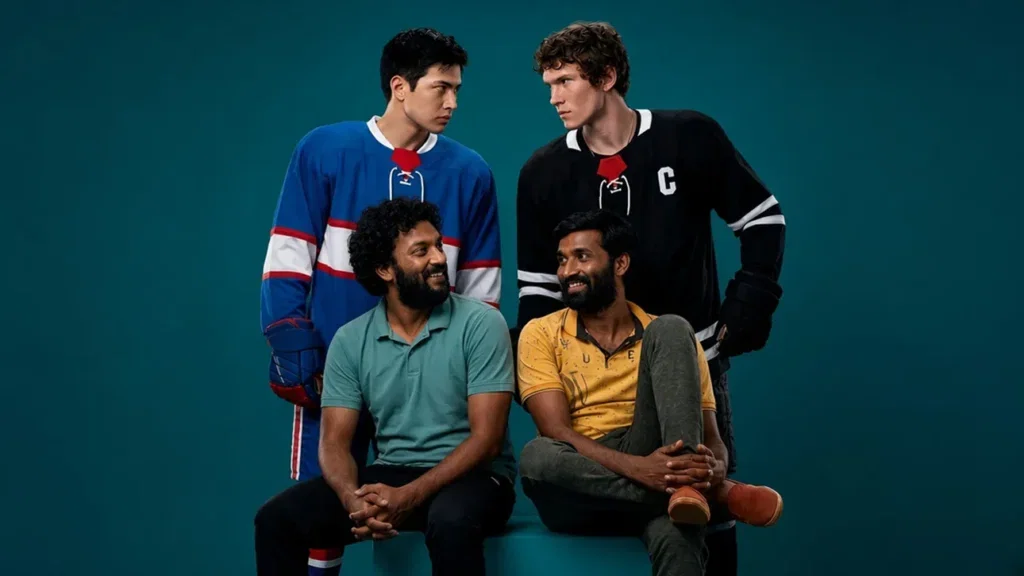


When Jacob Tierney’s series Heated Rivalry crossed Canada’s digital border to the US on Thanksgiving 2025, I was watching Cactus Pears (Sabar Bonda), a debut romance by Indian filmmaker Rohan Parashuram Kanawade, at New York’s IFC theater. Each centers on two young men expressing their sexuality and/or their love for another man, but the settings and grammar of the series and the film showcase different versions of queer life within the Bildungsroman plot (a story of reaching adulthood).
The media frenzy around Heated Rivalry has compared it to other English-language romances in various media and to Asian genres like boy love and K-drama, but bringing it into conversation with this Marathi-language love story throws the latter’s other contours, such as caste, into productive relief. Indeed, Heated Rivalry has catapulted to global fame, thanks to HBO coming on as a distributor for several international markets. Tierney, a seasoned actor-writer-director and a gay man, adapted it from a 2019 Harlequin novel, the second in the popular queer ice hockey romance series Game Changers by Rachel Reid. Both Tierney and Reid are Canadian, as are much of the cast and crew, the locale, the financing, and the original streaming service.
Cactus Pears, a more modest release, is notable as the first Marathi feature to be nominated for and win the World Cinema Grand Jury Prize: Dramatic at Sundance. It is autobiographical, based on Kanawade’s experience as a gay man in Maharashtra, western India. It is an indie film financed and distributed by Lotus Visual Productions and Taran Tantra Telefilms.
Tierney/Reid’s protagonists are two young athletes, Shane Hollander (Hudson Williams) and Ilya Rozanov (Connor Storrie), who meet in 2008 in Saskatchewan, Canada, as 17-year-old representatives of Canada and Russia’s junior hockey teams, respectively. Hollander is unnerved by his instant desire for Ilya, who appears more experienced, flirting with Shane and then initiating sexual contact over two meetings. Their relationship subsequently unfolds over a decade.
Heated Rivalry and Cactus Pears
While both men are closeted in a sport that is steeped in hegemonic Western ideologies of gender roles and sexuality, the stakes are slightly different for each. Shane worries about alienating his team, his fans, and the larger community, including sponsors. His emotional and political safety net is stronger than Ilya’s due to his Canadian citizenship—Canada legalized same-sex marriage in 2005—and loving parents, as well as due to his life being based near his hometown.
Ilya, who is bisexual, has a harder row to hoe, so to speak. His home country criminalizes homosexuality, and his father and brother are conservative. Moreover, they are cops and thus active enforcers of state law. His mother is dead, and he has one close friend. His life in the US is contingent on his work visa (as the foreign employee of a Boston-based hockey team); thus, he could potentially lose that job if his sexuality and love for another man become public. That would also likely mean his forced return to Russia, where he could be imprisoned or “disappeared”.
In Cactus Pears, Kanawade’s protagonist Anand (Bhushaan Manoj) is a single gay white-collar worker in the cosmopolis of Mumbai, an only child whose parents raised him in a slum after migrating to the city from a village for work. He is already out to them, but their extended rural family is ignorant of his sexuality and expects a heterosexual life from him, especially after his father’s death. The film tracks his frustration at the compulsory heterosexuality that is woven into his community’s Hindu caste practices (such as death rituals that he is told should be performed by a married son). He finds relief from this social pressure and from grief when he gets reacquainted with a male childhood friend, who eventually becomes his lover.
Heated Rivalry’s Harlequin Romance Roots vs Cactus Pears Indie Cinema Origin
Both romances explore youthful male homosexual love and the pressures of homophobia and heteronormativity. However, Heated Rivalry’s origin in the English-language romance novel genre and its theme of professional sports and international immigration, versus Cactus Pears’ nascence in an Indian language, class, caste, and domestic migrant context, present different intersectional queer experiences and visual registers. They thus invite and reward different political engagements from viewers.
Heated Rivalry belongs to the romance fiction subgenre of male/male romance. Male/male romance is predominantly written by and read by straight women (Wilder). The novel and TV show use some of commercial romance fiction’s favorite plot elements or “tropes”: the initial meeting or “meet cute”, enemies/rivals becoming lovers, a secret relationship, misunderstandings, the black moment/point of ritual death when a happy ending seems unreachable, care-taking or “hurt-comfort”, a happy-ever-after/happy-for-now ending—as well as erotic pairings and romantic character types like alpha male or grumpy/sunshine, and explicit descriptions of sexual activity.
Moreover, in keeping with broader genre practice, there is only a brief reference to religion (though religion is prominent in the “inspirational romance” subgenre): Ilya wears a Russian Orthodox cross that belonged to his dead mother and says he is a believer but no longer goes to church. His father’s death is not depicted through religious rituals, though we hear about Ilya paying for the funeral and a tomb.
Cactus Pears is not a commercial genre production, either in the above mold or that of the melodramatic, campy cinema popular in the Indian marketplace. Its pacing, characters, aesthetics, and production values are in keeping with its indie identity. Anand (meaning “joy”) is an office worker (perhaps in a call center) whose family is unlike the urban faux-cosmopolitan elite, the conservative rural elite, or the transnational Indians prominent in big-budget Indian movies and TV. His parents—a father who worked as a driver and a homemaker mother—are tethered to their rural origins even though they migrated to a shantytown in Mumbai.
Anand’s forced temporary stay in their ancestral village to complete the mourning rites after his father’s death further underlines the regional identity and networks he belongs to. The ten-day mourning period reunites him with Balya (Suraaj Suman), a childhood playmate he saw on summer vacations. Balya (a common pet name for a baby boy) is single, and there is the merest hint that he had more than friendly feelings for Anand in their youth. As things stand, their unfolding intimacy as adults resembles the “friends to lovers” configuration of Western romance novels rather than the “childhood sweethearts” trope.
Further, we get a romance plot structure that would be termed “forced proximity” in romance novels, in which events such as bad weather, family emergencies, community gatherings, etc. sever the romantic protagonists from quotidian life and force repeated contact. Here, Anand and Balya draw closer after Anand is compelled to stay in the village to complete his Hindu (cow-herder or similar) caste-community’s mourning traditions. There are thus points of similarity in the story structure and characters that might feel familiar to the reader/viewer of Heated Rivalry and its parent genre even as Cactus Pears offers glimpses of another world.
Breaking Away from the Patriarchies of Gender and Caste
Patriarchal structures operate in both Heated Rivalry and Cactus Pears, though their manifestations differ, partly due to caste in the latter. Heated Rivalry’s lovers have contrasting fathers in how they express gender roles: the former’s father, Grigori (Yaroslav Poverlo), is a Russian hardliner, a military veteran and cop who is dismissive of his younger son’s athletic successes in the decadent West but also angered by losses. Ilya’s point of view once reveals that “He didn’t want to hear his father—who likely hadn’t even watched the games—shame him for not bringing home a gold medal” (Reid) and we later hear him term his son “sloppy” and lacking “discipline” while criticizing his hair length and his clothing.
The patriarch is half a century older than Ilya, “set in old ways”, and dying of Alzheimer’s as Ilya is coming of age, and the situation makes Ilya feel resentful, sad, and guilty, shadowing his devil-may-care front and shaping his avoidant attachment relationship style. In Reid’s novel, he admits that he likes the cognitively impaired father better because “he was a real fucking asshole when he was… himself.”
Ilya had been coping with this (and his mother’s suicide) by performing a violent masculinity professionally and a heterosexually voracious one in his personal life – until he fell in love. He also confides to Shane after his father’s death that he regrets that Grigori never knew him fully (alluding to Ilya’s bisexuality but also who he is outside of machismo and “ladies’ man” behaviors).
His older brother, Andrei/Alexei (Slavic Rogozine), is made in the father’s macho mold and badgers Ilya for money, which Ilya gives even though such expectations “made his stomach hurt” because the father says he has a duty to the family and must be “a good son”. Ilya tells Shane that Alexei is a cop and he does not want to come out to him and their father since both will condemn him for his bisexuality. He apologizes for getting emotional during this conversation and is curt or deflects real intimacy with sexual behavior or words when the masculine façade drummed into him by his family feels under threat.
A big part of his character arc is to divest from this patriarchal gender-role investment that is harmful to his own wellbeing. The father’s death frees him of it, and Shane’s love accelerates his transformation into a more openly emotional man who can show affection to his partner, to children, and to friends.
Gender roles are less rigid in Shane’s family: his Anglo-Canadian father, David (Dylan Walsh), is quietly nurturing, and his Japanese-Canadian mother, Yuna (Christina Chang), is the more assertive, vocal parent in Heated Rivalry. Both are middle-class professionals, with the father working for the almost comically non-macho Treasury Board of Canada. Neither voices nationalist or chauvinist convictions, and both express verbal and non-verbal affection and support their son.
Overall, his parents do not espouse traditional gender behavior or patriarchal family structures. Yet, their pride in Shane’s participation in a violent sport—though he is rarely violent—is arguably an endorsement of tribal masculinity, bellicosity, and attendant body presentation (complete with bulging pectorals and eight-pack abs).
Moreover, Heated Rivalry underlines how sports superstitions such as growing a beard during the playoffs are hockey’s way of normalizing the conflation of the sport with specific masculine gender presentation. The wider homophobia Ilya and Shane fear stems from these gender biases that structure sports cultures. Heterosexual dating, sex, and marriage are the default behavior and expectation of its participants, even from people who are not hostile to queerness.
Shane’s parents privately wonder if he’s gay but default to the narrative of his presumed heterosexuality, and his peers and fans assume he’s straight. Meanwhile, Ilya’s teammates praise his promiscuity with women, never suspecting his bisexuality.
Their peers use homophobic slurs, and Shane’s mother voices an insult at Ilya that can be read similarly. Unsurprisingly, there are no openly gay professional hockey players in the real world, or initially in the novel and TV show. Ilya and Shane thus have to avoid any appearance of intimacy in public, and it takes years for Shane to declare he is gay.
Cactus Pears’ representation of patriarchy and homophobia, on the other hand, shows how they are intertwined with caste, class, and regional Indian culture. The plot revolves around the absence of Anand’s father, his death being the film’s opening scene. Anand had already come out to both his parents, however, and had been fully accepted. His mother continues to be his confidant and also intervenes when the family pressures him to marry.
This support is notable because it shows that his parents are socially progressive despite their roots in a rural and marginalized caste community and a working-class city life, identities associated with reactionary ideologies. While their rural community is conservative, Anand’s parents represent a break from that world despite lacking a cosmopolitan Indian modernity (and its putative openness to queer identity or allyship). Indeed, Anand’s father chauffeured the cars of this “modern” class, and his mother has low literacy. Anand himself is college-educated, speaks English, and has a white-collar job, but he is not one of the globe-trotting or culturally transnational Indians who are often associated with queer assertion.
Similarly, his parents are radical in ways that do not map onto stereotypes of Indian modernity. There is an implicit understanding between Anand and his parents that he will not marry because the only marriage permitted in this world is a heterosexual one—not just under Indian law, but in their rural and caste community’s conception of adulthood and family. They have shielded him from the importunities of that structure.
When Anand’s relatives chide him for performing funeral rites as a single man, and ask him to marry soon, in keeping with the caste’s religious rules, his mother stands by him as he refuses. Meanwhile, Balya is also under pressure to marry, and his father, an aging and somewhat enfeebled man, erupts into a rage at his disinterest in marriage and once chases him through the neighborhood.
Balya tells Anand about the skewed ratio of marriageable men and women in their caste community, a discrepancy stemming from the high rates of female feticide driven by the society’s prioritizing of male offspring. The situation results in some men marrying into a “lower” caste (but also gives an out to men like Balya who do not want to marry women).
Balya also mentions having “special” friends, revealing that there are men who are attracted to men in this ostensibly heterosexual hinterland, and he initiates verbal and physical intimacies that lead to his romance with Anand. The latter is mostly quiet, but slowly opens up to Balya, even consoling him after his father’s rant drives him from home one night. Their choices destabilize expectations about queer geographies and behaviors, foregrounding desires and ideologies that are absent in both non-Indian queer stories and in popular Indian narratives.
Both men are aware of heteronormative expectations but have not internalized homophobia or the performance of masculinity visible in Heated Rivalry. Balya is a consistent support system for Anand, driving him wherever he needs to go, teaching him how to ride a motorcycle, and comforting him in his wordless grief. He has less formal education than Anand and engages in his caste occupation of herding and dairy-farming. We also see him working as a fieldhand, but he is lean and fairly nondescript.
In fact, neither man’s body signals aggression or evokes the binary of top/bottom in sexual or social interactions (as they do in Heated Rivalry). Anand is physically unremarkable, too, a slight desk jockey who lacks skills associated with men, like driving or riding a motorbike. A mop of curls is his most striking feature, which is then tonsured in a Hindu religious ceremony. (The shaved head was historically a feature of a Brahmin man in this region, and tonsuring is done by Hindu men after a family death if they subscribe to the religion’s edicts about pollution and purification.) The film thus offers a different masculinity—especially this gender presentation related to the death of a patriarch—than one might encounter in stories marked by patriarchies in other places.
Death’s Essential Role in Heated Rivalry and Cactus Pears
Funerals in both Heated Rivalry and Cactus Pears provide inflection points from which the characters face not just gender prescriptions but their place in a social structure that aims to straitjacket them. Analogous to Ilya’s orphanhood facilitating his break from an exploitative family and societal constraints, Anand’s participation in the religious ritual of tonsuring severs him from the older, ritualized form of stoic masculine adulthood, allowing him to act on his true desire.
Soon after, he tells his mother, Suman (Jayshri Jagtap), that Balya intends to come back to Mumbai with him (though he is initially surprised by Balya’s initiative). Before this moment, however, Anand also dreams of meeting his father at the village temple and communes with him, suggesting that the dead father endorses his refusal to be railroaded into heterosexual performance. His mother also understands Balya’s sexual identity without being told that the other man is now her son’s romantic partner. She gives her blessing to their plan to go to Mumbai together, and her approval serves as a substitute for the traditional wedding that their family and caste community expects.
Both the show and the film also dramatize male sexual intimacy, though Heated Rivalry jumpstarts the men’s sexual interactions within 15 minutes. There are shots of both their naked bodies from many angles, albeit none are of their genitals (other than a photo of an erect penis, purportedly Ilya’s). Their movements simulate every kind of sexual contact—hugs, caresses, kisses, oral and manual stimulation of the genitals and anus, and anal penetration from the back and face to face. These scenes take place on beds, stairs, couches, countertops, showers, and bathrooms (and once outdoors in the novel), variously showing the men’s recklessness and their comfort with each other’s bodies.
There are verbal exchanges about what the tentative, inexperienced Shane wants, and Ilya is more direct and dominant, while demonstrating care and clarifying consent for different acts. The camera starts to cut away or fade to black on these scenes as the show’s season unfolds and the men become emotionally intimate and communicative.
In Cactus Pears, the first hint of sexual intimacy appears when the men strip down to their underwear to take a dip in a pond and then hug to share body heat. The second instance is Balya soothingly touching Anand’s hair as they sit in a grassy field under a tree. We later see them talking in the same field before the camera cuts to them sleeping naked in each other’s arms (presumably after some sexual act has left them replete).
At the end, they are facing each other as they lie on a pallet in Anand’s home in Mumbai—somewhat like Shane and Ilya are framed looking at each other in a car during the end credits of the show—and we are left to imagine if sleep will be preceded by sex. In other words, sexual activity in Cactus Pears is hinted at rather than filmed at length, though we see a full-frontal glimpse of their naked sleeping bodies in the field. While we see their genitals, the phallus is soft, going against the standard on-screen shot of turgid masculinity.
Another way of representing intimacy and affection, and breaking from heteropatriarchal ideology in the process, appears in both the show and the film in the form of a man feeding his lover. In Heated Rivalry, Ilya makes a sandwich—a tuna melt, which requires some cooking/baking—for Shane after one of their seemingly routine hook-ups, and offers him the non-alcoholic drink that Shane prefers.
Ilya acting as a caregiver is unprecedented, and it leads to a verbal intimacy during a subsequent sexual episode that leaves them both feeling emotionally vulnerable. These feelings precipitate Shane’s flight, variously termed “gay panic” or, in romance narratology, the black moment or point of ritual death, where the relationship appears to suffer an insuperable rip.
Each man then makes a series of poor choices, with Shane even briefly dating a famous actress and Ilya reacting badly. The resulting unhappiness brings them back together after a few months apart. Shane then makes up for having done a runner and for rejecting the food and love Ilya offered by inviting him to his summer home; notably, he is hospitalized and on medication at the moment and less verbally reserved.
We learn that Shane has stocked the house with Ilya’s favorite sodas and cooks food Ilya enjoys. They both thus demonstrate love before they can verbalize it. (The feeding-as-caring idea is reiterated by Shane’s father, who later cooks them pasta, which Ilya eats with entertaining, almost childlike, gluttony.)
The eponymous pears in Cactus Pears serve a similar purpose. These are locally grown fruit, and Balya remembers that Anand used to love eating them during his summer visits to the village. In this instance, though Anand is instructed by the family on the strict diet he must observe during the mourning period—limited foods of specific quantities and flavors—Balya sends him the cactus pears. In this time of gustatory celibacy, we witness the anomic and desolate Anand slowly tearing the fruit’s prickly skin, lowering his mouth into the pulp, and rooting into it with a near-sensual pleasure and gratitude.
Thus, while the men’s sexual intimacy is shown via discrete edits, this scene of Balya’s offering and Anand’s enjoyment of it becomes a moment of oral communion between the men that sidesteps their caste regulations and gender roles. In this, as well as in other scenes of physical and emotional intimacy and labor, Kanawade’s queer friends-to-lovers story shows a regionally specific queer aesthetic and politics at work.
Fairy Tale Endings Beyond Straight and Caste-Endogamous Marriage
Heated Rivalry’s Shane and Ilya drive off into the sunset, having inadvertently outed themselves to Shane’s father but finding a happy resolution within Shane’s family. It is not the fully-resolved, publicly celebrated happy-ever-after common in romance novels, but an open-ended happy-for-now toward a bright future. The camera stays in the car’s back seat as the two men smile and touch each other affectionately, and Cailin Russo’s song “Bad Things” promises a journey of doing “bad” things with and to each other.
In Cactus Pears, Anand and Balya travel to Mumbai by bus while the former’s mother extends her stay in the village, and the latter’s parents support his departure; his mother sees him off with spices, and his father with money. Balya plans to work as a chauffeur, while Anand will return to his office job; the hope is that they can live in the shanty home Anand’s parents built; it is unglamorous and working-class, but welcoming. The show and film, in their differing contexts, offer distinct visions of a queer win. There is no death, no outing, and no tragedy—only the promise of long-term companionship with the knowledge and blessing of (some of) their parents.
Over the course of their stories, Tierney/Reid and Kanawade address the pressures of heteronormative policing on queer men. Heated Rivalry’s two protagonists are affected by being in a homophobic and homosocial sport with rigid prescriptions about sexuality and masculine gender presentation—armor-like uniforms, tuxedos and suits for work events, hockey sticks as gun substitutes. (Ilya even pretends to shoot with one in the novel.) Ilya is also vulnerable because his ties to Russia mean that he has to travel there and is at risk of incarceration (as well as family rejection) if his queerness becomes public. At the same time, he is comfortable with his bisexuality, if not outright turned on by risky encounters.
Shane is biracial and under pressure to be a model minority in a white-dominant sport, with product endorsements that rest on his clean-cut, good-boy image, which is supposed to be heterosexual by default. He is closeted partly due to homophobia among his peers and sponsors, partly due to reluctance to be a gay icon in sports, and partly due to fear of disappointing his parents for loving his competitor. Family and the workplace are thus a microcosm of the larger hostile world the two lovers inhabit. They sneak around for years, trying to avoid notice from their professional colleagues; they text using female pseudonyms, and are teased about the “women” they are seeing.
In Cactus Pears, Anand’s workplace is not a factor in his life as a gay man, but it shows that he has broken away from caste-prescribed work, as did his parents. Balya’s farm labor, while an inherited caste occupation, seems to facilitate their romance on unpopulated grazing land, and his move to the city further disentangles him from the caste script of his birthplace. The limits on their romance come from their family and caste community’s ideology about appropriate rites of adulthood and collective ignorance or avoidance of homosexual desire.
Indian law is anti-queer but irrelevant to Cactus Pears, which presents Anand and Balya’s story as having a happy ending irrespective of whether they are legible to the larger world as a romantic couple. What matters to filmmaker Kanawade, in other words, is making Indian rural and working-class queerness visible through two men who bypass straight couplehood. Along the way, the story outs caste as a factor in anti-queer Indian culture.
While Heated Rivalry’s plot challenges white heteronormativity and its entanglement with sports capitalism and nationalism, and celebrates a loving male gaze, Cactus Pears’s story has different revolutionary potential: by departing from the straight coupling and marriage that perpetuate Indian heteropatriarchy, it poses a challenge to caste endogamy, the dogma that people must couple/marry within the same caste community.
Even without a queer wedding teleology or an inter-caste or anti-caste couple, therefore, the Cactus Pear’s resolution contains seeds of a different happy ending: the discarding of caste as an organizing socio-political structure. In other words, the foregrounding of heteronormativity and its discontents, especially in rural communities, might help dismantle the millennia-long story of caste segregation and resultant romantic tragedies, and allow for new happy romances.
Works Cited
Birdsall, John. “Those Tuna Melts in Heated Rivalry Are So Gay: The Queering of a Sandwich.” Shifting the Food Narrative. 15 January 2026.
daddy.berlin. “Repeated portrayals have created a perception that queerness is only an urban ‘phenomenon.’ I wanted to craft a story from my own city and rural experiences and represent rarely portrayed lower-class and rural queer characters and their existence with honesty.” Instagram. 20 March 2026.
Cochrane, Kristen. “Heteronormative Meaning: What Does Heteronormative Mean? Plus, 8 Examples to Know.” Teen Vogue. 18 November 2022.
Kamblé, Jayashree. “Love in a Casteless World in Romance Films ‘Origins’ and ‘Sairat’.” PopMatters. 10 April, 2024.
Martin, Laura. “ ‘There’s going to be a bandwagon’: After Heated Rivalry, women are driving a gay erotic boom on screen.” BBC Culture. 22 January 2026.
Modak, Ria. “Casteism, Orientalism, and Tokenism: “Indian Matchmaking” and the Failures of South Asian Representation.” Harvard Political Review. 3 October 2020.
NDTV MovieNews Desk. “Sundance Film Festival 2025: India’s Marathi Feature Film Sabar Bonda Wins Grand Jury Prize.” NDTV.
Pingley, Aniket. “Deconstruction of Caste: Dismantling Misconceptions.” Centre for Integrated and Holistic Studies. 23 July 2025.
Ramachandran, “Sundance Grand Jury Prize Winner ‘Cactus Pears’ Sets U.K. and Ireland Theatrical Release.” Variety. 9 April, 2026.
Regis, Pamela. A Natural History of the Romance Novel. University of Pennsylvania, 2003.
Schell, Heather, et. al. “Defining the Trope in Romance Fiction.” Journal of Popular Romance Studies, vol. 15, no. 1, np.
Schneider, Michael. “How ‘Heated Rivalry’ Became the Year’s Biggest TV Surprise: ‘We’re Now Premium Smut on HBO?’” Variety. 22 December 2025.
Spicer, Lucy. “Give Me the Backstory: Get to Know Rohan Parashuram Kanawade, the Writer-Director of “Sabar Bonda (Cactus Pears).” Sundance Institute. 13 December 2024.
Tabaie, Sheida. “Stopping Female Feticide In India: The Failure and Unintended Consequence of Ultrasound Restriction.” Journal of Global Health vol. 7, no. 1, 2017.
Wilder, Mims. (Wo)Men in Love: An Analysis of Sexual Scripts, Escapism, and Queer Explorations among Women Readers and Authors of Male/Male Romance Novels, California Institute of Integral Studies. 2025.