
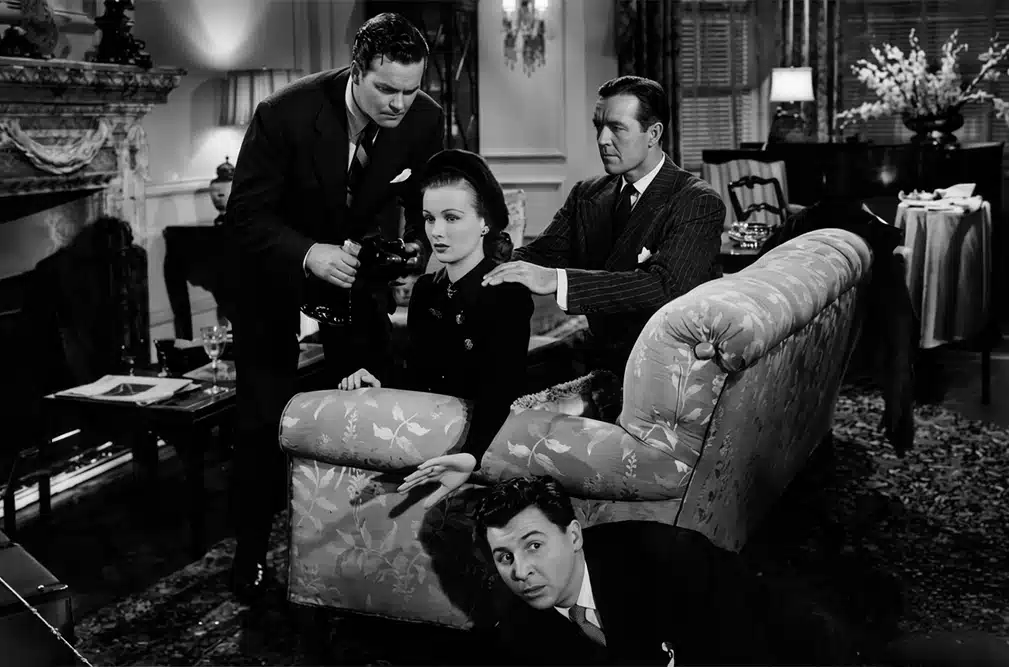

When a movie has been making the rounds in fuzzy eyesore prints on fly-by-night labels or YouTube, and you finally get a chance to see a beautifully restored print, it makes a difference. Case in point: George Marshall’s slapstick caper Hold That Blonde! (1945). I’m afraid we’re stuck with that exclamation point.
This Paramount B picture has virtually no reputation, despite coming from an important and prolific comedy director. Perhaps its obscurity will receive new polish now that Kino Lorber has issued a Blu-ray that shows the film in excellent shape for the first time on home video.
Hold That Blonde! begins on a dark and stormy night at a grand old mansion. As a narrator says something or other about crime, we see a portly man opening his safe, one of those old-fashioned black, boxy things that always fell out of windows onto the sidewalk below in old cartoons. The camera pans to the left, where a mysterious maid is peeking and smiling from behind a curtain. She’s played by our star, Veronica Lake, and she’s noting the combination.
Then we cut to another mysterious figure, crouching in his raincoat behind a pillar at a majestic bank. When the watchman passes by to sneak a cigarette, our skulker somehow makes his way into the bank (we’ll learn how later) and sets off the alarm at the huge walk-in safe. When police arrive to arrest him, we finally see it’s our other star, Eddie Bracken, insisting with a quavering voice that it’s all a mistake, he’s only putting it back.
Eddie plays Ogden Spencer Trulow III, whose grandfather founded the bank. He’s sent to a psychiatrist played by George Zucco, who played more mad doctors than a crocodile has teeth. Diagnosing his patient in about ten seconds, the doc announces that Ogden’s kleptomaniac blackouts are obviously tied to the trauma of being jilted at the altar, and he basically needs to get laid.
Well, the shrink says he must get a new girlfriend, but that’s what he means. Thievery as sexual repression was a fashionably Freudian idea that Alfred Hitchcock would push to the limit in Marnie (1964).
No sooner has the doc uttered his prescription than Ogden and Sally are meeting cute on the street, and Ogden has lifted her compact (with combination) out of her purse, causing her to follow him to his swell bachelor pad with well-appointed furnishings and an African-American valet named Willie (Willie Best). Ogden and Willie are about equally jittery and almost try to out-quiver each other.
Best is one of those charismatic talents who always played this type of role and always seemed better than his material. He’s really the third co-star, being more important than the crooks, the detectives, the society bigwigs, or anyone else running around in the shenanigans that constitute Hold That Blonde! As the commentary by film historians Julie Kirgo and Peter Hankoff points out, Willie and Ogden have a curious intimacy. Not only are they in the same shower scene (with Ogden in the shower), but when an unconscious Ogden lolls his head on Willie’s shoulder and murmurs, “My Sally,” the valet answers, “I’m not your Sally, I’m your Willie.”
Hold That Blonde! boasts a comic highlight as hysterical as any other sequence in 1940s Hollywood. Ogden, clad only in a towel, finds himself scrambling around the ledge of his penthouse and tangling with an irascible top-hatted drunk played by that eternal top-hatted drunk, Jack Norton. He’s not even credited, but audiences recognized him, as he’d played this character dozens of times. The extended sequence is an obvious shout-out to the classic silent films of Harold Lloyd, and it’s equally worthy of Laurel & Hardy. We’ll come back to that.
After Ogden gets off that ledge, it’s off to the swanky party where the famous Romanoff jewels will be on display. There, Ogden will make an even greater spectacle of himself. This seemingly backward and mousy character has been renewed into courageous improvisations by falling instantly in love with Sally. He calls her literally what the doctor ordered. Sally explains that she’s being blackmailed by crooks, so she’s allegedly no more responsible for her actions than Ogden.
Recognizable character actors include Frank Fenton and Edmund MacDonald as baddies, Albert Dekker as a police detective who stands around smirking, Donald MacBride as the insurance detective who likes dogs, Lewis L. Russell and Norma Varden as the folks throwing the party, and Bobby Watson as the put-upon butler who gets a nice routine with Ogden.
Hold That Blonde! is based loosely on a 1914 play, The Heart of a Thief, by the once-popular and successful Paul Armstrong. Several of his Broadway hits got turned into films. You may compare Hold That Blonde! with a previous film version, Clarence Badger’s Paths to Paradise (1925), which PopMatters reviewed here. The two films’ different approaches can be summarized by their stars. The silent film is a vehicle for elegant, top-hatted Raymond Griffith. Marshall’s film is a vehicle for jittery, bumbling Bracken, who was a last-minute substitute for jittery, bumbling Bob Hope, who was embroiled in a contract dispute.
Hope had co-starred with Willie Best in George Marshall‘s The Ghost Breakers (1940). Marshall also directed comedies for Laurel & Hardy (we said we’d come back to them), W.C. Fields, Will Rogers, Betty Hutton, Jerry Lewis, Lucille Ball, Fred MacMurray, Debbie Reynolds, Glenn Ford, and Jackie Gleason. One of his most famous hits was the comic western Destry Rides Again (1939) with James Stewart and Marlene Dietrich.
Hold That Blonde! isn’t only a Bob Hope movie without Bob Hope (Hopeless?), it’s a Preston Sturges movie without Preston Sturges. Paramount was Sturges’ studio, producer Paul Jones worked with him frequently, and both Bracken and Lake famously starred in Sturges’ hits. The off-the-cuff plot structure, which seems determined by the whimsies of a fate that toys with its hero, is a highly Prestonian element. It even uncannily anticipates the fact that Sturges was a few years away from working with Harold Lloyd on another building-climbing farce, The Sin of Harold Diddlebock (1947). If Hold That Blonde! can’t rise to the brilliance of Sturges, it’s an often-hilarious attempt.
The cinematography by future Oscar-winner Daniel L. Fapp makes the most of the horror-noirish opening sequence of rain and lightning, while the skyscraper bit employs Gordon Jennings’ photographic effects and Farciot Edouart’s process photography. The Kino Lorber Blu-ray’s crystal clarity, thanks to a 2K scan from 35mm fine grain, brings renewed sparkle to the comedy. If you have a choice between Hold That Blonde! and a true Sturges film, take the Sturges, but don’t wait for a rainy day to get around to Marshall’s neglected nonsense.