
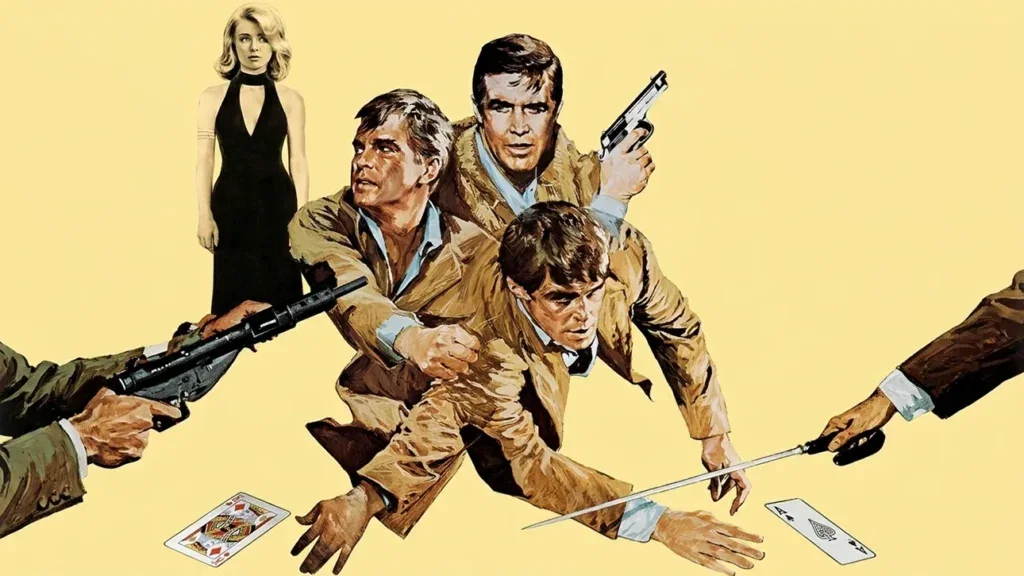
Name that movie: An innocent man is wanted for murder on the front pages of every newspaper, so he sneaks onto a train and hides in the compartment of a sexy blonde, who willingly conceals him. You say it’s Alfred Hitchcock’s North by Northwest (1959)? Sorry, the film we’re talking about is House of Cards (1968), an ultra-glamorous, semi-senseless pulse-pounder directed by John Guillermin, and it makes its home video debut in Region 1, at long last, on a Blu-ray from Kino Lorber.
Talk about a film that’s been missing in action. Even though House of Cards looks like a million francs in Techniscope and Technicolor and plays like a picture Hitchcock forgot to make, Universal delayed its US release by almost a year after it played in England. They then issued it as a double feature with the wildly unrelated Change of Habit (1969), a movie directed by William A. Graham in which Elvis Presley meets a nun played by Mary Tyler Moore.
House of Cards has never been on tape or disc in its home country, and TV prints were panned and scanned to the point of visual illegibility, as one can see from the trailer. Now it’s finally looking wide, crisp, and sparkly.
House of Cards begins underwater. The camera bobs to the surface, and we see the Eiffel Tower in the distance, so we’re floating in the Seine in Paris. A million movies show the Eiffel Tower to signal Paris, but this is a clever re-invention of the cliché, and Guillermin will consistently come up with visually interesting ways to convey the clichés that peppered (or Peppard) this script. We could argue that the film’s paranoid physicality is best enjoyed by people who don’t hear or understand the dialogue and simply follow the visual flow, without letting the plot distract them.
So, the Seine in the early morning. A couple of lovers pass on the bank. A well-dressed, somewhat weasel-faced man stands alone on a bridge studying the water. A man is casting his fishing rod into the water. Francis Lai’s main theme washes over us. This gorgeous earworm, mixing syncopated rhythms with a harpsichord-like evocation of an older, elegant century, struts its foregrounded slink throughout House of Cards, making the proceedings feel chic and sinister. The film relies on its attention-getting score, as many films of this era did, and it would be nice if more films today did the same.
As we may have guessed, the floating POV belongs to a man’s corpse that’s now caught on the fishing line. The weasel on the bridge grins, and House of Cards transitions to a lilting French theme song over credits of Tarot cards. The lyrics are by Pierre Barouh, who appeared in Claude Lelouch’s A Man and a Woman (1966), which was also scored by Lai.
We drop into frantic handheld POVs of a boxing match, where our hero, Reno Davis (George Peppard), is getting the stuffing knocked out of him by a wiry young man who doesn’t seem to be in the same weight class. Reno cuts his losses by throwing in the towel as the crowd boos, and he leaves the ring with insouciance. His assessment of his situation and avoidance of further beating, where others might hold out for pride, is practical as well as self-serving. Perhaps it hints at his allegiance with underdogs, in this case, himself.
The next section finds Reno and his trainer-buddy, Louis (Raoul Delfosse), zipping about in a car when a bullet pierces the top of the windshield. Jumping out, Reno races after the shooter and discovers it’s a little boy in pajamas who was playing with a Beretta in the park. Taking little Paul (Barnaby Shaw) to his staggeringly huge and well-appointed mansion, Reno confronts Paul’s elegant mother, Anne (Inger Stevens), and Uncle Claude (Ralph Michael). One cut later, she’s tracked Reno down the next day in her limo and offers him a vague job as a tutor to the boy, who took a shine to him.
This weird, off-putting household pines for its lost estate in the former colony of Algeria, where the boy’s father, a heroic general, was killed by a bomb. The most bizarre of the hangers-around is Dr. Morillon (Keith Michell), a psychiatrist who seems to live in the house and hover around Anne and her kid. Anne sends brazenly mixed signals that make us think she’s either a kind of prisoner or cuckoo.
We finally see third-billed Orson Welles in one of his few but naturally commanding scenes. He purrs his lines with disorienting Shatnerian … pauses and … inflections. He’s suave in an off-kilter way, perhaps with a touch of indigestion. We’ll later see him in a round ceiling mirror by a little pool, drifting about in a robe like a morbid pope. He’s publisher Charles Leschenhaut, clearly the head honcho and string-puller of whatever’s going on; the Bond villain, if you will.
Leschenhaut will have a bitchy dialogue with the bridge weasel (William Job), who starts getting uppity. Leschenhaut asks what the matter is; is there some bauble from Cartier’s he neglected to buy him? So, House of Cards even echoes North by Northwest by participating in the trope of the gay minion, as part of the general cinematic trend of homosexual baddies. When bad guys are coded as queer, it gives a certain kind of straight viewer of the 1960s a queasy thrill that explains their twisted villainy while making it all right when they get killed. You could also interpret that people take an anti-social turn when society outlaws and persecutes them, as seen in the writings of Jean Genet and his celebrations of thieves and prison homosexuality.
Papers could be written, and undoubtedly have been, about Hitchcock’s gay coding of killers, but the relevant reference here is Leonard (Martin Landau), right-hand man of Vandamm (James Mason) in North by Northwest. “Call it my woman’s intuition,” warns Leonard about his boss’s attraction to a beautiful blonde, and Vandamm says, “I believe you’re jealous.”
Very rapidly, Reno grasps that Leschenhaut’s clan are fascists planning to take over the world, which makes House of Cards into a James Bondish spy adventure, and Reno’s the two-fisted, window-jumping, roof-climbing, fire-starting, car-jacking, boat-rowing Yankee cat to put a spoke in their wheels. That’s why he needs either to die or get framed on a trumped-up murder charge.
The plot of House of Cards rambles from pillar to post, and from Paris to a rural castle to a train sequence to a lake villa, and finally, the Colosseum in Rome for a very stylish and absurd confrontation. The script, derived from Stanley Ellin’s 1967 novel, is by the married team of Irving Ravetch and Harriet Frank Jr., best known for a long series of films directed by Martin Ritt, including Hud (1963) and Norma Rae (1979). House of Cards and Blake Edwards’ mangled The Carey Treatment (1972) are the two films for which they used the pseudonym James P. Bonner, which may indicate dissatisfaction with the results.
In the commentary, film writer Gary Gerani opines that while House of Cards isn’t in the same class with North by Northwest or The Man Who Knew Too Much (1956), it’s better than Hitchcock’s contemporary spy films for Universal, Torn Curtain (1966) and Topaz (1969), which are also Bondian knock-offs crammed with location work. In any case, Hitchcock is the key influence, and it’s noteworthy that several of Ellin’s stories were adapted for the TV series Alfred Hitchcock Presents (1955-65). All this makes House of Cards seem like a project Hitchcock passed on.
Guillermin keeps Reno at the center of almost every scene, all designed and shot for maximum eye candy, while Lai’s score saturates the goings-on. Kudos to photographer Piero Portalupi, the costumes by Edith Head, the art direction of Alexander Golitzen, Frank Arrigo, and Aurelio Crugnola, and the set decorations by Frank McCarthy and Ferdinando Ruffo. One feels they’re the stars of the film, for they always provide value while the story goes through its paces without troubling its pretty head overmuch on credibility.
Many of its conveniences are dictated by convention. For example, the ending’s absurd detail is forced by a desire to prevent a certain character from shooting another, even though that would be better.
Gerani says Guillermin’s wife called House of Cards a fairy tale, perhaps in reference to its element of a maiden imprisoned in a castle who must be rescued by, in this case, a somewhat tarnished knight. The dialogue openly compares Reno to the biblical Samson, who pulled down the temple, or in this case, the “house of cards”.
We derive a sense of circularity from repeated motifs, not only in mythology but in the narrative. The opening ideas of a man on the bridge, a man with a fishing rod, a boy with a gun, and a hero who uses his professional fists will recur, in variations, in ways that feel cyclical and right, no matter how wonky the story.
Universal has hidden this film for decades, but we can be glad it’s on Blu-ray now. However we may judge it, we must first see it in its best presentation, and that’s what we get. House of Cards radiates its era and genre with a style that compensates for the shady logic of its paranoia-dream narrative. Your response depends on where you focus.