

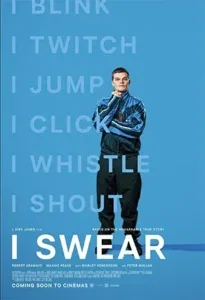
Biographical dramas about adversity often lean too hard on spectacle or caricature. I Swear, which tells the story of John Davidson, avoids glamorizing suffering.
John is a Scottish activist who works to raise public awareness about Tourette syndrome, the condition he lives with. Chronic and incurable, it is marked by motor and vocal tics that limit autonomy and can turn social life into a minefield. One of its rarest manifestations is coprolalia, the involuntary expression of swear words or offensive language. Even with therapeutic options available, the syndrome remains heavily stigmatized and poorly understood.
It is within this context that actor Robert Aramayo enters the film, playing John from his adult years in the 1990s through the royal honor he eventually receives for his public work. It is a physically demanding performance, but one that keeps the pain contained. Even as he reproduces the repetitive movements and vocal outbursts of the condition, his posture and gaze keep bringing his character back to the level of a tired man, not a diagnosis.
In his search for acceptance and some version of normalcy, John’s body folds in on itself during moments of crisis, revealing someone trying to deny his own visibility. In I Swear‘s more tense moments, as when John is arrested after involuntarily calling police officers “pigs” and claiming he is dealing drugs, Aramayo is convincing because he holds impulse, shame, and helplessness together without forcing the scene. Indeed, through performance, I Swear reshapes the social position of a man cut off from ordinary forms of connection, even at the height of his physical strength.
John is pushed to the margins throughout the narrative. His parents grow frustrated as the first signs of the syndrome emerge in puberty. Affection toward him begins to curdle into resentment and distance. His promise in football becomes a memory, undone by the loss of motor coordination. Romantic relationships do not survive the unstable stretches of a man who needs supervision in daily life. Professional stability is almost unthinkable for someone who might suddenly shout obscenities at a superior or a customer.
Aramayo answers all this by showing more than saying. The worn face and defeated appearance begin to shift once John finds encouragement and warmth among close friends, who become his real family.
Director Kirk Jones opts for a functional, demonstrative approach. Wide shots heighten the sense of isolation in the first act, which is centered on adolescence. The visual design stays close to that idea. John appears small within the frame, surrounded by lighting that grows progressively darker. Pain is expressed through the camera’s distance, culminating in an overhead shot at his lowest point, late at night.
Once a sense of purpose finally begins to form, Aramayo quite literally opens the curtains on his life in the scene where John meets Dottie Achenbach (Maxine Peake). She becomes a narrative turning point, pushing him toward autonomy through self-acceptance. I Swear then reworks its palette, leaving behind the darker tones and taking on stronger, livelier colors. A more subjective openness enters the story, something it had earlier denied, in contrast with the gloom of John’s childhood home.
Even so, I Swear follows the formula of a conventional biopic. The script is predictable, the dialogue often turns expository, and the shot breakdown shows little imagination. The drama depends mostly on the strength of the performances. The standard shot-reverse-shot pattern flattens tensions and holds back some of the film’s force. Everything seems calibrated to foreground the lead actor, avoiding distraction and giving up the chance at something denser, more expressive.
With its US theatrical rollout to begin on 24 April through Sony Pictures Classics, I Swear now enters a different kind of circulation, one that could easily pull it back into the awards conversation later this year. Aramayo already arrives with major momentum after winning the BAFTA for Leading Actor, and the American release gives the film a clearer runway for a performance campaign. He had already shown real force in Annemarie Jacir’s Palestine 36, where he played Captain Orde Wingate, but I Swear is the leap in his career: the performance that turns early promise into an actor we are compelled to watch.
That only sharpens what is already plain on screen: Aramayo comes out of I Swear much larger than the film around him, carrying a conventional biopic to a level of emotional precision and physical control that its form rarely reaches. In a film so invested in recognition, he is the one element that keeps pushing past its limits. I Swear, respectful as it is, shows little real interest in building a cinematic form worthy of the performances it contains.