
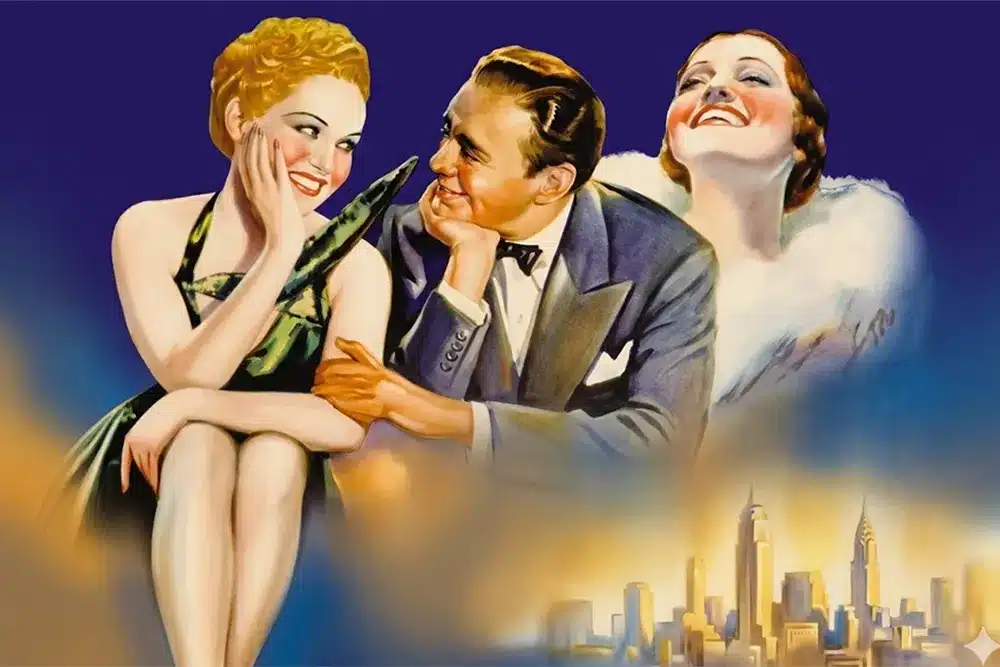
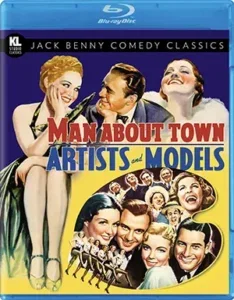
Jack Benny Comedy Classics is a new Kino Lorber Blu-ray with a double dose of late 1930s Paramount comedies starring comedian Jack Benny. Artists and Models (1937), directed by the all-purpose master Raoul Walsh, is little more than a briskly organized parade of diverse elements designed to distract the audience. Man About Town (1939) is the first film directed by Mark Sandrich after his string of stunners at RKO pairing Fred Astaire and Ginger Rogers.
Perhaps it’s difficult for modern audiences to realize how huge a star Benny was. His radio program could fairly be called a national institution, and he parlayed that popularity into many hit films. He wasn’t handsome nor especially witty. He didn’t fire off as many glib one-liners as Bob Hope or Groucho Marx, and he didn’t specialize in pratfalls, although he performs a couple in this set.
Jack Benny was a reactor, and his timing and dry delivery were everything. The most physical he got was standing there, looking befuddled, sometimes crossing his arms or holding his chin as he said, “Well!”
The two films in Jack Benny Comedy Classics even predate these gestures, as those got perfected on his long-running television show. Instead, the Paramount films show Benny as an entertainment maestro who gets romantically involved with fabulous women, although never too hotly and heavily. He couldn’t have pulled that off, either.
Artists and Models‘ Eye-Popping Production Numbers – and Underwear Jokes
If the title Artists and Models rings a bell, it’s likely to be the unrelated 1955 Frank Tashlin film starring Dean Martin and Jerry Lewis. This 1937 item is a very loose vehicle for Jack Benny, or rather, he’s the ringmaster.
After a lovely unfolding scroll of credits, the camera looks down on a city street from skyscraper height. We see three men on a scaffold putting the finishing touches on director Raoul Walsh’s credit, whereupon they plummet through a skylight and land on their feet to start singing on a stage. This group, soon to be joined by their fourth member, is the Yacht Club Boys. They’re a more exhausting version of the Ritz Brothers, if that helps.
The opening song lampoons itself and all musicals that throw overstuffed numbers at the audience. More and more elements congregate on stage until it’s closer to Grand Central Station than the Great White Way. After the hurly-burly’s done, the boys ask a patiently smirking Jack Benny what he thinks. “It stinks,” he says. He’s right, even if that begs the question of why you’d open your movie with it.
Benny plays Mac Brewster, the head of a fabulous Art Deco ad agency. As Eddy Von Mueller astutely explains in his commentary track, the farrago that is Artists and Models is Hollywood’s post-Vaudeville synthesis of all forms of mass culture in 1930s America, including film, radio shows, popular songs, magazines, newspapers, and the ads that support them.
There’s some kind of plot, of course. Artists and Models had a dozen writers on it, according to IMDB, and we’re hard put to say whether the flimsy plot stops for the insertion of eye-popping production numbers or whether the flow of numbers occasionally stops for a bit of plot, but we’ll say for certain that the numbers sell the show. There are also quite a few underwear jokes.
In brief, Mac scores a million-dollar contract from a silverware company run by Townsend (Richard Arlen), and Mac wants to promote his girlfriend and model Paula (a dazzling Ida Lupino in an early role) for their campaign. Townsend rejects her sight unseen because he wants a blueblood from the Social Register. An angry Paula flies to Miami and snares him by masquerading as such. They fall in love, obviously, and Mac kind of falls for a real society dame in Cynthia (Gail Patrick, also dazzling in Travis Banton gowns). Who will land the job? Who will land whom?
To the extent that anyone in Artists and Models has problems, they’re of the sort created by themselves through lack of communication. Such problems are simple enough to be resolved offstage in the most perfunctory manner, so the film can get on with the next number dropped in from nowhere.
Some numbers are performed by Judy Canova, who specialized in homely, gangly, plain-talking country gals who yodel up a storm. At one point, she rips through a parodic version of “The Ballad of Jesse James” with her sister, Anne, and brother, Zeke. Their famous trio was the Three Georgia Crackers.
Judy is also well-paired with Ben Blue, a very out-there, tetchy personality and eccentric dancer. Ben and Judy do one delightful dance that should have been longer, and then Ben jumps onstage with a brilliant parade of marionettes called Russell Patterson’s Personettes. That’s after the wonderful, now unjustly neglected Connee Boswell (misspelled as Connie) sings the sultry, Oscar-nominated “Whispers in the Dark” with the Andre Kostelanetz Orchestra. That number adds two underwater bathing beauties doing a coordinated routine, thus anticipating MGM’s Esther Williams vehicles.
The big finale is “Public Melody No. 1”, staged elaborately by Vincente Minnelli several years before his formal arrival in Hollywood. It stars an almost-unrecognizably young Louis Armstrong, though the voice and trumpet are instantly recognizable. He leads dozens of African-American singers and dancers, all as denizens of Harlem, in a gangster parody.
Alas, the lead vocal in that piece is performed by Martha Raye. Like Canova, she made her rep with a very big, not to say shrill, voice. Unlike Canova, Raye is here darkened to imply some degree of African American heritage. She’s not in outright minstrel blackface, but she’s a shade or two darker than her norm, as if the producers are trying to have it both ways.
This choice deserves lamentation, especially as Raye is surrounded by any number of black women who could have knocked the song out of the park in her stead. While lamenting it, Von Mueller says that some of the harshest complaints came from Southern censors.
That statement probably needs unpacking, as Southern censors weren’t known for progressive stances. They’re largely the reason that African-American numbers in studio-era musicals are self-enclosed, as though dropped in from another dimension; this choice facilitated the number’s removal from prints for those markets that would have objected.
In keeping with this policy, it was rare for black and white performers to share what we may call a mixed number. The darkening of Raye feels like Paramount’s misguided attempt at an end run around this artistic segregation. Even if I tell myself that annoying the Southern censors couldn’t be all bad, it’s exasperating and wince-worthy today.
If you’re wondering about the artists in Artists and Models, we’ve already mentioned Patterson and his Personettes. Patterson, who also illustrated the credits, was a famous commercial artist and cartoonist, and he appears in person along with several fellow illustrators in tuxedos. The two most likely to be recalled today are New Yorker cartoonist Peter Arno and Rube Goldberg, whose name has entered the lexicon for his nonsensical inventions. Patterson introduces Goldberg as “the original Surrealist”, and his dialogue with Benny qualifies for the moniker.
Even with its missteps, Artists and Models demonstrates that Raoul Walsh didn’t know how to make an unwatchable movie. He’d work with Jack Benny again in The Horn Blows at Midnight (1645), and with Ida Lupino in three enthralling noirs, They Drive By Night (1940), High Sierra (1941), and The Man I Love (1947). Artists and Models isn’t one of his high points, but he didn’t make very low ones. Even at its most eye-rolling, it’s socially and aesthetically revealing.
Man About Town‘s Butler Shines Like a Roman Candle
Jack Benny returned for Mitchell Leisen’s Artists and Models Abroad in 1938. It’s not on the double feature. Instead, we have Man About Town, a sexy farce scripted by Morrie Ryskind, who wrote a lot for the Marx Brothers.
Benny plays Bob Temple, a Broadway producer who’s transferring his hit show to London. Despite this set-up, some aspects of Man About Town come straight from Benny’s radio show. He’s introduced, scratching out “Love in Bloom” on his violin, and he spends the film trading quips with his butler, Rochester (Eddie Anderson). More on the Rochester character, later.
The well-constructed story is based on the idea that it’s absurd to think of Jack Benny’s character as a sexual being, much less a lothario. He yearns for his star, Diana Wilson (Dorothy Lamour), but she brushes him off by saying she thinks of him as an uncle. The other chorus girls say he’s “like going out with your Aunt Tillie”, and he’s referred to as “safe”.
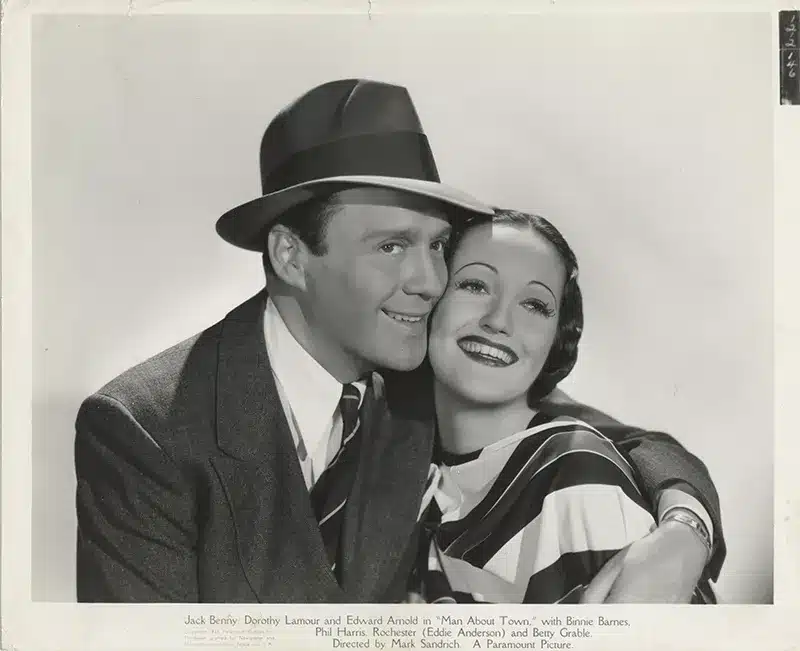
Bob determines to arouse jealousy in Diana by lunching with a married aristocrat, Lady Arlington (Binnie Barnes), who’s fuming because her husband, Lord Arlington (Edward Arnold), isn’t paying attention to her. She determines, in turn, to take advantage of Bob’s safeness by inviting him for the weekend to make her husband jealous, and her French chum, Madame Dubois (Isabel Jeans), has the same trick up her sleeve for her own neglectful husband (Monty Woolley). Bob also enlists help from one of his chorus girls, played by Betty Grable, on her way to stardom.
That’s all too complicated, but it flows smoothly and saucily enough as the kind of Hollywood sex farce in which nobody’s having sex, but everyone thinks everyone else is. A few numbers are staged from Bob’s show, which has an Arabian Nights theme, complete with harems. Again, it’s supposedly hilarious to think of “safe” Bob satisfying an endless number of wives. Only by projecting such a neutered persona could such a plot be constructed around him.
Bob’s closest relationship is with Rochester of the sandpaper voice, who steals Man About Town as Benny’s real co-star, despite being listed almost as an afterthought in the credits. They positively flirt in the scene where Bob practices his pick-up technique on a receptive Rochester, who coyly nibbles on oysters and caviar while vamping and smirking.
Indeed, there are several bits of business about Rochester pretending to be Lady Arlington on the phone. “Should I wear a dress?” he asks, and Bob says, “I’ll use my imagination.”
As Donald Bogle claims in Primetime Blues: African Americans on Network Television (2001), Eddie Anderson’s Rochester was fully Jack Benny’s co-star on radio and TV, and the audience knew it. He had to be explained as the butler or valet or whatever servant he was because that was the only socially acceptable reason for a white man and a black man to live together in the same house. The true reason, of course, is that Benny needed him around to swap perfectly timed repartee. Benny knew talent when it swept him off his feet.
While nominally following Jack’s (or Bob’s) orders, Rochester mostly does as he pleases, driving the boss’ car on his own errands, smoking his cigars, and offering nonstop contradictions and sarcasms. “Money isn’t everything. You must have heard that before,” says Diana, and Rochester answers, “Oh, I’ve heard it before, but I still ain’t convinced.”
Rochester goes beyond the “sassy servant” stereotype to become his own delightful person with hints of his own life. He’s the template for Robert Guillaume’s character, Benson, on the sitcom Soap (1977-81), who was equally indifferent to the ringing of doorbells.
Just a couple of doozies. When Bob explains that he didn’t get Lady Arlington’s phone number because it was only a lunch date, Rochester says, “Man, that’s like reading one page and throwing away the book.” When Bob asks what food he should order to make an impression, Rochester suggests fish and chips and a couple of bottles of gin. Bob snipes, “I want to make an impression on a girl, not a bunch of sailors!”
In Man About Town, Rochester performs in Bob’s show, at one point doing a comic dance. He also launches into a beautiful, graceful soft-shoe routine that’s only marred by the detail of his mugging by a nearby chimpanzee in a cage. African-American talent often had to put up with white people’s notions that monkeys and apes were comic fodder for black folks.
Social conventions keep trying to put Rochester “in his place”, but when he shines, he’s a roman candle. He’s even alive to class, as when he tells the dour English butler (E.E. Clive) that they’re in the same racket. The butler states that he’s been in this position for many years, like his father before him and his father before him, to which Rochester observes, “Your family’s sure in a rut.”
When the butler calls him an odd-looking fellow, Rochester replies, “Well, I wouldn’t talk, brother. You’re the only man I ever saw that looked like he was sucking a lemon and wasn’t.” Many reviewers in 1939 observed that Rochester stole Man About Town, and it’s still true.
Benny must have liked working with Sandrich. He also helmed Benny’s next two films in 1940, Buck Benny Rides Again and Love Thy Neighbor. Sandrich then directed Bing Crosby and Fred Astaire in the overwhelmingly popular Holiday Inn (1942), whose classic status is marred by the lousy idea of performing a blackface song to celebrate Lincoln’s birthday! Sandrich made three smooth WWII propaganda dramas, the best being So Proudly We Hail (1943), when he suddenly died at 44 in 1945.
Both Artists and Models and Man About Town are taken from new HD scans. They look excellent, but the sound on Artists and Models sometimes lacks clarity and presence. Eddy Von Mueller’s commentary on Artists and Models discusses themes and contemporary elements, while historians Paul Anthony Nelson and Lee Zachariah’s commentary on Man About Town focuses on career details.