
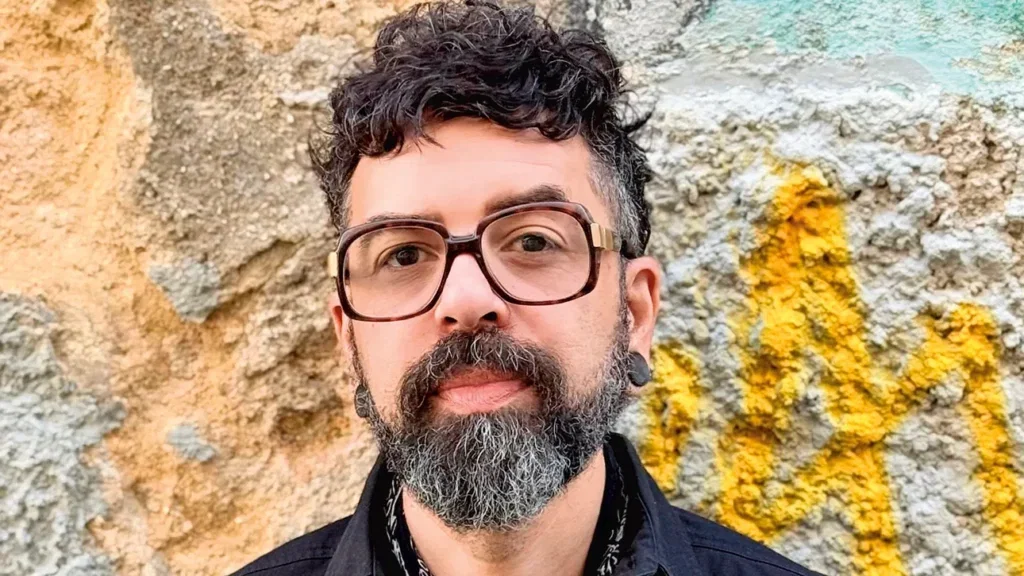

James Spooner is best known for his documentary film Afropunk and the festival that followed its breakout. When he decided to make the film, he began with a MacBook, a camera, and a vision. The film became a festival, and that festival became a phenomenon. Seeing the corporate takeover of his original vision, Spooner chose to step away from Afro Punk when it lost its DIY ethos.
In It Starts with Anger, Spooner continues the powerful journey he started in his graphic novel The High Desert, picking up the story in New York and carrying us through basement shows, club nights, and much more to explore the complexity of the punk scene and the additional layer of being a Black person in the scene. As a first-person account of the 1990s New York hardcore scene, it is among the best, a worthy sequel to a powerful first chapter. But it is so much more than that.
It Starts with Anger is more than a recollection of Spooner’s journey from punk to promoter to filmmaker to festival founder to former festival organizer. It is a firsthand account of what it’s like to be Black and punk, the joy of finding a complicated community and of discovering that even well-intentioned white friends don’t understand their own biases and attitudes. Spooner even confronts his own youthful biases and those around him, even as he immerses himself in Riot Grrl and other movements within the punk community designed to honor voices that spoke challenging truth to the largely cisgender white male crowds that found community in punk.
For anyone who has spent time in the scene, this is a must-read. I found myself thinking about my time in the DIY scene of my hometowns. I found myself not only revisiting questions that made me rethink my commitment to the scene, but also how closely my actions aligned with the ethos around me, healthy and harmful. I like to extoll that punk rock expanded my worldview and helped me find community with others who felt cynical about what mainstream society offered, but the truth is that it was also a breeding ground for bigotry, misogyny, and homophobia at times. Some of us stuck around and learned a thing or two, while others were content to start fights and eventually move on.
In addition to being a stirring, thoughtful account of an outsider in a scene made up of them, It Starts with Anger is also a call for cis male white punks to take a close look at their own behavior and to ask themselves if their scene is truly as inclusive as it claims to be and to think about the actions they can take to create community. There is room to do better, and like good punks, many are taking the mantle and building their own spaces, starting their own bands, and even launching their own festivals. At a time when the right has been creating its own definitions of “punk” that are exclusionary to anyone but cis white Christian men, there is no better time to revisit the inspiration that can come from underground culture and movements.
Even with all this story to tell, it took some time for James Spooner to decide it was time to revisit Afropunk. “The story of it has been one that’s weighed down on me since I left. It’s definitely been a roller coaster of emotions. Had I written a book ten or 15 years ago, it would have been a lot more salty. I think what really inspired me to feel like this was a complete story was when I started to notice the kids in the underground who were doing their own festivals and events. As I began reaching out to them just to say, ‘Yo, I love what you are doing,’ without fail, all of them were relaying to me that they were reacting to what Afropunk had become,” Spooner says.
What Afropunk had become was a corporate-sponsored, large-scale event, and while James Spooner had split from the festival by then, his name was still synonymous with it. “Many of them, most of them actually were like millennials, so they weren’t even around or younger, so they weren’t even around during my time, but they’d heard stories; they had it in their imagination what Afropunk was. Then when they went or as the stories started coming out about it, it was just disappointing for them. So they did what punks do, and they just started their own thing. And that really felt healing to me. Because that’s what I was hoping would happen,” he says.
Spooner is not precious about what he accomplished with Afropunk, although, honestly, he would be justified. In an interview with MTV.com that took place at the 2008 festival, Spooner told the reporter, “One day, there’ll be a 14-year-old who is doing their own festival and that will make ours irrelevant, and I will want to go to that festival. This is how I’ve always felt. Success was not predicated on us doing it,” he says.
It has taken years, but he now has a more nuanced feeling about the festival. “With time comes healing. I was able to see the long arc of this. I was lucky enough to see justice served and karma come back. And being removed from it all and just be able to say, ‘Alright, this is my part. This is what I did. This is where I failed.’ And I want to share that with the next generation, so they may not make these same mistakes,” Spooner says.
Of course, there were always Black people in punk, but they weren’t as represented as they are now, as the scene grows more diverse on stage and in the crowd, and it’s impossible to think that Afropunk was not a factor. “There’s a bigger space for people to be whoever they are, not just white, straight guys. You know what I’m saying? Like, there’s a kind of punk rock that allows for people with disabilities, allows for people of color, allows for people to be queer. All of these things were what it was supposed to be to begin with,” he says.
“In 2001, when I started the documentary, I was really angry. It took me a while to rewatch the movie and see the anger at the beginning, and then how it quickly turns into this celebration. But there’s a metaphor there because when I started the movie, the first thing that I did was make that dedication [that opens the film, which is “To every Black kid who has been called a [n-word] and to every white kid who thinks they know what that means.”]. The dedication is something I still stand by, but it was confrontational,” James Spooner says.
“I think that if I had to do it again, being who I am now, I might not start with that, but I think it’s valuable. What it’s saying is that it’s dedicated to every Black kid, because they have all been called that. Then there’s every white kid who thinks they know what that means, and that’s very much the punk scene.”
The punk scene attracts outsiders and socially conscious people, but not exclusively. It seems like there’s always a subset of people who are just at shows to fight and cause trouble, too. “That’s a specific kind of kid who gravitates towards the punk scene because they also feel like outsiders, and they also are angry. There are a lot of commonalities, but obviously not everything,” Spooner says. Often, that anger is directed at people who are othered in the scene, but even those who have good intentions can slip up, too.
“We progress as a society and humanity with allies, with people who are willing to look at themselves and be like, ‘Oh, I didn’t realize that. I didn’t know what that means, and I want to spend the time to learn’ or ‘I want to talk to my black friends about uncomfortable issues,'” Spooner says.
“I want Black people to read this book and feel affirmed, but I also want white people to read it and question themselves, and use it as an opportunity to have difficult conversations with other white people and with people of color. That’s the goal. I think the scenes are fractured and there probably still is a tough guy scene with bands like Terror, where Nazis would come. But I think that overwhelmingly, there is this embrace of DIY, and this embrace of that only scene being strengthened through diversity.”
James Spooner lives in Los Angeles, and he has seen a change in the makeup of the bands and crowds. “In the LA scene, it’s very brown. The white kids are in the minority. It is like 90-something per cent Mexican. It’s so brown they don’t talk about it. They don’t have to talk about it. They don’t have to have a Latino punk show because it is all Latino punk,” he says.
He also credits the increased access to scenes as bringing more people aboard. “It’s easier to find. You don’t have to be stuck in the scene that is in front of you because, being online, you can navigate and be like, there is this whole other scene that I didn’t even know existed in my town or in the town 40 minutes away. I don’t have to be stuck in this rural scene,” he says.
It Starts with Anger looks and reads like a great issue of a zine, blending flyers, graphic novel interludes, and Spooner’s storytelling. For a punk rock memoir, its aesthetic is a powerful match. While The High Desert is strictly a graphic novel, Spooner knew the story of Afropunk would need a different approach.
“I didn’t want to do this as a graphic novel because I felt like there’s too much information, and as it is, it’s at almost 400 pages. So imagine if I tried to tell the same story in comics. It would be like, ‘All right, Volume Three’. I definitely wanted to lean into a DIY aesthetic. I had my vision for it from the jump, to make it look like a zine, but still be, I don’t know if literary is the right word, but everything’s spelled correctly. I tried my hand at prose, and that was scary at first, but I just kind of leaned into the kind of storytelling that I could wrap my head around,” he says.
It was important to James Spooner that It Starts with Anger retain appeal for his comics audience, too. “I didn’t want to leave my comics readers behind. That was behind the decision to try to sell it as a hybrid book. Pantheon was the only one that stepped up, and they were a dream publisher to be part of. They never had any question about it; if you saw the pitch, it looks just like a book in stores.
Spooner was expecting to be heavily involved with the layout process, given the complexity of the project, but the book designer immediately understood the assignment. “I thought I was going to have to design every page. I figured no one’s going to understand how to do this, but the book designer did a chapter to see if it was what I wanted, and it was fucking perfect. I provided some minor notes, but that was it,” Spooner said.
The final stretch of the book details the festival’s purity of purpose at first, which slid into commercialization, complete with an Afropunk Toyota wrapped in illustrated barbed wire parked out front, free Mountain Dew, and press coverage from PBS, NBC, and MTV.
It was at this iteration of the festival where he also took the stage to call out an artist for playing a violently homophobic track during the festival and to reiterate that without queer people, there would be no Afropunk. This was his breaking point, and he decided to bow out, stating at the end of a chapter describing the Afropunk festival he christened “Mountain Dew Fest”, “I set out to start a movement, but our mission statement came second to our financial statement, and movements aren’t led by LLCs.”
There was some pain there, but James Spooner decided he was finally ready to talk about his exit from Afropunk. “I think it’s a capitalist cautionary tale. There is something to be said about growing up in this scene where, really above all, not selling out is the bedrock,” he says. Along the way, he was able to engage with people such as Ian Mackaye, whose Dischord Records remains the blueprint for many indie labels’ ethos.
“I’ve tried to boil down punk rock. I was talking about this with my wife, and it’s because she has a lofty idea of what punk is, and she’ll say, ‘Yeah, that’s not really punk.’ What if something is ‘punk’ sonically, but their politics are really off? We might not like it, but that is punk too. G. G. Allin is punk, as much as deplorable as he is, but Kimya Dawson is punk, too. So what do these people have in common? Like what does everyone in the pantheon have in common? It’s this idea that we’re in the underground,” he continues.
“So if you strip away the word punk, which feels very loaded because it’s part of their identity. You strip that away, and you just say mainstream and underground, then things become very clear. Because it’s like, is Green Day punk? Some will say no, some will say yes. “Anyone who is part of the underground, all points to the bands that signed to major labels and got big as not being punk, even though a lot of them sound punk, right?”
However, this is not a finger-pointing exercise, as James Spooner explains.
“What we’re ultimately saying is that punk is underground, and what looks or sounds like punk is not. There’s a value in the underground, because it’s resisting our culture, it’s resisting capitalism. I grew up in that, and I can still be tempted by all the sponsorship, and get my head gassed up by influencer deals and all of this shit. I can let this thing that I like birthed turn into something that embarrassed me. Then what does that say about people?” he says.
“We need to put a premium on resistance. Our scene is a reflection of the mainstream of the greater society. I think that a lot of us who grew up punk take those values with us into adulthood. Yes, we have to make a living, and sometimes we have to compromise our ethics and whatever to uphold our values to provide for our families because we live in a toxic world. But at the end of the day, there is still that resistance, and I want us to value that,” he says.
“You look at a company like Google, which at first had a core company value of doing no harm, but now they assist with bombing Palestine. They claim to have come from a punk ethos, but then they got so much money, so the imperative became to keep making more. Now it’s become participating in genocide to make more money. That’s what is important to them,” he says.
“I want people to question Afropunk. The festival was valuable for so many reasons, but none of them was because it was punk,” he says. “When we allow our cultures to be stripped of their gravity and their weight, and it just becomes Denny’s selling a mosh pit burger? What the fuck are we doing? How are we allowing this to happen?”