
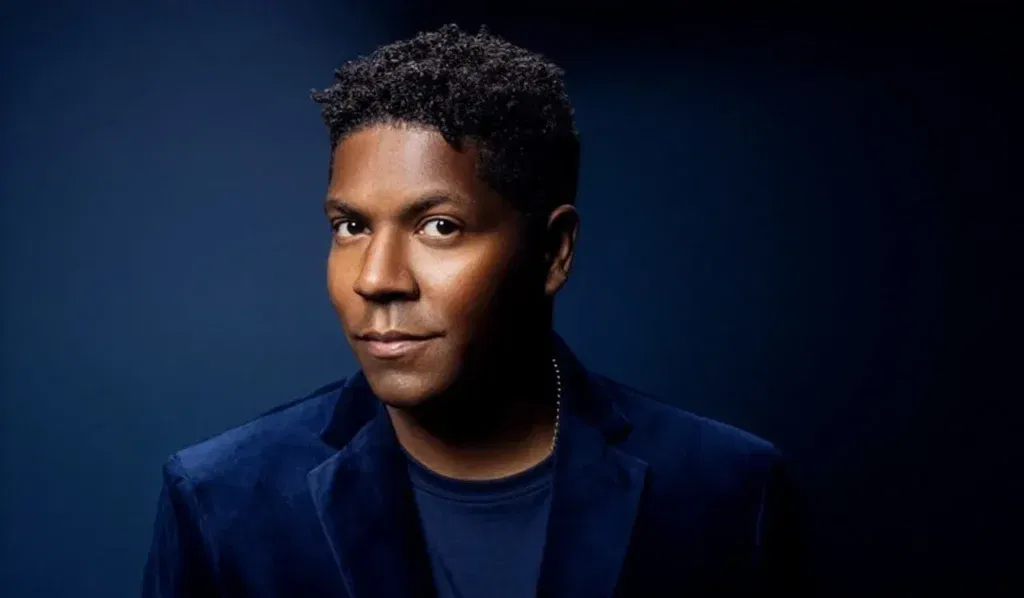

Jazz composer and trombonist Javier Nero might be thought of as a modern traditionalist in the music. His new album with his big band, the Javier Nero Jazz Orchestra, Alkebulan, was just released and features music rooted in the large-ensemble tradition. It also incorporates a variety of more modern elements: rhythmic groove that traces back to his interest in popular forms (hip-hop, soul, and jazz fusion from the 1970s), polyrhythms, and a blending of different forms into one voice.
I got a chance to hear Nero and his orchestra twice in the last year in Washington, DC, and Baltimore, where he is based as both a professor at the Peabody Institute of Johns Hopkins University and as a member of the United States Army Band “Pershing’s Own”, performing as a member of the US Army Blues. His big band performs monthly at An Die Musik in Baltimore, where I heard him more recently.
The new album follows the large ensemble’s 2023 debut, Kemet (The Black Land), as well as his first recording, Freedom, a 2020 release for a septet with special guests, including vocalists. On both big band albums, including the new Alkebulan, Nero continues to work with singers such as Veronica Swift and Nicole Zuraitis, whom he met during his graduate education at Miami’s Frost School of Music. Nero got his bachelor’s degree in music from Juilliard in New York.
Here is a review of Javier Nero’s new album and an interview with the band leader.
The New Album for Big Band: Alkebulan
Alkebulan is state-of-the-art big band jazz. Javier Nero uses the large ensemble for color, contrast, power, and momentum. For example, the title track combines Latin percussion with a lead melody featuring Veronica Swift’s wordless singing and the horns. It floats just a bit like Chick Corea‘s first Return to Forever Band (with Flora Purim’s vocals), but it also jabbers and punches like a hip-hop DJ in its opening figures. Nero wisely gets a guest spot from Baltimore’s great vibes player, Warren Wolf, and he colors it with the band at its most gauzy, though seconds later the powerful punching figure is back.
I asked Nero to talk about how he both follows the “big band rules” and breaks them, too. He explained: “My mindset has never been extremely traditional. I try to learn things and allow myself to write what I’m hearing without restraints. My influences come from beyond the traditional big band. For example, I grew up in the era of video games. I absorbed a lot of almost robotic, sci-fi, futuristic rhythms. I’m very focused on imagery.
“I love a lot of the Afro-Cuban rhythms and how they fit together. There are restraints and rules that the Caribbean bands have, but I don’t care about that. If it sounds good and makes sense to me, I will use that sound. For example, in “Make It So”, there is a part that is in 15/4, and I don’t care if it breaks some rules.”
“Make It So” does indeed have a leaping bass line joined to a Caribbean groove that sounds good. Low brass punches at the bottom, the voice and horns soar at the top, and it all flows into a contemporary alto saxophone solo that ripples with bop but also sounds up to date. Guest trumpet soloist Randy Brecker follows over a delicious stop-start accompaniment. The last solo, for electric guitar, sits over a more impressionistic framing that slowly builds into an exciting drum feature. The track sits in the middle ground between the traditional big-band sounds of Thad Jones/Mel Lewis or Gil Evans and the more 21st-century big bands of Maria Schneider and Darcy James Argue.
Javier Nero’s Beginning as a Jazz Player and Composer
In his youth in the Pacific Northwest, Nero got both classical and jazz instruction — the product of some of the best music education available.
“I went to public school in Vancouver, Oregon. The music program was classical-centric,” Javier Nero explains. “Getting a more classical sound on my instrument — darker, less bright, and pingy — was worked into my brain early. To this day, I play on a large, symphonic-bore trombone to get that sound.
“In middle school, we had a ‘stage band’ that played rock and jazz, stuff like the Chicago song ’25 or 6 to 4′. Then, during my sophomore year of high school, I got more serious. I joined the American Music Program led by Thara Memory, which rehearsed three times a week after school and traveled around the country. I became more competitive with the other students in my group.”
Nero was a good student, but so much of his time in high school was spent in music programs that he decided to get an undergraduate education in the field. “My parents didn’t know much about what a career in music would be, but they were encouraging. My dad was really into fusion, and I would hear 1970s Freddie Hubbard and Woody Shaw from him, also artists like [saxophonists] Gary Thomas and Joe Henderson.”
The sound of Javier Nero’s big band on both Kemet and Alkebulan seems to ride a line between the kind of education students usually get in school band programs and the other sounds he was raised with. He acknowledges that he channels the “specific and rich history of how jazz orchestration is built. With a quartet or trio, you have more freedom and less restraint. There is a certain accountability with a larger band, but I’m not really thinking about those things. I’m just writing the music that is in my head. I’m not trying to uphold some tradition.”
The Traditional and Vocal Sides of Javier Nero
There are moments on Alkebulan when the jazz tradition is extremely strong and clear. “Radiant Flower (Zara)” begins with a relaxed statement of the melody by tenor saxophone, with the band moving in from the edges on the second 12-bar section of the theme. The sound of the Duke Ellington band is strong here.
“I like Ellington and Basie, of course,” Nero acknowledges. “Generally, the sound and the camaraderie of a big band drew me in. A small group feels different. I have a lot of music for my seven-piece group. But I enjoy the creative aspect of writing for big band — there are more parameters, and that is part of the art for me. The number of available colors allows you to paint on a larger scale.”
Javier Nero also sounds somewhat traditional when he works with singers on standards. Alkebulan features an arrangement of “Devil May Care” (the Bob Dorough song) by Nicole Zuraitis, which uses a flowing Latin rhythm interlaced with swing and plenty of horn power. Veronica Swift shines on “Softly, As In a Morning Sunrise”.
“I went to school with Veronica and wrote the arrangements for her when she competed and brought home second place at the 2015 Monk competition. This arrangement of ‘Softly’ is one of the most popular things I have out there. Both of these arrangements for ‘Softly’ and ‘Devil May Care’ were originally small group arrangements for vocal quartet and tenor sax.”
Nero sees these arrangements as perhaps “the least organic of my writing” on the album — more traditional than his charts just for the band. I love how he frames and slightly alters the “Softly” melody, using a syncopated horn figure that reframes the tune, with Swift joining in before and during a swinging piano solo.
Javier Nero as a Modern Jazz Figure
Most of Alkebulan, however, is not particularly traditional. “The Fourth Dimension” uses a rock-solid electric bass sound to set up a cycling groove in 7/4. The harmonies are clear but far from “Tin Pan Alley” standard, and Nero expertly layers the parts of the band to make it sound more intimate rather than like a roaring giant. The tune is nimble.
“Ayla” is a gentle ballad that asks the piano to carry a melody for almost three minutes before the horns enter with any force. The alto saxophone reiterates the theme with support coming from the bottom before anything like a “big band” sound arrives.
“Tesseract” (the title refers to a “four-dimensional cube” often used in science fiction) starts with a very rhythmic piano figure, lifted by low brass, which then locks into a funky saxophone line that could be from a 1970s funk session. The tune then offers a synth solo (on an instrument called a malletSTATION) reminiscent of the synth-guitar solos we associate with Pat Metheny.
Nero is a big Metheny fan, and his use of wordless vocals on several tracks comes from his affection for the Pat Metheny Band, which used this arranging element. “I was really into the Pat Metheny Group, and I like the voice as a texture. At U Miami, I was in a vocal jazz ensemble.”
“In addition to the Pat Metheny Group, I really like the arrangements on The Music of Pat Metheny and Lyle Mays by Bob Curlow’s L.A. Big Band. Vince Mendoza’s art as an arranger and orchestrator is wonderful. And I love Bob Mintzer’s small and large ensembles. I was also into the Brecker Brothers Band — that fusiony stuff really influenced me!”
Making a Jazz Career Outside of New York
There is great music, jazz included, in communities and cities everywhere. However, jazz does have a particular reputation for being centered in the large cities. Nero is based in Baltimore now, also with a foothold in DC, less than an hour south. Great musicians, he says, are plentiful.
“I have a job that pays well, and I can have a family, but I still have that New York freelancer mentality: I have any free time, and I have to express myself. The disadvantage of not being in New York is that there are not as many jazz musicians, but I think the talent here is just as good, maybe better, especially for work in playing with my big band.
“You have to be able to improvise, but reading and blending are also crucial. I can find musicians from the four premier military bands here, and they can read and play together really quickly.”
As a creative musician, Nero’s goal is to get his music out across the country. “I want to travel and play my music around the nation. I am going to Florida in 2027 with Veronica Swift to play my compositions. I’d love to do a concert with the WDR Big Band in Europe. I am seeking wider recognition as a composer and arranger.”
Javier Nero is also a very impressive trombonist. His tone is clear and intense, and he walks the line ably between playing fast and agile and still sounding like someone who embraces the role of the horn as a lower, denser kind of brass instrument. “I only play two solos on the new album, but I would like to be better known as a trombonist. It has always been both in tandem. I have three degrees, and two are in performance. Being a trombone player is central to who I am as a musician, but it comes out in my writing as well.”