
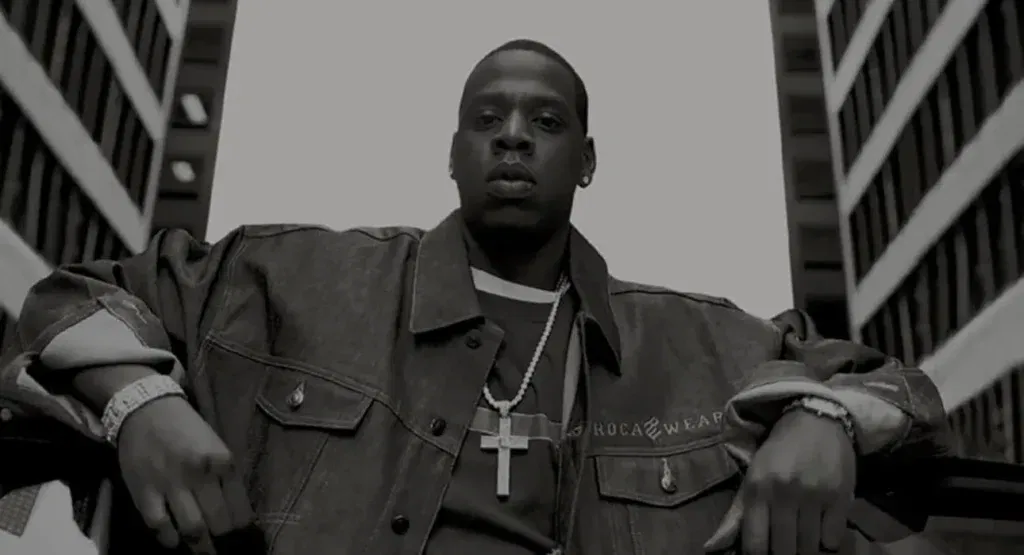
Sometime in 1999, Jay-Z drove out of the Marcy Houses vexed. On this particular day, he paid a visit to his old neighborhood in Bedford-Stuyvesant, Brooklyn, prompting excitement within the community. To accurately describe his positioning at the time would be to look at verse two of his 1997 deep cut, “In My Lifetime (Remix)”. For all the questions of “Is this world my world?” and “Am I the star of stars?” here he was holding court as rap’s undisputed kingpin. That reign, of course, became etched in 1998.
Against the backdrop of the deaths of the Notorious B.I.G. and 2Pac, Jay-Z sealed the power vacuum in what felt like one fell swoop with his blockbuster junior album, Vol. 2… Hard Knock Life. Where the predecessor, 1997’s In My Lifetime, Vol. 1, found the Brooklyn-bred emcee deliberately reaching for the throne, Vol. 2 fastened his seat at the top of the mount.
To quickly run down the album’s stats: Vol. 2 spent five weeks at No. 1 on the Billboard 200 chart, reached triple-platinum sales in just two months, and earned the rapper his first Grammy for Best Rap Album. Suffice it to say, the album took Jay from the corners to the droptop of crossover success. Still, despite making it past the axis of pop dominance, the rapper refused to flip.
As if learning from past mistakes (see the “(Always Be My) Sunshine” music video), Jay-Z made it a point to maintain his authenticity and steamroll over all expectations spurred by his newfound attention. In February 1999, rather than rub shoulders with pop elite at the 41st annual Grammy Awards, he opted to hit the road with DMX on the nationwide Hard Knock Life Tour. By May, he and his co-stars were invited by MTV to take a victory lap on Total Request Live after the tour concluded its sold-out (and incident-free) jaunt with a record-setting $18 million. That summer, he was as hot as fish grease.
Despite wanting nothing to do with the expectations that come with being a crossover artist, the summer saw Jay arrive like a Falcon 8X parked in the middle of the freeway: he occupied all lanes. He scored his first pair of No. 1 singles that season, notching the top of the Hot Rap Songs chart for the not-so-radio-friendly anthem “Jigga My Nigga” for the Ruff Ryders Ryde or Die Vol. 1 compilation, and occupied pop radio by way of Mariah Carey‘s “Heartbreaker” on the Billboard Hot 100.
Both records conquered the respective charts for two weeks. Without popifying his format, Jigga suffused the air — from TRLs and Rap City to Billboard and Hollywood box offices. Through it all, Jay’s modus operandi remained the same. As he would declare four years later on The Blueprint, everything he’d done up to that point was “for my culture”.
Starting his independent label Roc-A-Fella Records in 1996 and then flipping that into an unusually auspicious partnership deal with Def Jam in 1997 would be the precursor to what he would later admit on the aforementioned album: “Label owners hate me, I’m raising the status quo up / I’m over charging niggas for what they did to the Cold Crush.” Boycotting the Grammys was a means to not just call the Academy out for egregiously snubbing DMX, whose breakout year culminated in two No. 1 albums, but also for its longstanding penchant for cold-shouldering rap nominations on its live broadcast.
Launching the Hard Knock Life Tour was meant to bring together some of the biggest names in hip-hop and disprove the mainstream media’s blanket claim that rap concerts could not sell out arenas reserved for pop and rock acts. However, as much as these moves ensured that Jay hadn’t forgotten his core audience, the bigger his star power grew, the louder the opinions became.
If it wasn’t scepticism rearing from mainstream gatekeepers who shrugged at hip-hop’s universal appeal, it was the chatter coming from Jay’s backyard about his crossover status — that somehow, his pop-rap fame had changed him. That somehow his lamping in the Hamptons meant he could no longer come back home and congregate with his fellow natives in Brooklyn. “I been famous for four years,” he told Flipside in a 1999 interview. “The struggle doesn’t just go away like that.” For as long as Jay-Z maintained his signature unflappable cool, the sensations surrounding his world-famous persona had begun to take a toll.
Back to that incident in Marcy. As Jay was gearing up to leave, he received a parting message that didn’t sit quite well with him: “Be careful.” Harmless as it seemed, the words left Jay perplexed. After all, this was his home: Marcy Houses, the 27 six-story brick building maze that sits above the G subway line and occupies Myrtle, Flushing, Nostrand, and Marcy Avenues. Since the age of five, this was his world. He witnessed his first rap cypher in those same crowded courtyards. He navigated those same bench-lined pathways many a time with flashy whips. He filmed some of his most iconic videos there.
In his mind, to be told “be careful” meant he was an outsider. More specifically, in the lexicon of hip-hop, it meant he was no longer “real”, but what made it any different now? “Put a couple of chains on me, you put me in a role with Mariah, I’m still the same person,” he told MTV. “I’m not in there conforming or being different. I’m still Jay-Z.” However, no matter how much Jay considered himself to be still the same old Shawn from Marcy, his star wattage said otherwise.
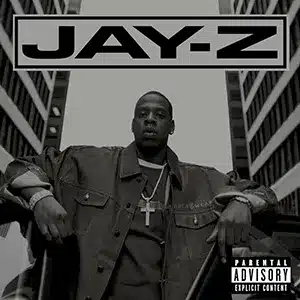
Enter Vol. 3… Life & Times of S. Carter, the most aggressive album in Jay-Z’s catalog. At 16 tracks, the ever-undeterred emcee sounds anything but as he fulminates on one end and tightens his durag on the other. There are bitter frustrations: “I expected to hear ‘Jay, if it wasn’t for you’ / But instead, all I hear is buzzing in your crew.” Keen observations: “Magazines said I’m shallow / I never learned to swim / Still they put me on they cover / ‘Cause I earn for them.” Unapologetic derisions: “And I come with durags to your so-called awards / T-shirt with my chain out like fuck y’all all.” Taking aim at the trappings of fame is nothing new within Jay’s archive, but what makes this one particularly special is that it offers a rare snapshot of the usually unflappable Jay in defense mode.
Where later albums find him being a bit more judicious with the bullshit, Vol. 3 directly tugs at a rogue gallery of culprits. There’s 50 Cent, who namedropped Jay-Z on the buzzy “How to Rob”: “I’m about a dollar, what the fuck is 50 cents?” There’s Nas, who also sent some veiled shots earlier that year: “And that’s right, we coming for the title.” There’s the haters: “All the haters eat a d—k, they want to see you broker.” There’s the media: “Soon, as I sell too much, watch them turn on him.” Lamenting from the top of the mount, Jay acknowledges sensations coming from critics, haters, and, perhaps, the loudest of them all: himself.
In the viscerally dissective “There’s Been a Murder”, he goes so far as to immolate his public persona (“I gotta do Shawn / ‘Cause even when Jay-Z was lukewarm / I was getting my loot on”), before telescoping out in time to assess the baggage of his hustler days: “See my life is like a see-saw / And until I move this weight, it’s going to keep me to the floor.” It’s a pattern that seeps through Vol. 3. For as often as Jay-Z sulks into deep analysis, he never sits in those thoughts long enough to get sunken by the apprehension. Instead, he signs off more emboldened by the burden.
No moment captures this assessment better than “Come and Get Me”, the song he immediately started brainstorming after that surreal encounter in Marcy. The record plays like the sonic composite to the “It became personal with me” meme: “I made it so, you could say, Marcy, and it was all good / I ain’t crossover, I brought the suburbs to the hood / Made ’em relate to your struggle, told ’em ’bout your hustle / Went on MTV with durags, I made them love you.”
For nearly six minutes, Jay skips the comfort of a leather therapist couch and airs his grievances over a bombastic Timbaland beat that sounds like it could very well backdrop a Hype Williams-directed Shaft adventure in a pre-gentrified Bed-Stuy. The record itself is an emotional roller coaster carefully guided by Jay’s profundity.
The violent reaction to his perception that opens up the first half of the record (“For niggas that think I spend my days in the sun / Well here’s the shock of your life / The Glock not the mic”) gets unpacked on the other end as an et tu, Brute-like response (“The funny thing / I represent y’all every time I spit a verse / And that’s the shit that hurts”). However, before Jay could sound desolate, he zooms out to accept his newfound reality: “My game change, but my mind-frame remains the same.”
When Jay-Z isn’t occupied by the album’s hanging bootlaces on fame and identity, he plays the role of ghetto reporter, offering sweeping shots of the tortured dimensions within the crucible of America’s underbelly. He uses the mic like a camera during these moments, offering on-the-ground reportage on the desolation and dejection of inner cities through his own experience in Marcy.
In “NYMP”, he takes listeners on a ride back to the subject of Vol. 1′s “Where I’m From” and uses it as a microcosm to provide a bird’s-eye view of the poverty, neglect, and systemic catastrophe imposed on Black and Brown communities worldwide. His vivid raps sound like red-brick building blocks over a Brian and Brenda Russell-sampled foundation, as he dishes hardboiled tales of ghetto alienation and the treachery that often plays out within.
All of these recollections highlight one of Jay’s strong suits: fluently representing and narrating the story of Black hardship. Within Vol. 3′s tough-as-kevlar exterior is a pulsating love letter to the streets — more plainly, and less nebulous: a commitment to Black optimism. Instead of painting these stone-cold portraits of societal ills and survival for thrills or braggadocio, he wears them like a badge of honor, as if to say I was just like you.
Forged in Marcy, Jay excavates these experiences not only to raise awareness among the broader public but also to shed light on those living through them. The references to sporting durags at “so-called awards” or flipping the bird to Lady Justice, as a result, aren’t so much about reinforcing his post as a devil-may-care, pop culture refusenik as they are an indication of his unwavering devotion to representing for his people.
For as much as he contemplates the double-edged sword of his public image, these musings find him using the exercise to voice the circumstances in the shadow world of an American underside where its denizens define normality. “I grew where you hold your Blacks up, trap us, and expect us not to pick gats up,” he raps on the thunderous “Dope Man”, a song that plays mock trial on the surface, and beneath exposes the systematic racism that plagues these communities. By the end, he whisks away the gloom and assumes responsibility for reversing the narrative, bringing Black hustle and aspiration to the centre of the zeitgeist. “Your Honor, I no longer kill my people, I raise mine.”
However, just as important as being a beacon for his culture, Jay-Z also loves the sport of rap. Like, a lot. To that end, Vol. 3 is lyrically the strongest installment in the Volume trilogy. It’s the chapter where Jay trades “king” for god emcee, and formally steps into his Super Saiyan-esque “Jay Hova” persona. With his durag cape flapping in the wind, Jay operates at the apex of his steel-clapping, chest-beating, unapologetic bullying, taunting a galère of adversaries and sceptics.
He sets the tone on the intro, “Hova Song”, which sounds like it was produced atop Mount Olympus. Switching between first and third person, he makes one thing immediately clear: “Hova the god, I should be rapping with a turban.” Despite its blasphemous suggestion (“I know way better than that,” he would clarify in 2000), the clever alias essentially articulated “I’m Him” before the phrase could enter our cultural lexicon.
In this way, he doesn’t sound like a rapper trying to outrap his peers. Instead, he’s hovering above the entire coliseum. The mightiness is turned up to the max on the album’s technical rap master class, “So Ghetto.” Here, the angels and gods practically attach wings to Jay’s Timberland boots, as he lyrically ascends: “I spit that murder-murder-murderous every time / A verbalist iller than Verbal Kint is, or O-Dog in Menace / I’m ill, start-to-finish / I rip apart contenders / I’m hot!”
He’s so disgusted by the competition that he consumes every nook and cranny of the beat supplied to further the distance between himself and his counterparts. In the street single “Do It Again (Put Ya Hands Up)”, he serves a club-friendly record for the crowds at the Tunnel and Cheetah, but still slips in his disdain: “How the fuck you talking bout emcees on our heels?” Throughout, this godly confidence fastens an ‘est’ to just about every rap skill associated with Jay.
In the Southern-fried bounce of “Snoopy Track”, the shit-talking is at its slickest. In the Mariah Carey-assisted “Things That U Do”, despite its obvious radio attempt, the “flow of all flows” is at its sickest. The lyrical altitude showcased overall is at its absolute highest, even on the record’s lulls.
The weak spots on Vol. 3 have nothing to do with the rhymes themselves. Instead, it is the lack of a throughline. Blatant radio-reaches (“S. Carter” and “Hard Knock Life”-Xeroxed “Anything”) and a few subpar decisions (“Watch Me” and “Pop 4 Roc”) are probably the reason why Jay, himself, criminally ranked the album lower than The Dynasty: Roc La Familia andThe Blueprint 3.
While they aren’t as clumsy as “The R.O.C.” or “Off That”, some of these records, such as the Dr. Dre-produced “Watch Me”, seemed like good ideas in theory, but the result left much to be desired. (The Pepsi Super Bowl LVI Halftime Show might be the closest we’ll ever get to a spectacular Jay-Z and Dre collaboration). Still and all, some of those misses (one of which was eventually corrected on Amil’s debut album) turn into guilty pleasures when Jay’s free-flowing haughtiness kicks in (“I just use rap to put shit in my name,” he boasts on “Pop 4 Roc”). To his credit, he did intend to make Vol. 3 his most cohesive album.
In the weeks leading up to the record’s December release date, Jay-Z found himself in the studio with Michael Jackson, who was in the throes of recording his tenth studio album, Invincible. Sometime during that visit, Jay spoke to Quincy Jones about the sequencing of Thriller. In his retelling, the intent wasn’t so much to recreate the landmark album as to achieve a somewhat similar linear structure. “He showed me a little chart and everything, and I followed the guidelines,” he told MTV.
However, those ambitions were mired by bootlegging. Nearly a month before Vol. 3 was scheduled to hit stores on 29 December, and the album was widely available on the streets. Infuriated, Jay was left to cut and paste records at the last minute, leading to two different versions of the album. The worst of it, though, came on the night of Q-Tip‘s Amplified album release party at Manhattan’s Kit Kat Klub, where Jay-Z stabbed a record executive believed to be behind the leak, Lance “Un” Rivera.
Against the backdrop of a media shitstorm, Vol. 3 arrived as the first No. 1 album of the new millennium, moving 463,000 units to give Jay-Z his biggest first-week sales up to that point. Initial reception to the LP was generally favorable, with outlets like Rolling Stone dubbing it “his strongest album to date” and The Source bestowing it four out of five mics. However, those fleeting highs were sullied by a potential 15-year jail sentence that hovered over the album like a specter. In 2001, Jay pleaded guilty to a misdemeanor assault charge and was sentenced to three years probation.
“Two More Raps For Rapper” headlined the New York Post, while the front page of the New York Daily News featured a blown-up photo of Jay in a durag next to the words “Rapper Brawl”. Instead of caving, Jay put up a million dollars and invited the MTV Making the Video production crew on a trip to Trinidad and Miami, where he parked a yacht at the center of the pop zeitgeist with his Hype Williams-directed music video for “Big Pimpin'” featuring UGK’s Bun B and Pimp C. The record became the first hip-hop video to be featured on the MTV series and earned Jay a Top 10 hit that helped push the album from a hazy start to double-platinum in less than three months.
Between Jay-Z’s legal trouble and the big-budget “Big Pimpin” video, Vol. 3 often feels like lost footage in the context of his rich catalogue. It also didn’t match the blockbuster success of Vol. 2 or the critical acclaim of the albums released after. Where it truly stands as a capstone — certainly within the Volume trilogy — is in its ability to provide a rare snapshot of the ever-undeterred Jay at his most vulnerable and vehement, sparing nary an iota of sympathy. Think of Michael Jordan navigating the league after his first NBA championship win in 1991 and the controversy brought by Sam Smith’s book The Jordan Rules, which was released shortly after.
With his back against the wall, the usually unbothered emcee sounds his most combative, paranoid, and callous with the goal of protecting his position at the top of the mountain. It’s an album that blazes through all its surrounding chaos, crystallising an allegory of self-redemption. The presentation is grand, and the lyrics are raw, but altogether they offer buoyancy to the out-of-the-hood survival tale that makes flourishing imaginable. That is a reality that, at least, brings some semblance of order between the worlds of Shawn Carter the hustler and Jay-Z the rapper.