
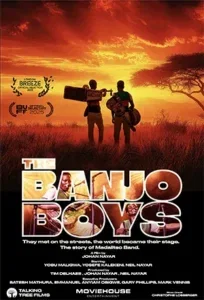
Humanity speaks loud and clear in Johan Nayar’s intimate documentary, The Banjo Boys. Our humanity is deeply in question lately. Wars are breaking out all over the globe, headlines constantly speak of disasters, man-made and natural, human rights keep losing ground, and all the while, many prefer their phones to human interaction.
Over five days of screenings, live shows, and Q&As at the 12th edition of the SeeYouSound music-themed film festival in March 2026, people gathered to share their passion for music and movies. Among all the noise and the crowds, The Banjo Boys, a small, independent film, had its Italian premiere.
The director, Johan Nayar, presented his incredibly compassionate documentary to a sold-out room of riveted viewers. The film was part of the festival’s “Music is the Weapon” section, which has been brilliantly curated over the years by Juanita Apráez Murillo.
When asked at the opening of the festival for a recommendation, Apráez Murillo emotionally blurted out, “Go see The Banjo Boys because they’re enormously humane and we really need that right now.” Though hers is a non-competitive section, it has always been a thematic voyage apart from the feature, documentary, and video clip offerings. At this point, she has devoted fans who make it their business to join her in experiencing music’s power to influence culture and politics worldwide.
Johan Nayar, who studied film at the New York Academy, is a director, editor, and videographer “with over 20 years of experience crafting compelling visual stories.” To watch his film is to be carried along on a bumpy ride in which you’re not sure how you and “the boys” will make it to the end.
At the outset, The Banjo Boys seems like a fairly straightforward documentary about two musicians from Malawi, Yobu Maligwa and Yosefe Kalekeni, who meet by chance in the capital, Lilongwe. About 15 years after they first started playing together, they encountered an Englishman, Neil Nayar, also a musician, who became their manager.
Speaking of his brother, director Johan Nayar says, “Neil wears all these different hats, and he does a great job for the band. He learned the local language, he’s their roadie, he’s their translator. He’s incredibly competent.”
To say things get interesting at this point in the story is a bit of an understatement. The very ingenious, highly determined, but seemingly mellow Neil, the younger Nayar brother, decides to put his passion for and knowledge of music, along with his intuition and hunger for adventure, to work. As their manager, Neil accompanies the Madalitso Band on an odyssey that takes them on numerous tours around Europe and beyond.
The Banjo Boys mostly follows the band in chronological order as they tour Europe and Africa, and eventually head to the US. There are also a series of sit-down interviews with Neil, Yobu, and Yosefe that fill in some details of their journey.
As his first full-length documentary, Johan Nayar found “going from the rough cut to the final cut was really quite a challenge. The rough cut was much longer, and the process was quite lengthy. Yet once we got that over the line, we knew we’d be able to really fine-tune it.” In this way, he cleverly weaves the story together, leaving plenty of room for live concert footage and informal, sit-down interviews.
Back in 2002, both Yobu Maligwa and Yosefe Kalekeni found themselves in Malawi’s capital city after having left their respective villages during a devastating famine. As Kalekeni tells the story, they saw each other on the street and exchanged a friendly hello in passing as they both walked on. Apparently, Maligwa turned back and started up a conversation with Kalekeni, who describes the encounter, “’ Do you play guitar?’ Yobu asked me because I always roam around strumming. Then he said, ‘Why don’t we start a band? I play too… let’s join forces.’ So we started, just for fun.”
The two would go around town, busking on corners and playing while roaming the streets. Often, they were insulted and called “mad”. Kalekeni reflects, “They [passersby] would say, ‘Go back to your villages, go farm you peasants!’ But we didn’t give up.” The musicians met a music producer, Emmanuel Kamwenje, who continues to co-manage them. Eventually, they went to his studio and recorded their first album, Fungo La Nyemba, together.
Originally, the band was called Tiyese, which translates to “let’s try”. Maligwa explains, “because we felt we were not there yet.” An acquaintance recommended they change their name. “’As Tiyese, you will just be trying forever! You will remember my words,’ she said. So from that day we became Madalitso Band.” Madalitso means “blessings”, which genuinely echoes the heart and soul of the duo, along with their approach to life and music.
The Musically-Minded Nayar Brothers
Having played in numerous bands, including one with his brother Johan and one in Malawi called Neil and the New Vibration, Neil was familiar with all sorts of music. Yet he was in search of a particular sound. One day, he noticed people walking along the streets in Lilongwe and playing, “I wanted that,” he exclaimed. Not long after, Neil met Yobu and Yosefe casually in the parking lot of Emmanuel’s studio. As Neil tells it, “We never expected it to go where it went.”
In 2017, when they were booked to perform at the Sauti Za Busara Festival in Zanzibar, the two band members were skeptical. Initially, they did not want to leave Malawi with Nayar for their first real gig on an island off the coast of East Africa. “We said we’re not going because we didn’t know that person,” recounts Maligwa. “We changed our minds when they told us there would be someone else. It was agreed that we would be joined by Emmanuel’s brother, so we would be three Malawians and one stranger. That’s why we agreed to go to Tanzania.”
It’s a good thing they went to Sauti Za Busara because, as Neil points out, “I was just hoping we didn’t embarrass ourselves, but then the first gig was outside, and people loved it. At the [performance] inside, the whole place erupted.” The following year, they had their first European tour.
Meanwhile, brother Johan was back in the UK and didn’t meet the band until 2019 when the boys set off on another European tour, and he caught their show in Lyon. When the Madalitso Band later arrived in England, “It was all a bit of a coincidence because after my first run at the cinema, I had a ten-year hiatus,” says Johan Nayar. “I was just getting back into film, and I had a week of holiday from my day job, which coincided with their week in the UK. I asked my brother, ‘Can we arrange it so that I film this tour?’ I just made it into a little mini doc about their week-long experience in the UK.”
Johan began to think he had an amazing story. “I was very curious about the back story, and to find out how these guys, who managed to get so far from the streets, effectively. I began picking my brother’s brain about different things.” Johan says, “I had it in my head that this could become a feature film project.” Johan worked it out with Neil and Tim Delhaes, a tech-marketing executive, who came on as a producer.
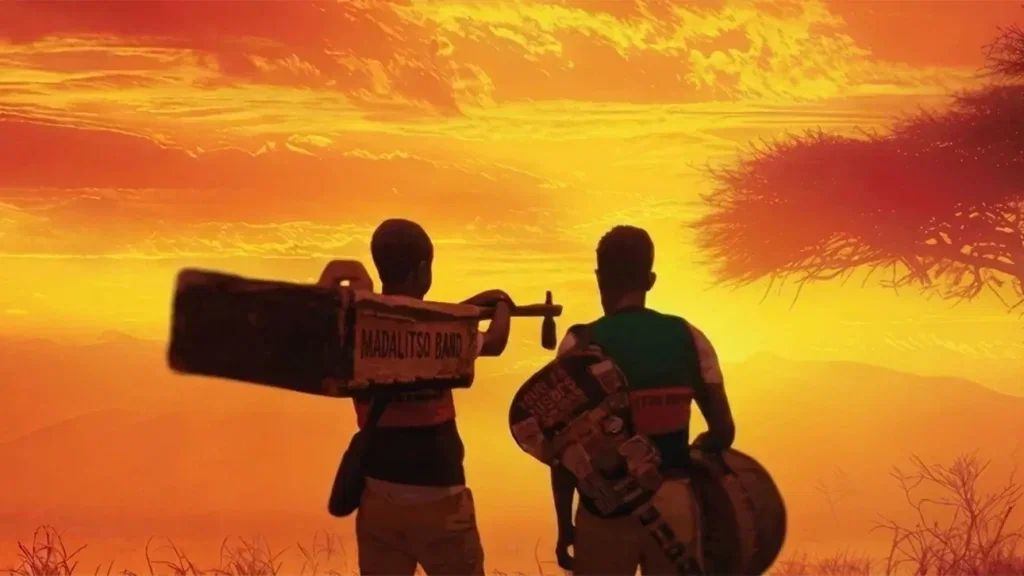
The director’s interest in the band’s story reflects a curiosity most people have when they hear the music, which is layered and infectious despite its simplicity. Kalekeni plays a four-string guitar and a foot drum, while Maligwa plays a babatone, a one-string slide bass; both instruments were made by the musicians.
“In Malawi and southern Africa, the meaning of the word banjo is just a stringed instrument,” says Johan Nayar. “These guys use truck and motorcycle cables for the strings. They insist on building their own sound. The whole essence of it is that each babatone and banjo has its own unique sound.” It should be noted that a babatone has a barrel-like shape at one end, attached to a long neck, and is about ten feet in length.
In addition to creating their own specific sound, the Madalitso Band also envision their future. As Maligwa tells it, “While walking with our instruments, new songs would come to us. We’d receive revelations from God, through songs, especially me.” He recounts having various insights, often through dreams, including seeing themselves “performing on a stage in a faraway place” and seeing “the sky above them getting bright red until a fireball appeared from the sky” that struck Maligwa, who, when he awoke, said he had attained “the gift of sight”.
These accounts proved to be challenging to convey visually. However, Johan Nayar carefully chose to use some animated sequences accompanied by Yobu Maligwa’s voiceover, allowing him to explain. “I’m more of an atheist and tried to capture those moments from their point of view,” he says. “We went into animation to describe some of that to avoid any kind of judgment.”
It turns out both Yobu Maligwa and Yosefe Kalekeni are rather religious and regimented. After performances, they do not party or drink, and they were initially critical of manager Neil’s desire to celebrate afterward. The two are also notorious for rewatching Kung Fu Panda in their room together after they finish playing a gig.
If Maligwa and Kalekeni are offended by the party atmosphere at their gigs, they don’t let on. Johan states, “When you look at the energy of the band, it is very much driven by the audience response. The band really feeds off the energy of the audience. The dancing is something that I’m sure pumps up their energy, and they will play more for those…. I don’t think there’s any conflict with the religious side of it.”
Even in the confines of a movie theater, the music is incredibly captivating. So how does this humble duo appeal to so many people? “I think if you see the band in the right setting, like Womad or Glastonbury, the music just rides up like a really good DJ set. They lure you in. A lot of people will be sitting at the beginning of the set, then you slowly reach a sort of midpoint where half the people are sitting, and by the end, almost everyone’s dancing. There is something hypnotic about the beat.”
Johan Nayar grows increasingly enthusiastic as he describes the musical pattern. “The beat is just a four-to-the-floor dance beat, which you get in a DJ set in a nightclub. As the track builds in, Yobu belts in this incredible voice. You see those drops. (I listen to a lot of dance music.) You see the tension building with a back proper tone, and then the baseline comes in with Yobu’s voice.” In tune with the music vibe, The Banjo Boys intensifies through the twists and turns of the various tours, mixed with the intimacy we share with the guys.
Riding on Faith, Passion, and Music
Having survived COVID-related cancellations in 2020, Madalitso has regained its momentum despite endless logistical glitches in the years that followed. From visa complications, to overbooked flights, to travelling with the oversized babatone, things can become exasperating. Neil recounts many of the adventures as they occur, with camerawork that is often handheld and/or his own.
On the one hand, the gig work is entertaining, though his frustration comes through. At one point, he contemplates making a change, declaring maybe it’s time to throw in the towel. Thankfully, they organized a tour in Malawi, a sort of final hurrah, traveling by car with far fewer hassles. These small, personal venues reveal the musicians’ families and hometowns.
Here, too, Neil comes to the realization that he is truly involved in something meaningful. “I travelled to Malawi with a one-way ticket, guitar, no money, and here I was saying it’s not my dream, but it was my dream to be part of something important, to be involved in music, to be doing something that’s changing the lives of people.” Maligwa weighs in, “We feel all this came from heaven. We are not greater than anyone.” At this point, Kalekeni chimes in, and together they say, “These opportunities are blessings that come from heaven.”
What helps keep The Banjoy Boys on track is Johan Nayar’s ability to truthfully depict what goes on in the lives of these three men, both on the road and back home in Malawi. All the ups and downs of life on the road and then returning to non-touring life are laid out, complete with frustration and disappointment, and showing how faith and passion help carry them forward.
The three men are bound by their dedication to music and its ability to transcend borders and barriers. It is noted at the press questioning at SeeYouSound that Johan seems to be a fourth member, a banjo boy himself. He responds, “We had a bit of a revelation at our Q&As after we had a preview of the film. It also emerged that I’m one of the banjo boys, too.”
Johan Nayar has made several short fiction films and says he is currently working on a couple of full-length screenplays that reflect his interest in thrillers. “A big influence of mine is the French New Wave, and I love improvisation.” Indeed, The Banjo Boys, though a true story, has a fictional storytelling feel in its ability to build tension as the band goes through growing pains and adjustments.
The Nayar brothers themselves once had a band called the Dharma Bums, but it dissolved due to differences. With The Banjo Boys documentary, they have reunited and collaborated on a very personal project and even wrote the soundtrack together. The siblings have enormous respect for the band members, and it comes through in Neil’s work as their manager and in his telling of their story. This is echoed in Johan Nayar’s filmmaking, which is non-invasive, allowing the musicians to display their pure talents and recount their version of the experience. Furthermore, when seeing their live performances, viewers understand the music’s raw power to unite and transform.
The Banjo Boys began its festival circuit in October 2025 with its “absolutely brilliant premiere” at the London Breeze Film Festival. The documentary has travelled to the US twice and has been screening around the UK this spring. “I’m focused on building a life for the film that goes beyond traditional release,” says Johan Nayar. “We’ll be working closely with universities, libraries, and schools on educational screenings, Q&As, and workshops, creating a long-term pathway for the film to live in academic spaces.”
He adds, “At the same time, we’re launching something more immediate and alive: The Madalitso Experience, a hybrid event bringing together the film and a live performance from the band, starting this June in London. As a team, we are keen to make real-time connections with audiences by blending these two art forms into one very special evening.” Authenticity abounds in the film, and the innovative combination of the two experiences is sure to give audiences a generous dose of humanity.