
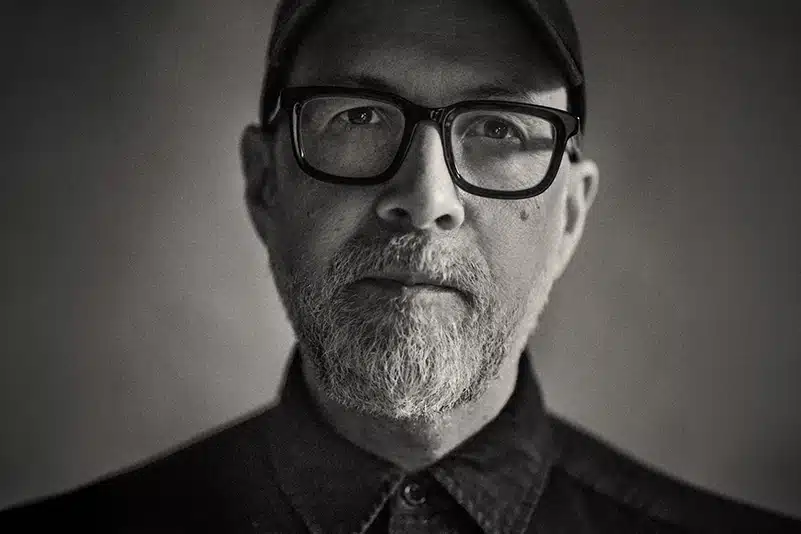

Fans of the drummer, composer, and arranger John Hollenbeck are having a great 2026. His most recent recording with the synth-sax-voice quartet George is a complex celebration of groove, texture, and audacity. Peace and Justice is Hollenbeck at his other extreme: working with the 17-piece Hot Club Jazz Orchestra (Lisbon, Portugal) on complexly interlocking arrangements that defy genre or cliché.
Hollenbeck is a writer and arranger with an extraordinary sense of pulse and color. The band here is a “traditional” jazz big band: five woodwinds, four trombones, four trumpets, and a four-piece rhythm section of guitar, keyboard, bass, and drums, sometimes supplemented by a singer. However, Hollenbeck’s charts are a world (and nearly a century) away from what most would consider “big band jazz”. Though the music on Peace and Justice uses swing and occasional improvisation, it is defined by a wider range of reference than Ellington/Basie/Thad Jones-Mel Lewis/Gil Evans even as those composers/arrangers lurk in the background.
“Sighs”, for example, begins with a staccato line of prepared piano playing in a playful 10/8 time signature, as the band groans and joins the melody and drums prattle playfully. Vocalist Rita Maria (not the Brazilian singer, Maria Rita) adds sung and harmonized “sighs” along with spoken-word scientific information about the human act of sighing, in English and Portuguese. You’d call it conceptual music if it weren’t simply so whimsical.
At the opposite end of the spectrum is Hollenbeck’s arrangement of Geri Allen’s “Feed the Fire”, which uses a swirling melody and its attendant groove as the launching point for solos that, eventually, ride over a conventional walking bass line. Still, Hollenbeck peppers the arrangement with quirky ensemble features and leads it to a stuttering restatement of the theme on piano, used as the backdrop for a wonderful tenor saxophone solo. This could never be just any band.
“In the Middle of the Yard” is also closer to convention, with a long alto saxophone melody and improvisation framed in a manner that suggests the jazz tradition. A chorale of horns reshapes the melody as the rhythm section plays with the sensitivity of a great jazz piano trio. This track is key to the album because it is one of two performances based on a Ukrainian folk song, the original inspiration for the project.
The other, “Red Shades”, is adapted from “Oh, the Red Viburnum in the Meadow”, a song by Stepan Charnetskyi that has become a symbol of Ukrainian resistance. Hollenbeck states it plaintively over a bowed bass drone, then lets the simple melody flower in a layered round of different voices and shifting key centers. As the many voices interweave, Hollenbeck reaches into his bag of tricks, swirling different pulses and repetitions to rub against each other and create a shivering, Philip Glass-ian veil, then introducing wordless vocals for a melody that leads the track to develop… what?—a harmonically shifting funk groove! To give us back the theme in a different light.
The most characteristic sounds across Peace and Justice come from the stunning counterpoints Hollenbeck mixes and matches with such melodic invention. The title track passes overflowing melodies back and forth between low brass, voice, bass, guitar, and piano. Each one seems to be the main theme or at least a variant, but the joy is in the sum of them all together. If you want to hear, in Hollenbeck’s musical methods, the idea of how a democracy could work, I don’t think he would object, especially as a track like this gathers steam and revs up to get your heart racing.
The heart races most clearly on the opening, “Sinanari”. Hollenbeck wrote it for his percussive Claudia Quintet from a Turkish song, and here it comes off as a spinning, brassy fusion song. The insistent pulse of “Racing Heart, Heart Racing” contains more of that chattering Hollenbeck counterpoint, including licks for flute, Fender Rhodes, and hand percussion that make the band sound like no other.
Peace and Justice ends with two pieces that use Hollenbeck’s compositional vocabulary with a more impressionistic hand. “Verbena” is a gauzy setting for a heart-tugging melody played by bassist Demian Cabaud. It flows into “Power of Water” (also from an earlier Hollenbeck album, Shut Up and Dance), where Cabaud is doubled by electric guitar and drums in a syncopated typewriter pattern that underpins the development of surging brass chords and a keening melody for woodwinds and voice. The track and album slowly wind down as the band’s voices trace just one of Hollenbeck’s cycling lines to silence.
The ambition of this recording is huge, but the music is never difficult or overwhelming: it is tonal and constructed with logical progression. More importantly, it is plainly the work of one imagination. John Hollenbeck’s music is as distinct to me as that of Gil Evans or Oliver Nelson; you immediately hear the colors he whips up in distinct ways. Sometimes he has 18 voices to work with, sometimes far fewer, but his signature is a prize for our ears.