

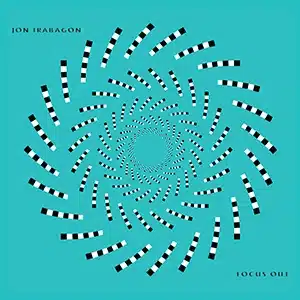

Saxophonist Jon Irabagon is the kind of modern jazz musician who makes hash of boundaries, categories, and debates about “the tradition” being at odds with the vanguard. He is a Juilliard-trained virtuoso with mastery of the jazz tradition dating back a century, and a musician who regularly runs roughshod over the so-called rules. He records electric and acoustic projects; he improvises both within and outside traditional harmonies; and he doesn’t specialize in just one or two kinds of saxophones, yet he sounds authoritative from bass sax all the way up to sopranino. More importantly, he often embodies these seeming contradictions on a single recording.
Jon Irabagon makes your head spin, but I don’t feel dizzy; I feel grateful.
Focus Out is one of two new releases on the saxophonist’s own Irabagast label (yeah, he does that too). The other is a set of duets with Dan Ostreicher, both men playing bass saxophone, Saturday’s Child. It is amazing. However, Focus Out, which features Irabagon’s dazzling quartet (Matt Mitchell on piano and Fender Rhodes electric piano, Chris Lightcap on electric bass, and Dan Weiss on drums), is my favorite album of the year so far. The band’s last recorded outing, 2022’s Rising Sun, was also something special, but the new one is more varied and more ambitious.
The leader plays alto saxophone throughout, sounding exceptionally nimble and free. The music works in several modes at the same time: it is modern small-group jazz that uses tricky compositional forms to reorient your ears; it updates the raw early fusion sound of the 1970s Miles Davis bands with powerful intensity; it invites a set of spectacular improvisers as guests to play boundless “free jazz” in a state of ecstasy; and it operates with some influence of 21st century hip-hop in creating some tracks featuring vocalist Kokayi that are fully beyond category.
The core sound of Focus Out is in the supernova connection of the quartet. The first two tracks put Mitchell’s playing on Rhodes out front, with Lightcap and Weiss creating a bed of quicksand funk beneath him. It’s a cousin of the jungle funk that Davis played with the likes of Corea, Henderson/Holland, DeJohnette/Foster, and company in the 1970s. Still, it is leavened by the precise MBASE sound from a later generation.
“Morning Star” is three concise minutes on a roller coaster, with Irabagon’s alto and Mitchell’s right hand locked in unison lines, interspersed with improvised lines that shiver with energy and connect to the rhythm section at the root level. When the last unison line ends in perfect coordination at 2:56, the reaction will be Wooooo!
Then “Focus Out” starts with a more James Brown/Sly Stone kind of groove, stuttering with an extra-long bar in an irregular form. Mitchell sprays those diffuse Rhodes chords, with just enough tasty dissonance, in every direction, improvises in two-handed counterpoint, and then Irabagon plays the written blues theme on top. Sure, you’d be happy to hear this for the whole track, but two-and-a-half minutes in, Lightcap starts walking at hypersonic speed, with Weiss following him on the ride cymbal.
Irabagon follows in double-time before they all shift in a straight-time swing with Mitchell sliding over to acoustic piano. Time keeps morphing under an Irabagon solo that you have to hear to believe: he uses an elastic phrasing that makes it sound like parts of his playing are a tape run backwards, only to glide just as easily into blues playing that could be from a gut-bucket 1950s record. It’s gobsmacking fun.
If the entirety of Focus Out was this quartet playing with this level of creativity and freedom, it would be one of the year’s greatest jazz astonishments. There is a bonus track, “Center Post”, that presents the quartet playing a relatively straight-ahead post-bop composition with Mitchell shining on acoustic piano and long stretches of driving swing.
Jon Irabagon widens the focus of the band on three succeeding tracks, bringing in two tenor saxophone virtuosos in Mark Shim and Donny McCaslin, trumpet wizard Dave Ballou, and Miles Okazaki on guitar. These four sympathetic and daring improvisers turn the track “Evening Star” into a moody bit of jazz-rock New Orleans jazz — Lightcap, Weiss, and Mitchell are in that “Miles Runs the Voodoo Down” mode as the horns and guitar weave through dense collective improvisation in which individual players rise and fall and written licks — fast and precise and impossible to miss — surge to the surface.
It is a fantasia of freedom, but every 60 seconds or so, the group plays together with so much precision that you realize the jungle vibe is in serious control. Each pair of open ears will find its favorite section. Still, I can’t resist Okazaki’s guitar and Mitchell’s piano working together before the horns enter again in climactic freedom, only to have that written theme come together one last time.
The album’s other guest is the vocalist Kokayi. In “Paper Planes”, he casually and genially raps over a happy theme expressed by all four horns in loose joy. Soon enough, he is free-styling, and so are the horns in a barroom conversation that should inebriate just about anyone in the mood for some intoxication. “Indigo Stains” brings him back with a post-modern art song, featuring carefully composed sections, swirling horns, a hooky verse that might bring to mind Bob Dorough singing with Miles Davis, and then effects-rich percussion that cracks the performance open into a blend of chamber music and a groove for rapping.
If you are a listener who yearns for even more variety, Jon Irabagon is there to provide something at the other end of madness. He and Matt Mitchell perform a lovely acoustic duet, “Prayer (for Reomi)”. This ballad is no less original and astonishing than the wildest part of Focus Out. Each harmonic shift is fresh, and Mitchell’s solo is a reminder that he can take a beautiful structure and find its most gripping internal movements. Then Irabagon returns, playing his alto as if he were trying to conjure the memory of Johnny Hodges.
Jon Irabagon juxtaposes these musical styles purposefully. He is a modern jazz player whose influences and vocabulary are historically wide. Not every album he makes is this broad — recent projects have included solo saxophone music recorded outdoors and a purely acoustic band that he calls Plainspeak. Irabagon knows the value of focus, but his aesthetic also finds value and power in lowering the walls between genres and conventions. As a saxophonist, he can use the so-called advanced techniques of classical new music, but he also has the technique to channel Ben Webster. Why not let both inclinations inform a single piece of music?
As a composer and bandleader, Jon Irabagon wants to open your ears to styles co-mingling. If Sinners was both an indie film about blues music in 1930s Clarksdale, Mississippi, and a vampire movie, then Focus Out can also be many things at once. Irabagon’s heart as a musician is big enough to feel and do it all.