
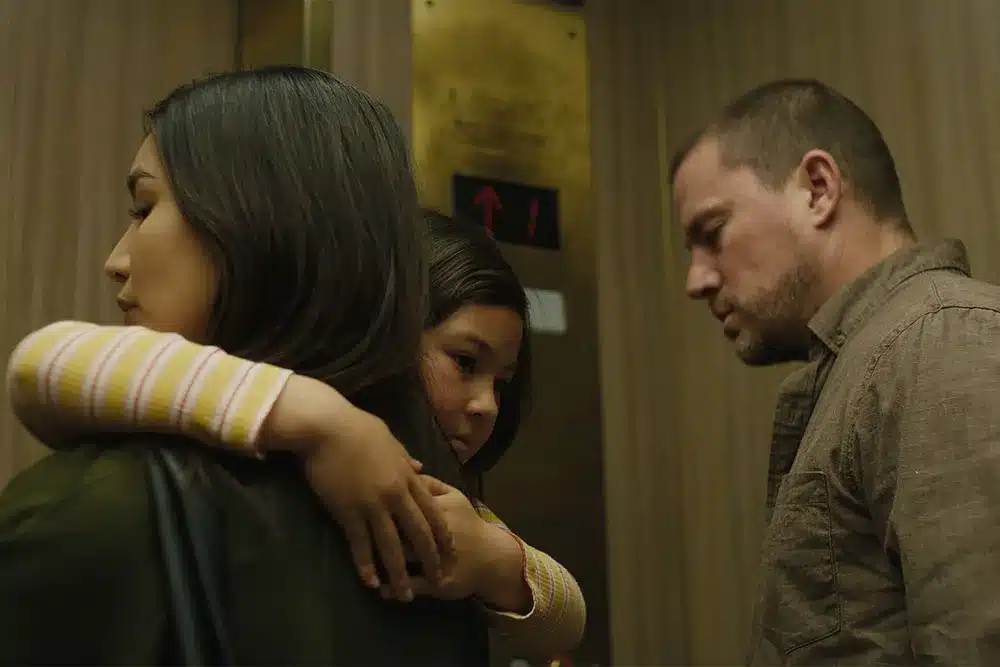
As critics, we’re prone to using words like “important” and “powerful” too liberally. While the former might over-hype Beth de Araújo’s sophomore feature Josephine, the impact of its storytelling and craft is immediate. By Josephine’s end, you will need to take a deep breath. It is afterward, however, that this crime drama really gets under your skin and leaves you feeling emotionally and intellectually pummeled.
The story revolves around its eight-year-old titular character, played by Mason Reeves, who develops behavioral issues after witnessing a horrific crime in San Francisco’s Golden Gate Park. Her parents, Claire (Gemma Chan) and Damien (Channing Tatum), struggle to console and guide their daughter through her trauma. As the only eyewitness to the crime, the hopes of a successful prosecution rest with the young Josephine.
Beth de Araújo has crafted a film that first and foremost doesn’t need to be reckoned with, so much as sat with. Before we can begin to reckon with the disturbing subject matter, we must first digest the narrative that becomes lost in the emotional and psychological reeds of exceptional circumstances.
Josephine doesn’t concern itself with neat dramatic arcs. Instead, Araújo is willing to explore characters lost in an ordeal that redefines a period of their lives. At times, it can feel as if either the characters or time itself is standing still. Josephine is a film about characters who have to feel their way through a situation while accepting that they are trying to find their way in the dark.
The director’s focus remains on how everything in her story is rooted in the psychological and emotional fallout of a girl witnessing something she can neither process nor talk about. The story is also about parents struggling to regain the power to protect, nurture, and communicate with their daughter. Josephine speaks about the delicacy of the mind and the fragility of innocence. Look closely enough, and from the opening scenes, there’s an absence of emotional intelligence.
Damien tells Jo (Josephine), “Being scared does you no good at all. Come on, take that thought and throw it in the trash, okay? Scared doesn’t live here.” This is the first example of many black-and-white approaches to trauma. Furthermore, the way the police safeguard Jo should compel stunned gasps from viewers. Beth de Araújo explores how, as adults, we are at our worst, reckless. We search for and cling to simplified ideas to help us survive the complexities of life, and we pass these processing methods from one generation to the next.
Indeed, there’s a Freudian-esque quality to some of Damien and Gemma’s advice, which finds comfort in repression rather than confrontation. For example, the idea of fixing one’s own problems, including those painful emotional wounds. It echoes the traditional British colloquial expression of “pulling up your breeches”, or, get on with it without complaining.
The director is attentive to striking a balance between confusion and coping by juxtaposing despair and hope, darkness and light. Araújo is challenging her audience to consider whether our memory simplifies Josephine‘s story by focusing on its darker, harrowing aspects and forgetting its gentler elements.
While it’s only natural to be overwhelmed by the violence of the story, the relationship between Claire and Damien shows warmth, deep respect, and appreciation for one another. It is a profound observation about how two people can empower one another through love and kindness. For example, Damien tells Jo that he’s a better man, thanks to her mother. There’s also a tender moment when her mother tells Jo that she wants her to be able to confide in her in a way that she couldn’t with her own mother.
It would be unfortunate to allow the violence to swallow one’s experience of the film whole, but it may be Josephine‘s destiny to be defined by its dark subject, an event trapped in a moment in time, which clouds the mind and blinds our nuanced gaze. The film demands to be appreciated not only for its story and its challenge to the audience, but also for its craft.
Technically, it is superbly put together from the start. Greta Zozula’s cinematography is not only a stylistic choice but also imbued with a physiological presence, interacting with the physical exertion, panic, tension, and adrenaline rush of the opening scenes. The handheld camera mimics a person breathing, syncing with Damien and Jo’s early morning exercise and football practice before they’re separated, and Jo stumbles upon the assault.
The way Araújo and Zozula play with distance is also striking, moving from the up-close warmth of a father-daughter bond to the cold distance from which Jo witnesses the assault. The choice of framing in these early scenes conveys the transition from warmth to a cold, violent malice. How Araújo and Zozula frame Josephine’s interactions with the police and the victim roots the story in this eight-year-old and her trauma. This creates a bond between Jo and the audience, who are forced into the child’s personal space, present and up close, as she witnesses the traumatising event and is carelessly cared for in its aftermath.
Every frame, every shot is given methodical consideration by Beth de Araújo, Zozula, and the editors, Kyle Reiter, Nico Leunen, and Anisha Acharya. Music is not used to persuade the audience into feeling a certain way. Instead, the film emphasizes natural sounds, such as a dog barking and other urban noises, which, in one scene, trigger Josephine. Rather, music is used sparingly and to good effect by allowing Jo’s audiovisual world to breathe. By omitting non-diegetic sound, Araújo and composer Miles Ross allow the audience to connect with Jo more deeply and continually create space for them to enter the film and Jo’s world.
Throughout Josephine, it rarely feels like anything is guided by an arcane conservatism. Instead, Araújo and her team create the impression that Josephine has been painstakingly handcrafted. A better descriptor for this film than important is “necessary”.
Based on her own experience of witnessing a sexual assault when she was eight-years-old, Araújo has confirmed some scenes are autobiographical. It’s therefore not surprising that Josephine feels so genuinely raw in its depiction of the subject matter, which one must regard as a brave therapeutic exercise.
Josephine is also a reminder of the importance of a creative space for women to talk about their experiences of violence and trauma on their own terms. It’s here that “important” becomes an honest and necessary descriptor, despite initial reservations.
For the audience, Josephine’s overwhelming strength may lie in the fact that we cannot always articulate an understanding of the narrative’s events, nor can the characters. Instead, it’s a film we have to feel our way through, and accept that sometimes we can only try to find our way in the dark. That’s why one is left feeling emotionally and intellectually pummelled by Josephine, because it honours the confusion one endures in these types of experiences.
Josephine premiered at the 2026 Sundance Film Festival in the U.S. Dramatic Competition, where it won the Jury Prize. It also won the Audience Award. Josephine screens in the main competition of the 2026 Berlin International Film Festival.