
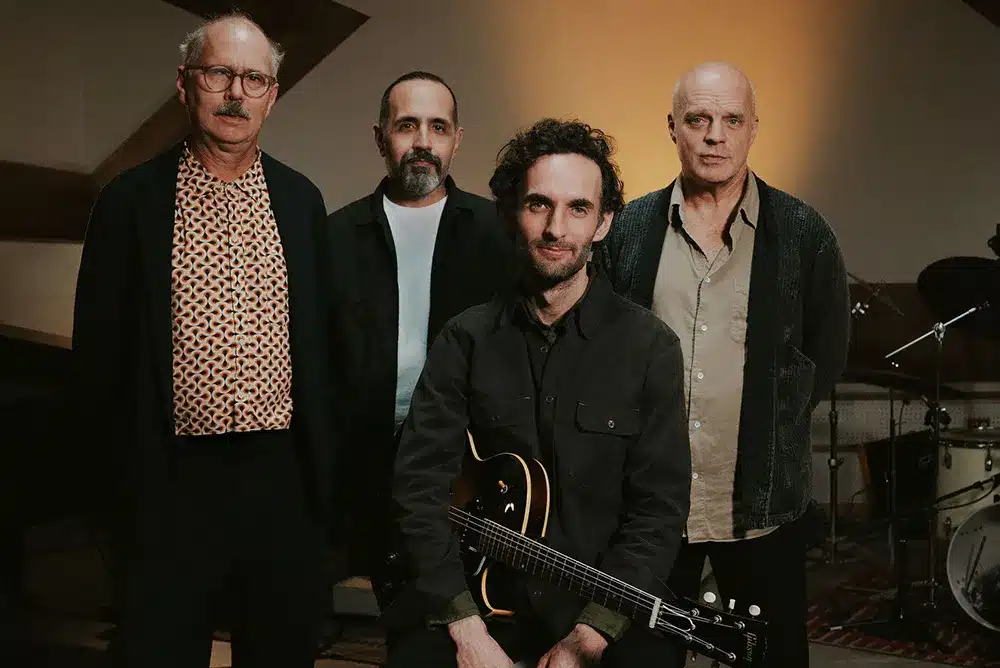

Julian Lage, 38 years old, is part of the generation of jazz guitarists who follow the block of Pat Metheny, John Scofield, and Bill Frisell and have absorbed the way that mainstream jazz (learned in school) and modern popular music (rock, indie or otherwise; soul; funk; hip-hop) can work together seamlessly.
The guitar is, of course, the perfect vehicle for finding a place where music from 1935 to 2025 comes together. Once upon a time, there was Charlie Christian who begat Les Paul who begat Chuck Berry and so forth — to the point that players like Sonny Sharrock, Vernon Reid, and Nels Cline can hardly be said to belong to any one genre of music. While Lage‘s career is certainly one in the jazz lane, his aesthetic as a 21st-century musician owes as much to, say, the Band as it does to George Benson or Pat Martino.
Scenes From Above is a lovely and clear example of that sound. This new album — his fifth for Blue Note and his second in a row produced by Joe Henry — features nine Lage originals played by a balanced quartet. Bassist Jorge Roeder has been a fixture in Lage’s bands for years, and drummer Kenny Wolleson has played with Lage as well as a vast cross-section of music from Ricki Lee Jones and Tom Waits to John Zorn and Sex Mob.
The new element in the band is keyboard wizard John Medeski. This recording, along with the 2025 gigs preceding its release, marks the first collaboration between Medeski and Julian Lage. Medeski’s presence colors almost all the tracks here, and the ensemble’s musical conversation is focused and warm. Medeski, of course, is also a member of Medeski Martin & Wood, the instrumental ensemble that has avoided being pigeon-holed just as a jazz group for more than three decades. With Medeski as a key member, the music on Scenes From Above is that much more likely to take on shades of Americana and groove, and it works.
Medeski is mostly heard on his Hammond B3 organ in a delicious combination with Lage’s clean electric guitar. “Talking Drum” is a tasty example, dishing up a stop-start boogaloo over which the two share the hip theme, with a harmonic wandering bridge that makes the tune feel optimistic and warm. Medeski offers both stadium-ready organ swells and percussive punches with his left hand, while Lage delivers the legato melody and the slapping percussive accompaniment. Medeski solos first, both creamy in tone and distorted as he pushes his instrument through its Leslie speaker cabinet. Lage makes unexpected melodic choices in his solo: puckish and sly, and each chorus (including the last, after the melody returns) ends with a dramatic set of descending chords. Wow.
The same basic sonic ingredients can be used in utterly different ways. The opening tune, “Opal”, combines B3 and that clear electric guitar on a melancholy tune that puts plenty of church into a minor mode. There aren’t really “solos” or any kind of jam, just the haunting tune with interludes of atmosphere that say it all.
“Red Elm” puts Roeder’s acoustic bass in front, strummed, followed by 4/4 swing that puts electric guitar and organ in conversation, leading to breezy swing from Wolleson. “Solid Air” is an atmospheric ballad that alternates between airy arpeggio washes and a conversational melody begging for a lyric about a love just out of reach. Again, the musicians — at least here on the album — don’t take the form out for rounds of solos.
Those tunes where these fearsome and creative improvisers don’t actually take solos add to the feeling that Scenes from Above is not quite a “jazz” album. I can’t help but think of the lineage of soulful rock music that is associated with the Hudson Valley (that is, for those not from the New York City area, the rural areas in close “upstate New York” along the river near famed Woodstock) — the music of Bob Dylan and the Band, music that Medeski touched on in the album Hudson that he made in 2017 with John Scofield, Larry Grenadier, and Jack DeJohnette, all then residents of the area.
Grounded in blues, country, and folk, this is the music that Greil Marcus famously described as being derived from “the old, weird America” and documented in the legendary 1952 compilation album Anthology of American Folk Music. The chord sequences are less likely to sound like the Tin Pan Alley “ii-V-I” sequences of Richard Rodgers and more likely to be direct and unexpected.
Which isn’t to say that Scenes is a rock, folk, or alt-country record, but these jazz musicians have stylistic range and mix up this other hybrid style with their own hybrid magic. It is “jazz” not because it is instrumental but because the vocabulary of tradition is integrated in small ways with other musical languages.
Several songs lean toward this Music From Big Pink or Basement Tapes sound simply by using acoustic guitar and organ together in a certain way. “Ocala” has a rhythm and melodic shape that lean toward a tango, but the texture of Julian Lage’s acoustic and Medeski’s theatrical-sounding organ takes you back in time. Here and on most other tracks, the organ doesn’t try to emulate the jazz icons like Jimmy Smith or Larry Young but conjures other worlds.
“Havens” starts with Wolleson and Roeder grooving in a delicious double time, and then Lage’s acoustic guitar is content to play just a rhythmic role, putting an organ melody in the center. The band cook up the groove so the acoustic guitar gets a chance to burn in a solo as hot as any Telecaster.
There are also two tracks on which Medeski plays some acoustic piano. “Storyville” is a dramatic travelogue, with solos for Roeder and Medeski that are as out there as anything on the album. Medeski mixes his piano and organ in his feature moment, the two keyboards swarming over each other in thrilling dissonance.
Then “Something More” closes the album with a heart-tugging mid-tempo track. Medeski lays down chords that would work well on a, say, a Bonnie Raitt song. The rhythm section provides a soulful backbeat, and Lage plays with simplicity to keep it all centered and clear. The song allows for a small bit of three-over-four polyrhythm at the end of the form, like a reminder that these musicians know that a bit of spice works in a simple but truly delicious dish.
Scenes From Above is a comforting album, one that fills you up with warm sensation from the inside. Julian Lage has a guitar sound that radiates, even though it is clean — it’s in the way he conversationally phrases his lines, from the center of all this great American music, like a singer who isn’t trying to impress you but to tell his story. The rhythm section pulses like different kinds of heartbeats. John Medeski, the album’s ideal wildcard, colors each Lage composition to perfection. For all its ease of listening, this album isn’t comfort food as much as a really balanced meal.