
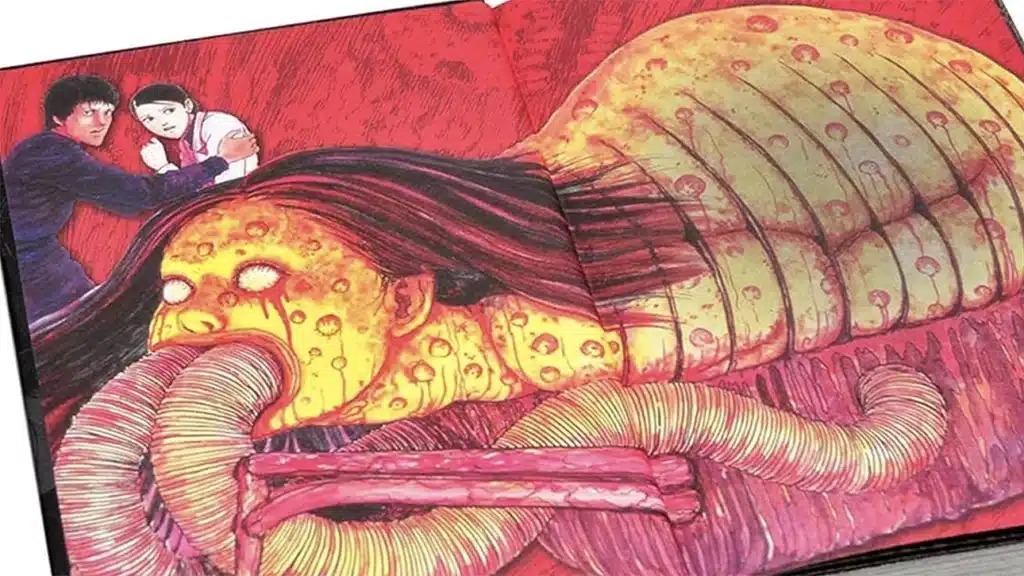

There is a particular kind of horror that emerges not from the monsters we see but from the slow, creeping transformation of the human body into something unfamiliar, repulsive, and yet still alive. In Gyo, Junji Ito’s 2001 manga, the human form is not simply destroyed, it is entered, repurposed, and humiliated.
Though often discussed as one of Ito’s more grotesque or absurd works — famous for its walking fish and circus of the infected — Gyo is perhaps best understood as a profound and disturbing entry in the tradition of body horror. It is a narrative not merely about invasion but about violation: the kind that occurs from the inside out, biologically and sexually, as mechanical parasites turn flesh into fuel. The result is not just transformation, but desecration; a perverse reengineering of the human form. Like Philip Kaufman’s Invasion of the Body Snatchers (1978), John Carpenter’s The Thing (1982), or Ridley Scott’s Alien (1979), Junji Ito’s Gyo reveals the horror of a body that no longer belongs to its owner.
The central premise of Gyo is deceptively surreal: fish have grown mechanical legs and begun invading the Japanese mainland. At first glance, it suggests the absurd; a shark with legs, the grotesque rendered comic. This absurdity, however, masks a much deeper threat. These creatures are not natural mutations; they are the result of a military experiment gone awry, in which a biomechanical parasite — fueled by putrefaction — animates the dead. The creatures that emerge from the sea are corpses, propelled by gas and metal, sustained by human remains.
These fish are not malicious; they simply operate, dragging behind them a stench so vile it becomes its own form of contagion: the “death stench”. This miasma — omnipresent, penetrating, foul — prefigures the biological corruption that will follow. It is not just a sign of death, but a marker of transformation. To smell it is to become part of it. Ito’s creatures do not roar or shriek. They hiss, leak, inflate and enter the body.
Junji Ito’s Body Horror: Mechanized Violation within a Tradition of Transformation

What makes Gyo so uniquely disturbing is its focus on the bodily entry points; the orifices that define the limits between inside and outside. Mouths, anuses, and vaginas are not symbolic in this story. They are literal gateways to biological invasion. Once the parasite — a biomechanical machine with insect-like tubing — penetrates the host, it forcibly injects gas, expanding the body from within. Skin stretches. Bowels fill. The person is not killed, but kept alive in a state of grotesque puppetry, their body used as a walking gas sac to power the very thing enslaving it.
Ito’s visual style is precise and anatomical. The parasite enters the body like an industrial syringe. The suggestion is not just horror, but sexual horror: rape as mechanical function, violation as infrastructure. Kaori’s transformation — the girlfriend of the protagonist and one of the first human victims — is particularly disturbing in this light. She is not merely infected. She is entered, inflated, and turned into a spectacle. Everything happens from within, as if her body has been colonized by a system she can’t fight.
The effect is chilling. Gyo is Invasion of the Body Snatchers without metaphor. The horror isn’t what’s happening to society. It’s what’s happening inside your own intestines.
Perhaps the most perverse and thematically rich segment of Gyo occurs in the circus, a bizarre, carnivalesque detour in which the infected are paraded as freakish entertainment. Here, the overtaken human bodies are not killed but made to perform, their gas expulsion and bodily distortions used for grotesque slapstick.
This comedy is weaponized. It isn’t for catharsis; it’s a show built on shame. The bloated, violated forms of these victims are trotted out, laughed at, dehumanized again and again. This is a circus of forced exhibitionism.
We might read this as Junji Ito’s commentary on the spectacle of the grotesque in horror media. Much as films exploit bodies for shock, the circus in Gyo turns the infected into unwilling performers. Their degradation is not hidden; it is illuminated, costumed, choreographed. Unlike traditional zombies, these creatures do not rebel. They do not moan. They simply perform until their gas runs out.
This draws a line to Shinya Tsukamoto’s 1989 sci-fi horror, Tetsuo: The Iron Man, where metal overtakes flesh and the body becomes a violent, sexualized machine. In Gyo, however, the mechanization is not rebellion. It is compliance. You will be taken, you will be inflated and then you will dance.
In its final chapters, Gyo offers no rescue, no explosion, no chosen one. The parasite continues to spread, now airborne, and even the ocean no longer offers escape. Tadashi, the protagonist, ends up adrift, surrounded by death, the stench clinging to his skin. The horror here is entropy. The body doesn’t die; it keeps moving, animated by gas and shame, until it falls apart.
Like The Thing, the horror is not assimilation but function: what the body does after it’s no longer yours. In Gyo, the soul is not lost; it is ignored. The body becomes a vessel, and the mind is discarded.
Though Gyo is a silent manga, its pages are saturated with sound. Junji Ito constructs an auditory landscape using visual rhythm, onomatopoeia, and panel pacing. The parasites hiss, wheeze, inflate, and burst. The bodies they inhabit squeal, groan, and expel. A single panel might show a swelling abdomen with a tiny pshhhh trailing from a wound. These effects are deployed sparingly, amplifying their realism and the disgust they invoke.
Just as crucial is how Junji Ito frames the infected. He doesn’t obscure them in shadow or action. He often depicts them head-on, lit like a specimen in a medical textbook or a crime scene. This bluntness reinforces the violation. We are made to confront what has happened. There is no symbolic haze, no supernatural filter. Just the human body, mechanized, exposed.
It’s in this pairing — clinical framing and grotesque sound — that Gyo becomes overwhelming. The horror is not just what these creatures do, but how undeniably real they are on the page. There is no escape through metaphor. The body’s betrayal is loud, clear, and humiliating.
An anime version of Gyo, directed by Caspar Seale Jones and produced by Ufotable, was released in 2012. While it follows the manga’s plot, the mood is strikingly different. Much of the oppressive, invasive atmosphere of the source material — that sense of creeping, suffocating violation — is replaced with a more chaotic, almost campy tone.
This is a common pitfall with Junji Ito adaptations: the events and imagery may be faithfully reproduced, but the intangible dread, the deliberate pacing, and the suffocating mood often dissipate in translation from page to screen. Gyo’s anime is a case study in how horror’s impact can hinge less on what happens and more on how it feels.
While many of Ito’s stories explore bodily transformation and loss of autonomy, Gyo uniquely frames this violation as an internal desecration’ an erotic and biological invasion that fuses flesh and metal into a living, humiliating prison. Compared to The Enigma of Amigara Fault (which is included in Gyo as a standalone story), where bodies contort and stretch in an eerie, inevitable surrender to mysterious forces, Gyo’s horror is not fated but forced, a calculated colonization of orifices and organs.
Similarly, Junji It’s Uzumaki series tells of a spiral curse that mutates bodies through obsession-driven metamorphosis; slow, organic, and psychologically entangled. Gyo’s transformation, however, is mechanical, violent, and relentlessly invasive. “The Hanging Balloons”, a chapter in Horror World of Junji Ito, externalizes bodily horror into surreal, airborne predation on identity, a haunting spectacle of faces turned against their owners, contrasting Gyo’s internalized puppetry. Across these works, Ito dissects the fragility of bodily integrity and selfhood, but Gyo’s parasitic machine is uniquely terrifying in its explicit fusion of sexual violation, bodily inflation, and dehumanization.
Gyo may be remembered for its absurd imagery — a shark with legs, putrid acrobatics — but these are surface details. Beneath them lies a tightly wound study of sexual horror, parasitism, and the dissolution of bodily autonomy. Junji Ito offers no villain, no savior, no solution. Just a sustained meditation on what happens when the body becomes alien, exploited, and grotesquely reprogrammed. It is not a story of death. It is a story of prolonged, humiliating survival.