
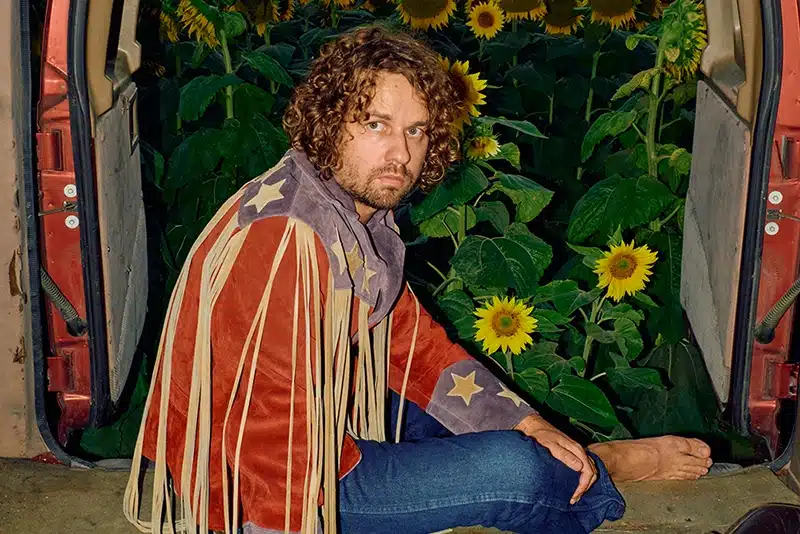
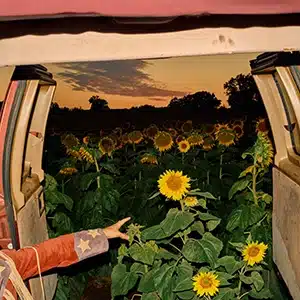
Kevin Morby’s Little Wide Open serves as the final instalment of what was conceived as a trilogy, with Sundowner (2020) and This Is a Photograph (2022) documenting specific aspects of his return to Kansas City. The record is penned as a love letter to the Midwest, but it also celebrates the great expanse of middle America in subtler ways. Morby‘s eighth studio album comes across as his most direct, understated, and poetic work to date. Ultimately, Little Wide Open is a masterpiece of simple and, at times, epic proportions that will linger deep within one’s soul.
“Badlands” is a relatively straightforward opening statement. It begins with the clicking sounds of horse clops and guitar lines that accompany the lyrics full of imagery reflecting the landscape: sparks from a firecracker, a dog barking in the dark, wild fields of lavender. The Midwest is depicted as a place where one might go to get some rest, but don’t let the simplicity deceive you. The tornado siren lies in wait, ready to harmonise with the world around it (brought to life through Justin Vernon’s vocals).
Since Kevin Morby longed to be a musician in the big world, it took some time for him to appreciate the sites of his upbringing fully. In a recent interview with Pitchfork, he said, “Not having all the access to culture, it can create in a certain Midwesterner this lust for life. It only took time to realize the beauty within the Midwest itself.” If previous records focused on specific aspects of Morby’s experience after returning to Kansas City, this one expands beyond the confines of his environment to the greater mythology that hangs over the heartland.
There is such a diversity across the flyover states that it’s hard to settle upon a definition, only that the Midwest has a way of getting under one’s skin. In the essay “Field Guide to the North American Troubadour” by Rachel Kushner, Morby shares, “Kansas City is not the badlands, but it’s my badlands. It’s not the bible belt, but it’s my bible belt.” The region can be hard to pin down, but it’s all-encompassing. In “All Sinners”, he references Idaho, Oklahoma, and Ohio, places distant from each other geographically and varied culturally. Perhaps, that’s why here and elsewhere he falls back on the metaphor of heaven—it’s a place on earth.
None of these pronouncements (even the Belinda Carlisle allusion) is made tongue-in-cheek. There is too much at stake to flirt with levity. Take “Die Young”, which acknowledges a blood brother—his late best friend, the musician Jamie Ewing—followed by descriptions of life-altering experiences, with the simple yet powerful sentiment “thank God that we didn’t die young.” Morby ruminates on the past but isn’t weighed down by it. He has discovered freedom through a newfound understanding of life and death, best encapsulated in the lyrics: “And if time plays tiny violins, then we play symphonies through the centuries / And if time is a violent driver, then we ride passenger.”
Morby’s lyricism distinguishes Little Wide Open from his other works. The track “100,000” paints a picture of individuals standing in for the masses and vice versa. Lives feel significant despite their ephemeral nature. Tangible illustrations of pretty girls (“You’re gonna swan dive when you kiss her / You’re gonna write poetry, babe, when you miss her”) and ugly boys (“Muscle cars in the front yard, / Master of Puppets, and kill ’em all”) stand in contrast to the sheer number of people, dead bodies, and highways crisscrossing the plains.
Within the album, language connects and motifs surface, whether they are symbols found in nature (butterflies and fireflies) or the setting itself (riding passenger, cowtown, and bible belt). Accordingly, each song comes to represent an essential part of the unified whole.
Sonically, Little Wide Open feels both lo-fi and epic. The drums can sound enclosed (“Bible Belt”), the soundbites unexpected (“Javelin”), and the music self-referential (“Cowtown”). Still, the decisions were all intentional, thanks to Aaron Dessner’s production and complementary playing (which consistently proves why he’s one of the best producers in the business).
Morby cited Tom Petty‘s “Square One” (from Highway Companion, 2006) as an influence. In the article, he noted that he had a revelation upon discovering the quiet beauty in Petty’s catalogue. While the second half of the record is more understated, the musicians showcase sophisticated guitar parts, as on “Natural Disaster”, and moments of pure intensity, like the end of “100,000”.
As Morby now splits his time between Los Angeles and Overland Park, the record may be a culminating moment for him personally, but it eclipses anything he’s done as a musician. The eight-minute title track sounds less like an opus and more like a meandering reflection; still, every second feels essential. Kevin Morby describes feeling overcome in the wide-open space. When the beauty gets to be too much, there’s a very real possibility that one’s heart might explode.
Listening to the opening track sequence (from “Badlands” through “Javelin”), one might have the same reaction—that rare sensation when one has witnessed too much splendor. If that is your experience, Little Wide Open will have left a lasting impression, a perfect rendering of heaven on earth.