
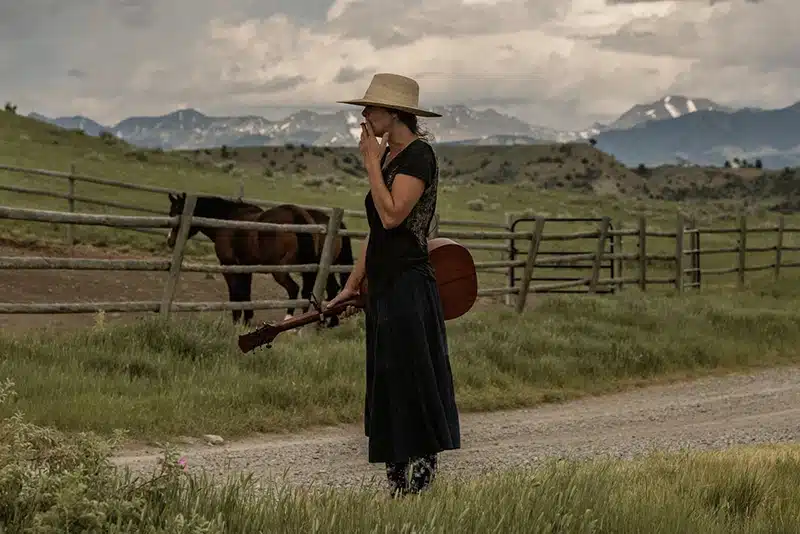

Kiki Cavazos’ songs are made of dust. Anyone with half an ear will hear an earthy voice that makes you feel as if Cavazos has kicked dirt into your face and shown you a country you never knew or wished existed, which is to say she is like a 1930s troubadour with her eyes fixed on a dusty road, where a spiritual truth is hard-earned and where hope often feels only to be found in the last town you’ve left. Born in Montana, Cavazos ran away at 16 to Alaska before heading south to Mexico. Yet this has nothing to do with how she sings of a fate wherein facts have no face and pathos is all there is.
We’re believing Cavazos’ role as a troubadour due to her performance—not her story. Granted, Cavazos has traveled the country like a Guthrie protégé and thus is “authentic”. Yet authenticity is not verisimilitude; this is to say Ramblin’ Jack Elliott, a middle-class New Yorker born to Lithuanian Jewish parents, who made you fall for his cowpoke drawl and accoutrements. Put differently, it is through Cavazos’ performances that her past is illuminated.
Therefore, the biography of the artist would fall apart without conviction—in fact, what makes Cavazos interesting is the opposite: absence. These terse and straightforward stories tell themselves, as if the narratives could exist without their author, as if they were lying on a dirt road and all Cavazos had done was scoop them up. Yes, Cavazos could be singing from the first half of the 20th century, or, for that matter, the one before and the one before that. Thus, time seems irrelevant to Cavazos, who pushes it aside to make her own place in history from where her tale can be heard.
On her debut album, Goodbye Blues, Kiki Cavazos deploys the American landscape to measure the narrator’s life against: where she has been and where she is heading, or, more accurately, who she was and is. Yet these elusive markers can only reveal the miles between, not the truth, and what Cavazos wants is the truth. Or at least a truth that will lead her to love, to have something to hold onto, to remind her of the part of herself she thought had died when she chose the road over love.
The opener, “Goodbye the Crazies”, doesn’t need words to tell its melancholic tale; it is right there in the rough-hewn fingerpicking, bolstered by a tremolo-inflected guitar and a double bass. Lyrically, though, Cavazos, with a Proustian-esque flashback, reminisces about meeting other traveling kids at the Crazy Mountains in Montana, set off by a visit in the present day, not to mention a sly reference to Bob Dylan as in the lyric, “if you’ve nothing, you’ve nothing to lose.”
In “Black Eyed Man”, her sonorous voice leads the song, as if it has no choice but to follow, to submit, to yield. With regret and ambivalence, the narrator reflects on letting go of a relationship. “Hawthorne and Heartache” works as a summation of the record: the protagonist is regrettably alone after spurning her lover. In “Little Old Dusty Road”, the highlight of the album, you hear the singer working through memories; those slow days when time stands still, and all there is are yesteryears.
Beneath its hard exterior, Kiki Cavazos’ voice has a sensitivity worthy of Skip James; equally, she can draw blood with a Karen Dalton-esque brute-force sigh, as if taking a bite out of heartbreak and spitting it back into your face. Big Thief (who she has opened for) said, “We believe Kiki Cavazos is one of the greatest songwriters of all time. Both mystical and salt of the earth. The best of the best.”
With a jaunty double bass and a Johnny Cash “boom-chicka” rhythm, the tragicomic “Pedestal” echoes John Prine; it is playful and fun, including Cavazos’ not-so-much-subtle country twang. Importantly, it endows the record with a moment of levity.
The sprightly-strummed “Cold Mountain Blue” is another track about lost love, while “Grey Ghost Train” could be Lucinda Williams: a plain-spoken directness that lands like a punch. Although the album title indicates a valediction to the blues—much of it caused by love—the narrator of the last track, “Two Bit Two”, plaintively sings, “but there ain’t no paved road is gonna bring me home”, which does not suggest a sanguine ending.
Kiki Cavazos is neither an archetype nor a floating referent; her songs are as real as the snow on the ground in Montana—in other words, they are ephemeral yet elemental, as if you can feel the cold on the breath of the singer, who seems weary that she could crumble into dust. For certain, she is different with her cut-to-the-marrow voice and unadorned fingerpicking, which makes you fall for a sound as much as an idea. In any case, Goodbye Blues suggests you can get used to anything; thus, the narrator returns to the road, a home to itinerants in many ways. Sometimes, though, home is not where you want to be.