
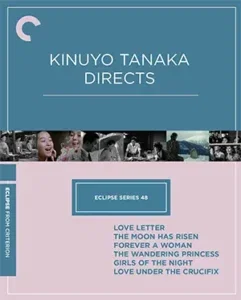
How many Japanese women have directed films? Wikipedia’s page on the topic lists 51. How many can you name? From now on, the world’s film buffs should at least be familiar with Kinuyo Tanaka, because all six of her films have been restored and presented in Kinuyo Tanaka Directs, the 48th volume in Criterion’s Eclipse series of “lost, forgotten, or overshadowed classics”.
Fans of Japanese cinema should already be familiar with Tanaka, as it may be impossible to overstate her importance as one of Japan’s most famous and beloved stars. She was a favorite actress of Kenji Mizoguchi and worked with other major filmmakers as well. When she began directing, some of the esteemed directors she’d worked with contributed scripts for her projects.
The six films she directed over a ten-year period from 1953 to 1962 make her Japan’s second woman director after trailblazer Tazuko Sakane. Kinuyo Tanaka consistently focuses on the position of women in the country’s evolving postwar society. Let’s take a closer look at the titles in Kinuyo Tanaka Directs.
Love Letter (Koibumi, 1953)
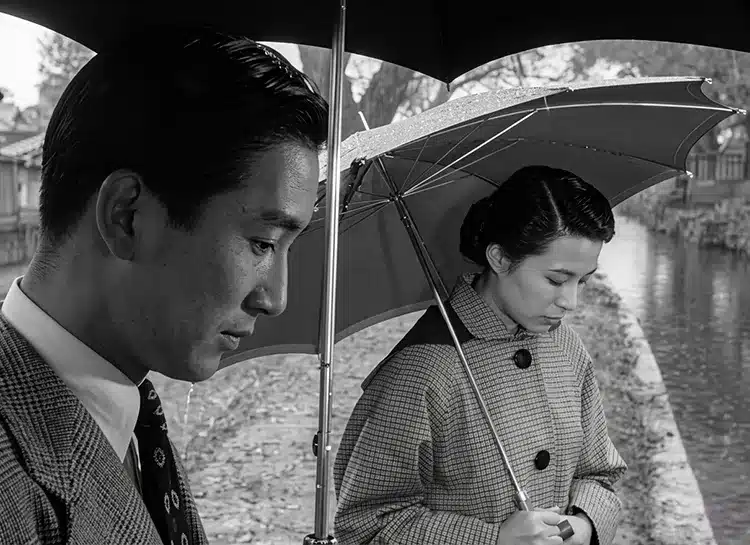
Love Letter, which played at the Cannes Film Festival, initially seems to be the story of two brothers who share a small apartment. First, we meet the carefree go-getter Hiroshi (Juzo Dosan). He’s introduced, emerging from a taxi carrying his flashy, westernized girlfriend, who turns out to be unimportant to the plot. As Hiroshi navigates the busy, bustling street and makes his way upstairs to his little flat, the tone and imagery give a distant nod to the films of Takashi Shimizu, Kinuyo Tanaka’s first major mentor in her acting career.
While Hiroshi, who buys used books and magazines and resells them in his little sidewalk nook, represents the youthful hustling side of postwar Japan, his older brother Reikichi (Mayusuki Mori) seems to be struck with ennui. He feels guilty over letting his kid brother support him, and we quickly learn that Reikichi cherishes an old love letter from a hometown girl who was married off by her folks to some guy who has since died. Reikichi now wanders Tokyo aimlessly, hoping to find her, which isn’t exactly a plan.
Reikichi’s old chum Yamaji (Jukichi Uno) takes him in as a partner in his letter-writing business. Their clients are prostitutes or similarly “fallen women” who need letters written in English to cajole money out of distant American servicemen whom they’d serviced. The scribes simply invent poignant words of devotion. It’s all a cheerful scam of mutual exploitation, and these gum-chewing women are the opposite of depressed or downtrodden.
In this situation, Reikichi coincidentally discovers his lost love, Michiko (Yoshiko Kuga). She’s lost a child by one of these distant Americans, and Reikichi rakes her over the coals for it. He can’t forgive her, although his brother and Yamaji both berate him. The latter even slaps him to deliver Love Letter‘s message against “casting the first stone”, an explicitly Christian reference.
Yamaji declares that all we Japanese are responsible for the war and that everyone in the postwar period has suffered hardships. He feels no more disdain for the women than they feel for themselves, although Michiko has been made to feel so remorseful that she looks for a real job to be worthy of Reikichi. Her landlady is played by the director herself. Michiko’s dilemma as an orphaned widow who does what she can gradually dominates the narrative of Love Letter. Her ambiguous situation symbolizes postwar Japan under the shadow of the American military.
Kinuyo Tanaka provides a busy, crowded mise-en-scène, often in real locations around Tokyo, from traditional gates to modern train stations. Even the studio sets, like the brothers’ apartment, are designed so that vistas open onto a crowded world as people pass up and down the stairs. Many of the people we see on the streets aren’t extras, so the film becomes a snapshot of its moment, both physically and philosophically.
The story of Love Letter is the product of two other major artists. The prolific novelist Fumio Niwa, according to Wikipedia, is a controversial figure who faced censorship during the War. The screenwriter is Keisuke Kinoshita, one of the country’s important and beloved filmmakers, for whom
Kinuyo Tanaka also worked as an actress. The essentially simple story, which uses a close study of human relations to extrapolate a difficult and fraught postwar condition, comes across as a sound, unassuming choice for a directorial debut.
The Moon Has Risen (Tsuki wa noburino, 1955)
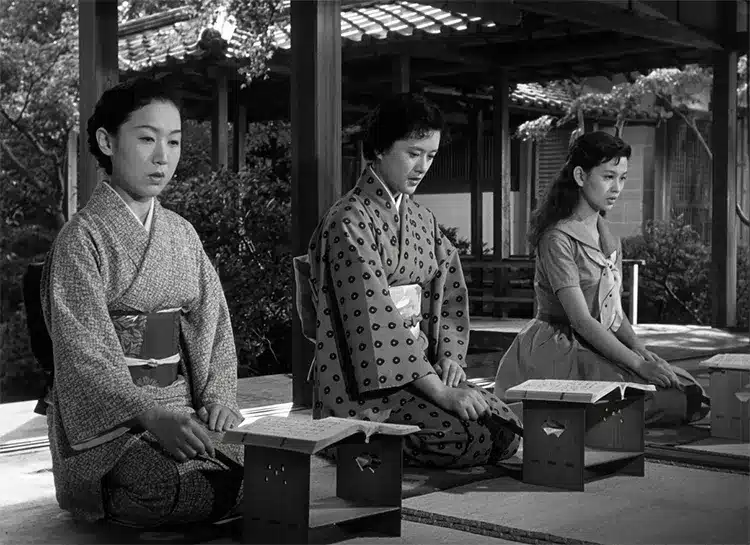
The Moon Has Risen will be of special appeal to fans of Yasujiro Ozu, who gave Kinuyo Tanaka the script. She cast one of his most famous players, Chishu Ryu, and often staged and shot the film in the Ozu manner, so the result is similar to discovering a lost Ozu film. Here are the many lyrical establishing shots, here are sequences showing how people leave one room and enter another, here is an ending that recaps the beginning to imply that all is the same yet different.
As in so many Ozu films, The Moon Has Risen focuses on matchmaking and whether a family’s daughters will marry. The comfortable suburban family is that of the widowed, more or less retired Asai (Ryu), who receives top billing as the patriarch, although he only appears in a few scenes. References to the war are delicate, such as Asai stating that he evacuated to this country town from Tokyo in 1943. Informed viewers will understand why the family is alive and well.
If there’s a central hero, it’s Choji (Choji Yasui), brother-in-law to the widowed eldest daughter. He’s lost his job in the modern postwar capitalism because he had a fight with a buyer, and now he’s at loose ends, taking translation jobs. His cultural orientation is very Western, as reflected in his clothing, and he makes references to authors such as James Joyce and Somerset Maugham while smoking and listening to Western classical music. However, he’s living with traditional monks who recite sutras.
Choji receives a visit from an old school friend, Amamiya (Ko Mishima), whose successful job at an electric company involves microwaves that don’t interfere with telephone and TV reception, making it very cutting-edge. He can play Chopin Nocturnes, although he doesn’t bless us with that on screen.
The moving and shaking is done by Asai’s brash, youngest, most modern daughter, 21-year-old Setsuko, who yearns for bustling Tokyo. She’s played by Mie Kitahara, who made a brief career as an emblem of Japan’s restless young womanhood. Setsuko wears western clothes while her older sisters wear traditional kimonos, and she practices blowing smoke rings in emulation of Choji.
Deciding that Amamiya and her middle sister Ayako (Yōko Sugi) must be in love but won’t speak or act on it, she manipulates everyone around her to bring them together. She enlists Choji as her main ally. One of the messages of The Moon Is Risen is that it’s easy to know what’s best for others but hard to act in one’s own interests, and much of the drama concerns whether Setsuko and Choji will get together. Tanaka plays the senior servant.
Culture is everywhere in The Moon Is Risen, and not only Western. The opening scene features the family attending a traditional poetry recital at the monastery where Choji is staying. Lovers send telegrams referencing classical court poetry by a famous lady-in-waiting, and this act is described as both modern and traditional. The last scene will feature Asai and his eldest daughter, Chizuru (Hisako Yamane), launching into another recital in honor of autumn, now that the summer of romantic turmoil has been resolved. All is different, all is the same.
One thing Kinuyo Tanaka handles differently from Yasujiro Ozu is that, while everyone is exquisitely civilized and you’d almost believe this is a world without serious problems, the emotions are less repressed and more forthright, and that’s another element of shifting postwar styles. As the youngest and most impetuous family member, Setsuko expresses sadness, anger, ill temper, and joy with the least restraint.
If the arc of The Moon is Risen has a climactic crisis, it’s in the confrontation between modern egoism and Buddhist selflessness in Choji’s job-hunting, whose main drama is gracefully elided in favor of second-hand reporting. Optimistically, Choji’s selflessness about one job is rewarded immediately with another from a bastion of tradition, a monk’s school. His non-monkish diet won’t matter, as he’ll only be teaching English. Again, the modern and traditional are united in the new world, where the same seasons still turn.
Forever a Woman (Chibusa yo eien nare, 1955)
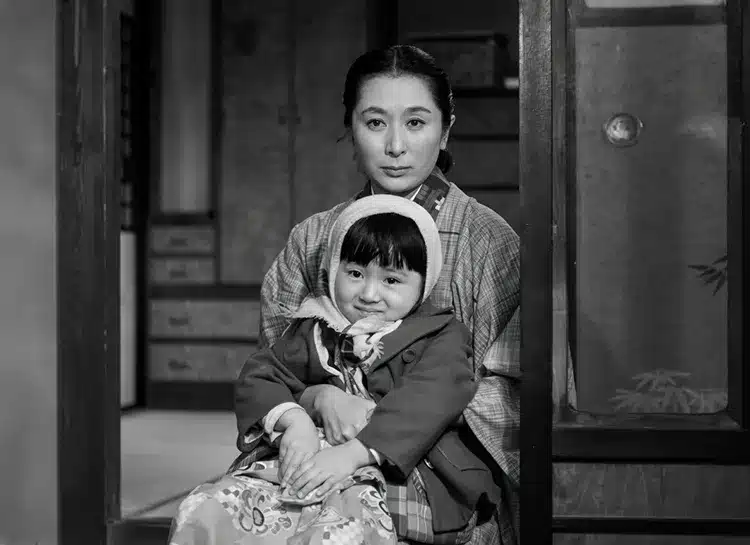
This biopic tells the story of Fumiko Nakajo, a newly famous poet who died the previous year. She died of breast cancer shortly after publishing a book of tanka (short poems) that discuss her illness and mastectomy.
Forever a Woman opens on a pastoral scene of grazing cows while we hear an accordion tune. This deceptively restful setting soon reveals that Fumiko (Yumeji Tsukioka) is having problems with Shigeru (Junkichi Orimoto), a bitter, unfaithful husband addicted to pills. They divorce and their two children are divided between them. Fumiko works on her poetry while ignoring the pain in her chest until she collapses and is rushed to the hospital. One sequence shows the breasts (perhaps a body double) being sterilized for surgery.
That’s all in the first half, and it’s something the contemporary audience knew in advance. The second half is dominated by her relations with a handsome reporter (Ryōji Hayama), who conducts an affair with her while admiring her nobility and encouraging her to publish more poems. This section becomes an increasingly powerful tearjerker of strong images and tender gestures, building to a final poem: “As a mother with nothing, all I can leave you with is my death. Please accept it.”
Also in the cast are Masayuki Mori as a married friend she loves silently, Shirō Ōsaka as her brother, Hiroko Kawasaki as their mother, Yōko Sugi as a best friend, and Bokuzen Hidari and Chōko Iida as the elderly couple in the cancer ward. As usual, Kinuyo Tanaka gives herself a minor role.
It’s difficult to know how much of the true story has been altered. For example, Fumiko had four children in real life, not two. Her poetry book’s title refers to the loss of her breasts, whereas the film shows her book being accepted before she’s diagnosed. In fact, she hears about the publication only moments before she collapses for the first time, implying some kind of karmic connection about sacrificing for literature or even the price of divorcing her husband.
In short, Forever a Woman is a parade of noble repressions for social norms, though she rebels against this to some extent by refusing to marry again and even by having a dying affair. In a perverse way, we could argue that dying is an act of rebellion against the regular slots prepared for her.
Forever a Woman is a very loose translation of a Japanese title, also listed by Wikipedia as The Eternal Breasts, in reference to the poetry book’s title. Akira Wakatsuki wrote the biography that inspired the film, while the screenplay is by prominent feminist writer Sumie Tanaka (no relation to the director). The two Tanakas would collaborate again on Girls of the Night.
Wikipedia also says the scriptwriter withdrew from a 1951 project at the same studio, Nikkatsu, because they wouldn’t allow its heroine to divorce. That implies Forever a Woman is a groundbreaker for its real-life and unapologetic divorce scenario as well as its treatment of breast cancer. Hollywood cinema of the time also shied away from divorce (except in remarriage comedies) and rarely specified what kind of cancer killed its brave heroines. A good comparison is Rudolph Maté‘s No Sad Songs for Me (1950).
The British Film Institute chose Forever a Woman to represent 1955 in its 2022 selection of the best Japanese films of each year since 1925. Tanaka handles the material with simplicity, organizing crowd scenes, many outdoor shots, and studio interiors. One recurring device is that she slowly pushes the camera forward, giving both intimacy and a sense of the inexorable.
The Wandering Princess (Ruten no ohi, 1960)
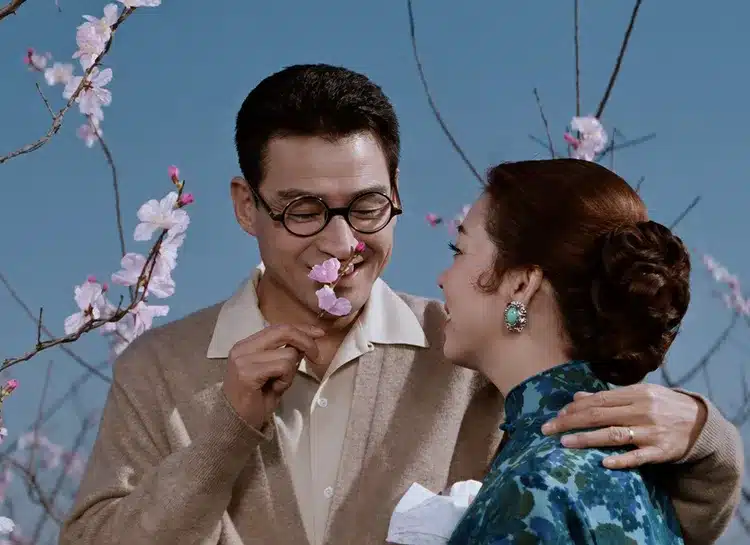
The Wandering Princess is another biopic of a famous woman based on a bestselling book. In this case, the book was the 1959 memoir of Hiro Saga, whose life was an epic of highs and lows. Daiei Film Company lavished a color and widescreen budget on this project, and Kinuyo Tanaka takes advantage to provide a sumptuous spectacle of studio designs and costumes that emphasize ceremony and spectacle as the artificial surface of life. Part of the budget is the presence of superstar Machiko Kyo in the main role.
The Wandering Princess opens with the discovery of a young woman’s body in the grass in 1957. The woman who turns out to be our heroine is Hiro Saga (Kyo). She covers the young woman’s face and cries gracefully. Then the story flashes back to the 1930s, when young Hiro belongs to a wealthy family with royal connections and intends to become a painter.
Perhaps in keeping with the idea of painting, Tanaka often uses framing and gorgeous painted effects, such as sunsets, and employs traditional sliding doors as a literal split-screen effect to divide the screen into geometric patterns. One especially lovely shot finds the camera gliding to the right in accord with those walking in that direction until we come to a gorgeous flowering plant placed in front of a screen that blocks a corridor.
Hiro’s family is suddenly informed that, from her photo, she has been selected by the Chinese emperor’s brother as a suitable wife for political reasons. Those who have seen Bernardo Bertolucci’s The Last Emperor (1987) may recall that Emperor Puyi was appointed as the puppet ruler of Manchuria (Manchukuo) by the colonizing Japanese Imperial Army. He had no heir and wasn’t likely to have one, so his brother, Pujie (Eiji Funakoshi), wants to marry Hiro in a cynical bid to “cement relations” between Japan and the part of China it occupied.
She’s overwhelmed but goes along with it and learns to love her husband. The Wandering Princess depicts him as kindly and bespectacled, while his emperor brother is initially cold and distant for fear she’s a spy. The emperor’s own wife is a useless “doll” addicted to opium.
Half of The Wandering Princess observes Hiro’s life of somewhat frustrated splendor in the boonies. Distantly offstage come rumbles of the increasing Pacific War, which the US and Russia will join, and imminent attacks by the Chinese army. The film’s second half follows her tramping from pillar to post, accompanied by several court women and servants, as they flee armies and are captured by Chinese partisans. This is the “one damn thing after another” part of the narrative. Even though Hiro is at the center of political goings-on in one sense, she knows she’s a bit of collateral symbolic flotsam.
We come back around to the opening scenes as it’s explained that her daughter has committed suicide “for whatever reason.” (Wikipedia says it seemed to be murder-suicide.) The stricken mother speculates briefly and blames herself for not noticing her daughter’s pain. At this time, her husband was living in a Chinese prison camp, while Hiro had made her way home to Japan shortly after the war. The year after the film, he’d finally be released, and she went to join him in China. We can wonder to what extent her book and this film factored into those developments.
While touching on the fact that Japan’s militaristic and colonizing efforts were a disaster and that the Chinese didn’t want them in Manchuria, and also on the paranoia and control of the army, The Wandering Princess keeps its focus on the noble suffering of a loyal wife and mother who, as a political pawn, ends up suffering even because she’s a loyal wife and mother. In Forever a Woman, Fumiko also suffers initially because she’s too good for her husband, and then simply because she’s a woman.
The scriptwriter of The Wandering Princess is another prominent woman writer, Natto Wada. She wrote many films and was especially known for collaborating with her husband, director Kon Ichikawa. One of her streamlining bits on this project was that Hiro had only one daughter, when in fact there were two. The other had a long life and five children.
Girls of the Night (Onna bakari no yoru, 1961)
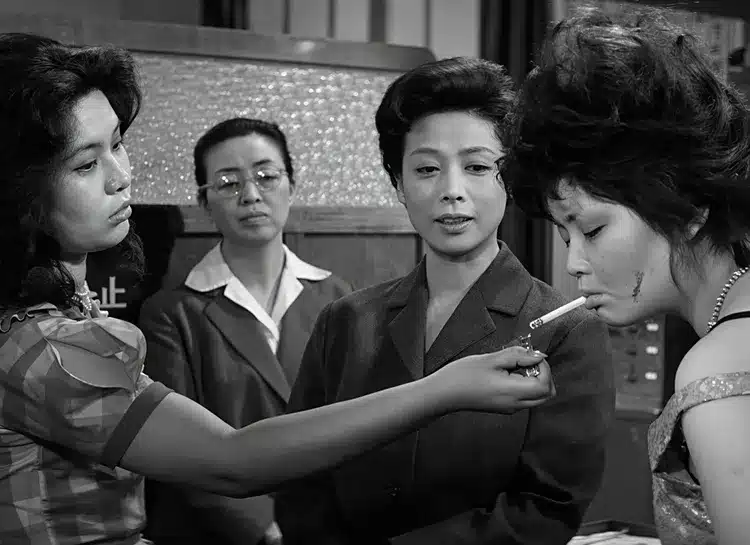
Presented in widescreen black-and-white, Girls of the Night is a social-problem picture responding to the 1957 passage of Japan’s anti-prostitution law. Until then, prostitution had been legally licensed.
Prostitutes are shown being arrested by the police, but they aren’t jailed. Instead, they are consigned to “protective” institutions whose purpose is to rehabilitate them and find regular work. The first two-thirds of Girls of the Night provide anecdotes and episodes among the inmates that add up to a mosaic of facets and tones, including one cafeteria free-for-all and one shocking scene of violence.
The wards are looked over with a benevolent eye by Mrs. Nogami (Chikage Awashima), a warden who is the bureaucratic and progressive equivalent of a madam. In an expository sequence, she provides background and data to a visiting group of bourgeois women, including that some inmates have diseases. One older woman, Kameju (Chieko Naniwa), is a frustrated lesbian who hangs herself out to dry over a younger colleague who keeps escaping over the wall.
The primary inmate is Kuniko (Chisaku Hara), who is almost three different people, depending on which job she’s farmed out to. First, she works hard at a store until the complacent mistress (Chieko Nakakita) finds out her background and treats her with contempt. When Kuniko goes into factory work with a bevy of other young women, she frankly confesses her past and finds ever greater friction, including torture inflicted by the “respectable girls”.
Finally, Kuniko finds fulfilling work at a plant nursery where the people are understanding, and she even receives a marriage proposal from a handsome, tall man played by future prolific star Yosuke Natsuki. Here, Girls of the Night seems to be at a crossroads. Either it will head towards a wish-fulfillment “happy ever after” or a forced tragedy in which Kuniko finds herself under the thumb of her old pimp. Nimbly, Yumie Tanaka’s screenplay avoids either choice with an open-endedness that says life is hard, but hope may exist, as symbolized by the crashing ocean. While the ocean is a cliché of Japanese cinema, it’s satisfying here, not least for its unexpectedness.
Girls of the Night could have presented the women as hard-luck cases misunderstood by society, and that element is present, but the film loads nuance into both the individual personalities, some of whom weren’t so unhappy or who miss “the aroma of the men”, and the new laws, which Mrs. Nogami judges even-handedly as both problematic and trying to address real wrongs. One of the sharpest exchanges is when Kuniko asks why it’s wrong to sell your body instead of your mind and your time for the same end of earning a living. Mrs. Nogami admits she doesn’t know and can only conclude the body is sacred.
Kinuyo Tanaka brings her usual professional flair to organizing this material. She must have been aided by the fact that she’d played prostitutes and geishas, standard roles for Japanese actresses. She was familiar not only with such roles but with their dramatic conventions, and she presents these women as more than suffering saints or shameless hussies. Her source for Girls of the Night is a 1960 novel by the female novelist Masako Yana.
Love Under the Crucifix (Ogin-Sama, 1962)
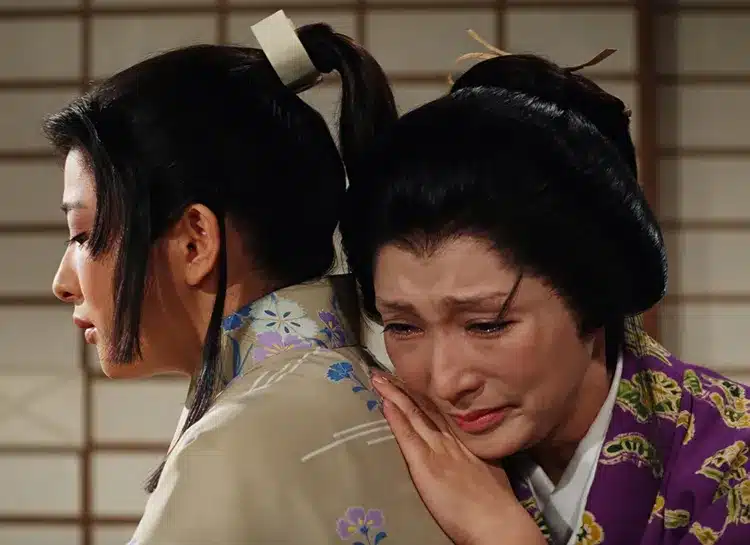
Working for the second time in color and widescreen for a lavish historical drama, this is Kinuyo Tanaka’s final film and, for my money, her best. Love Under the Crucifix, a gorgeous drama set in the late 16th Century, is highly Japanese in its combination of restraint and intensity. Like Forever a Woman and The Wandering Princess, it’s based on real people, though its direct source is the novel Tōkō Kon’s award-winning Ogin-Sama (1957).
Ogin, also referred to simply as Gin (Ineka Arima), is the adopted daughter of perhaps the greatest and most influential master of the tea ceremony, Sen no Rikyū. He’s played by the renowned kabuki star Nakamura Ganjirō, who projects immense dignity. You could program a whole series of Japanese films about tea ceremonies and the life of Rikyū.
Rikyū serves Lord Toyotomi Hideyoshi (Osamu Takizawa), who’s presented here as something of a despotic fatcat who bans Christianity. The ban affects a powerful member of the Catholic Jesuit minority, Takayama Ukon, played by major star Tatsuya Nakadai with sleepy bedroom eyes and a standoffish demeanor. He’s the man for whom Ogin pines, even though they both marry other people.
Ogin is the only one of these figures who seems to have been invented by the novelist as a way of correlating the three famous figures. Her quietly willful determination to carry a torch for Takayama provides as much heat as the political tensions. She becomes Tanaka’s second divorced heroine.
With a title like Love Under the Crucifix, you’d suppose Christianity is a major theme. That’s true, in a way, but it’s almost an accessory, like the wooden cross Ogin receives from Takayama as a kind of kiss-off early in the film. Ogin herself doesn’t much understand or like Christianity, which she perceives as keeping her from her love. The screenplay by Masashiga Narusawa concentrates less on persecuted Christians than on ritual and ceremony in everyone’s life, from arranged marriage to court etiquette to the tea ceremony, which is presented as a sacramental act in which tea is the equivalent of Catholics drinking blood-wine from a priest’s hand.
Tanaka stages everything ceremonially, and she has photographer Yoshio Miyajima gently glide the camera right or left, forward or back, with the utmost grace as the people move themselves like pawns through the overdetermined ritual of their lives. There’s a clear connection with the similar rituals in The Wandering Princess.
Love Under the Crucifix is a feast of textures and colors in visual geometries. Lighting effects are used emotionally more than once, and there’s a brief black-and-white fantasy. Hikaru Hayashi’s score is also beautifully restrained yet expressive. A turning point in the story is a torrid scene in which the rain of Pathetic Fallacy comes down in sheets as the lovers flee capture and seek refuge.
The liner notes by Imogen Sara Smith mention that this Shochiku release was produced by a company founded by three actresses to control their careers. Arima was one. Another was Yoshiko Kuga, the star of Love Letter. The third was Keiko Kishi, a major star who lends support with a cameo as a woman getting carried off to be crucified because she wouldn’t let a lord have his way with her.
Kinuyo Tanaka remains more famous for acting in other directors’ films, but Kinuyo Tanaka Directs demonstrates her command of the qualities needed to marshal major productions under her own baton. Her career was very busy and distinguished, and it’s too bad she didn’t squeeze in a few more directorial projects of her own, but the half dozen she made are nothing to sneeze at. It’s a pleasure to discover her output in one handy package.