

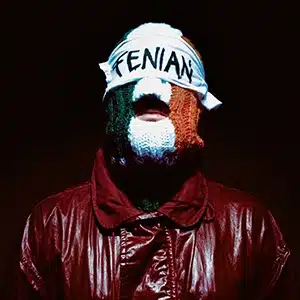
In the excellent song “An Rá,” from Kneecap’s extraordinary new album Fenian, the Belfast rap trio mock the supposed gifts of British imperialism—a sardonic inventory of what the Crown left behind—and the joke lands like a brick through a window. Three lads from West Belfast telling centuries of colonial history to fuck off, and they manage to make it sound like the most natural thing in the world.
Kneecap have been doing this since their first song, “C.E.A.R.T.A”, dropped in 2017 (cearta is Irish for “rights”), and make no mistake: they are a political band with very straightforward political messages about the evils of British imperialism. However, until this album, they mixed politics with a need for a drink and a smoke, the beats directing listeners to get drunk and stoned while yelling at the Brits to get out.
As they showed in their very funny, if somewhat uneven, 2024 biopic, Kneecap, they are not intellectuals using rap to speak to the kids; they are the kids. Such kids take a little too much MDMA on a random Tuesday night and write about nationalistic harassment by the police while trying to find someone to sleep with. In Fenian, the lads still like a good time, but the album has a different feel. The beats are not as light; the lyrics are not as juvenile. The album hits on a different register than their previous work, and the change has produced something remarkable.
Kneecap draw from a remarkably wide pool. The record’s sound has been described as old-school gangsta rap mixed with the monster-truck onslaught of peak Prodigy, with threads of post-punk, techno, and West Coast hip-hop running throughout. Meanwhile, DJ Próvaí has specifically credited the 1990s UK rave scene as a unifying cultural force. Beyond those anchors, Fenian traverses drum ‘n’ bass and Detroit hip-hop, with individual tracks pulling from the cinematic atmospherics of Massive Attack. It’s a lot to discover on a single listen, even within a single song.
In “Carnival”, which details Mo Chara’s terrorism charge in the British courts, the song opens with a courtroom scene featuring an old, crusty British voice as the presiding judge, which is reminiscent of the framing of N.W.A.’s “Fuck tha Police”, with Dr. Dre donning the robes. The track ends with blunt, harsh force: “All this killing / you’re complicit / history will remember / you pieces of shit / and you’ll never be forgiven”, which is an echo of Bob Dylan‘s “Masters of War” (“Even Jesus would never forgive what you do”).
What makes all these genres and references work—and they do work, in a way that feels original rather than derivative—is not genre but geography and grievance: the sonic restlessness of a band raised in Belfast after the 1998 Good Friday Agreement that supposedly brought “peace” to Northern Ireland.
Kneecap‘s debut, Fine Art, announced them to the world as something genuinely new: Irish-language rap that wore its politics like war paint, with humor as its delivery mechanism. However, Fenian, named for the medieval Irish warriors whose identity was later weaponized as a slur against Irish Catholics, represents something harder-won. According to Mo Chara, choosing the word as the album title was an act of reclamation: of language, of heritage, of identity. That reclamation is the album’s backbone.
The record was born of chaos. A whole album was scrapped, and the trio decamped to Streatham in London to spend two months on fresh material with producer Dan Carey, known for his work with Fontaines D.C. and Kae Tempest, who makes a wonderful appearance on “Irish Goodbye”, the album’s closing track. The drama surrounding the band was considerable: a Coachella set that lit up social media and rattled governments; Mo Chara facing a terrorism charge, later dismissed by the courts; the British Prime Minister publicly declaring their Glastonbury appearance “not appropriate”; and a US tour cancelled under threat of arrest. The chaos also produced the grist for new material.
What Carey and the band have built together is an album that finally matches the scale of what Kneecap are trying to say. The opener, “Éire go Deo” (“Ireland Forever”), sets the tone: woozy and elegiac, a tribute to the Irish language as a living act of resistance rather than a museum piece. From there, the record moves through industrial hip-hop, trip-hop, and euphoric rave anthems. It’s the sound of a band that has absorbed the full sweep of working-class Irish culture and bent it to their own ends.
The colonial thread that ran beneath Fine Art now breaks the surface entirely. “Smugglers & Scholars” reflects on the Irish revolutionary period, its title a play on the old epithet “land of saints and scholars”.
More startling is “Palestine”, featuring Ramallah-based rapper Fawzi delivering verses in Arabic. It’s a powerful expression of Irish-Palestinian solidarity built around a thought experiment of reverse colonization: checkpoints in Amsterdam and walls around Paris. It is not a cheap rhetorical gesture. Kneecap understand, viscerally, what it means to have your language suppressed, your identity criminalized, your culture treated as a threat. The parallel they draw is genuine, and the song carries real emotional weight.
Fenian is divided into two thematic halves: one focused on Kneecap’s private life, the other on the public. This structural ambition pays off. The political thunder of “Carnival” gives way eventually to “Irish Goodbye”, a devastating meditation on grief and suicide featuring Kae Tempest. Móglaí Bap wrote the song following the loss of his mother to suicide, and it is the most vulnerable thing Kneecap have ever committed to record. That they can move between these registers—from righteous fury to profound tenderness—without losing coherence is a measure of how much they have grown.
Fenian proves Kneecap are more than chaos merchants taking the piss. In the final bars of “Palestine”, they state their terms plainly: “Ní stopfaidh muid / Go bhfuil gach duine saor” (“We won’t stop / Until everyone is free).” They mean it. And for the first time, the music is big enough to carry the weight of that promise.