

Kraftwerk, founded in 1970 in Düsseldorf, Germany, by Ralf Hutter and Florian Schneider, didn’t just bring electronic music to the masses with their groundbreaking records. They imbued their synthesizers, vocoders, and electronic percussion with an occasional pop sheen, making them more acceptable to mainstream audiences. While elements of krautrock and an occasional punk energy were distinctive elements of their first few albums, Radio-Activity is their first entirely electronic album and helped set the stage for their sound for years to come.
Kraftwerk‘s fifth studio album, Radio-Activity, was released in November 1975 and includes Hutter and Schneider along with Karl Bartos and Wolfgang Flur on electronic percussion. This lineup would remain unchanged for 15 years. While the side-long title track of their previous album, 1974’s Autobahn, was something of a sonic representation of the famous German highway, Radio-Activity is their first full-blown concept album, organized around the themes of radioactive decay and radio communication.
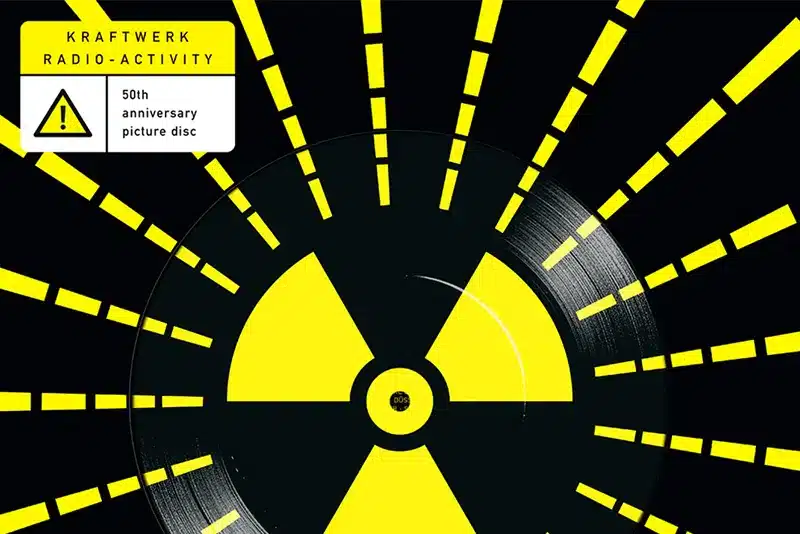
To mark the record’s half-century, a 50th-anniversary picture disc is now available (featuring newly reimagined cover art), as well as a Blu-ray edition that includes a Dolby Atmos mix, a 5.1 surround mix, and a 2009 stereo remaster. In other words, Kraftwerk fans with a penchant for high-quality audio in a variety of formats will be in heaven.
Radio-Activity clocks in at a modest 37 minutes, but plenty of sonic delights are packed in, and the emotions run from utterly paranoid to a soothing electronic balm. While the brief opener, “Geiger Counter”, acts as a sort of overture and introduces the album with the fuzz of distorted noise and heartbeat-like electronic percussion, it runs into the title track, a sleek mesh of slow-motion rhythms, layers of synth chords, and treated vocals in English. German painter, poet, and audiovisual artist Emil Schult, who spoke better English than Hutter and Schneider, contributed lyrics that also include words in their native German.
The record’s variety becomes more pronounced on repeated listens. There’s the emotional pull of the almost hymn-like “Radioland,” with plaintive chords alongside bleating, radio-transmission-aping effects and vocoders that seem to predict Neil Young’s 1982 synth freakout masterpiece, Trans. Things also turn sunny and optimistic with the thick, melodic keyboards of “Transistor”.
Additionally, there are plenty of brief interludes that pop up like sketches of ideas that work well on their own but almost beg for further exploration, such as “Intermission” and “The Voice of Energy”. Kraftwerk fans that seemed satiated by the luxurious long-form delights of Autobahn may feel jarred by the shorter cuts, but more likely than not, this new approach signified an exciting new trend for the band.
The confluence of electronic experimentation and pop smarts is alive and well on sterling tracks like “Airwaves” and “Antenna”, to the extent that it would be hard to imagine Thomas Dolby, New Order, or Daft Punk existing without these priceless musical moments. In what may seem like an oddly sentimental moment, Radio-Activity closes with the eloquent plastic soul of “Ohm Sweet Ohm”, one of several moments when Kraftwerk exposes their fragile beating heart.
Kraftwerk would go on to release many more records after Radio-Activity. While their latest studio album, Tour de France Soundtracks, was released in 2003, they still actively tour, with Hutter being the only original member (Schneider passed away in 2020). Their entire discography deserves attention, but Radio-Activity—now sounding better than ever—is arguably their creative watershed moment.