
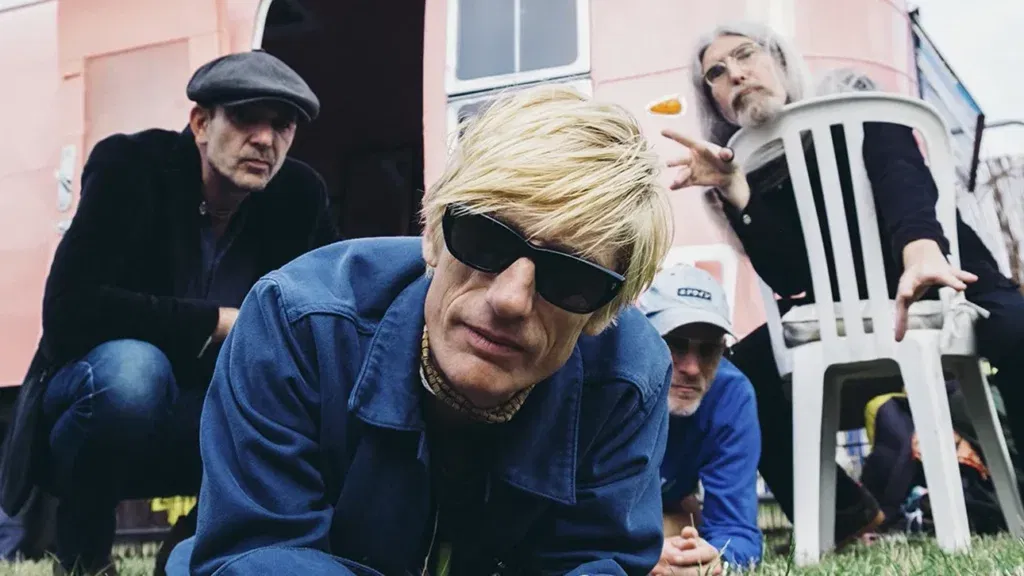

“Love is what makes it all worthwhile. Otherwise, there’s no taste. Life is just dry.”
—Crispian Mills of Kula Shaker, 2026.
In a candid Zoom discussion spanning thousands of miles between the West Coast and Western Europe, the frontman of English psychedelic rock band Kula Shaker treated me to a glimpse into his existential mind. Although present to discuss the band’s new album, Wormslayer (2026), Mills also offered a bounty of insights into his worldview and the concepts that shape Kula Shaker’s work and creative life force. From physical media to ruminations on consciousness and what everyone is ultimately after, Mills helps us answer questions like “Who are Kula Shaker?” and more.
What inspired the title Wormslayer?
It’s always fun to see your name in print—a title or a book. One of the wonderful things about vinyl is that it’s a bit like writing a book. You have a substantial piece of work, and you can hold it in your hands. You don’t really become aware of the work that’s gone into it until you can physically touch something. A great title should feel like it’s earned its existence.
“Wormslayer” is slightly tongue-in-cheek. In England, a worm is an old-fashioned term for “dragon.” It’s a derogatory attribution, maybe, because it’s related to Satan, the original worm.
There’s a famous folk song in the Northeast of England called the “Lambton Worm”. It always fascinated me that the dragon is only scary when he’s in the dark. When you bring him out into the light, everyone realizes he’s just a worm. Just a guy crawling on his belly. I always liked the imagery and the different layers of meaning.
We also started off playing a live version of an old song of ours called “Time Worm”, from our second album, Peasants, Pigs & Astronauts (1999). We’d never played it live, so we were mucking around with it in a rehearsal, and it turned into this colossal riff. The old song evaporated. What was left was this thing, and so we used the word “worm” in the title to evolve it. Wormslayer is a mutation out of “Time Worm”.
Your last album was Natural Magick (2024). How does Wormslayer differ from or build upon that collection?
Wormslayer is really a Part 2. Like Rubber Soul (1965) and Revolver (1966), it’s like one long session. We’d had a long break where we hadn’t had Jay [Kula Shaker’s keyboardist] in the band, and he came back. There was this huge rush of creativity and excitement, and we wrote and recorded Natural Magick pretty quickly whilst on the road.
We were still writing and recording when it was finished. Tracks that ended up on Wormslayer were already coming out toward the end of Natural Magick, so it’s all part of the same rush.
I think you can hear that. With Natural Magick, we said, “Let’s get really economical and disciplined with our songwriting, and make sure we can do everything in three minutes.” It’s great to see how that works, and we’ve basically done that on Wormslayer, as well. There’s more surrounding it, but the kernel of all the songs is a tight arrangement.
The magic of creative life is that, on the one hand, you’ve got to keep ahold of the reins and not fall off, but you also just have to let it take you, you know? You’ve got to let it have a life of its own. You’re not the controller.
Crispian Mills on Creativity, Love, & Opposites
The intuitive part of creative life is allowing it to flow, understanding that it has a separate existence. It’s all to do with the mystery of consciousness. We’re getting very profound now, but there’s a higher reality going on, and you’re just tuning into it. Creativity comes through communication: people talking to each other, cooking, gardening, relationships, and so on. It’s all about transcending your small consciousness, where you’re separated from everybody in your own little bubble of worry, or anxiety, or fear, or whatever. When you get out of that, you’re able to be much more generous.

God is the highest expression of that community mind. You’re not just on your own, you know?
Music is much more fun to play with people. You’re all sharing that intuitive experience. Even better is when you have an audience. At the same time, it’s lovely to sit down at the piano or the guitar and get lost in that. Whether it’s the individual or the collective, they’re both equally important. If one is neglected, the other suffers. You’ve got to reconcile these opposites. That was what Achintya-Bheda-Abheda [simultaneous oneness and difference] Tattva was all about, which was our first big hit in the UK.
As I’ve gotten older, I’ve realized that everybody is after the same thing. Everybody’s after love, right? Reconciling of the individual with the whole. Love is what makes it all worthwhile. Otherwise, there’s no taste. Life is just dry.
Wormslayer follows the character of a winged boy exploited for profit, as explored in tracks like “Good Money”. Where did this character come from?
It’s almost a shaggy-dog story now. Basically, it was a story that my grandmother wrote. She wrote this short story for her grandchildren about a little boy who grows wings in this small community in Ireland. It shows how people treat him and the differences in opinion about him.
It’s all about trying to own your individuality, that spark in you that is divine that you’re born with, which is uniquely yours.
I loved it. One day, I decided to turn it into a film… it basically got locked up in a Hollywood dungeon in development Hell. I lost my family gift. My family treasure. It was quite hard for me. They wanted millions of pounds for me to get it back. Eventually, I realized that I could just write a song about the story instead.
Then I was going to write a whole album. I wrote two or three songs, and Alonza Bevan [Kula Shaker’s bassist] said, “Let’s just put these on Wormslayer, because they sound good, and it might take you ten years to write the whole album. Why don’t we just start now?” These songs do fit Wormslayer‘s narrative flow. The Winged Boy is kind of like one of the characters on the Wormslayer quest.
Crispian Mills Reveals Wormslayer‘s Thematic Core
I think it’s about people. It’s about the spiritual quest. That involves facing your demons. Evil definitely exists, and I don’t think anyone can doubt that now.
We’re so connected to the world. We can see everything that’s going on, and I think the lesson for me, in terms of slaying dragons, is that you’ve got to slay your own dragons. If you do triumph with your own demons, you will be able to make sense of what’s going on in the world. It’s a very personal thing for me, about facing evil, demons, fear, isolation, trauma, abuse, and things that a lot of people have dealt with—way more than any of us would admit.
We all want to be happy, and we all want to be uplifted and full of love. We all want to get to that place of satisfaction, but if we’re broken people, then we’re constantly going to be frustrated. You’ve got to do the work on yourself. It’s not going to be easy. It’s like that old spiritual song, “You Got to Walk That Lonesome Valley”. You’ve got to get on the quest.
Crispian Mills Advocates for Self-Accountability
I have enormous respect for humanitarian and charitable causes; the world would be a poorer place without them. But I think, in terms of expectations we have, that we put a lot of pressure on ourselves to make a difference. The only place you can really make a change is in dealing with your own issues. That’s where you really do have the power.
If you’re lucky enough to have a few close people in your life, then you can make a difference on them, too, but it takes time.
What other ideas—personal, cultural, or philosophical—felt important to you while writing this album?
One huge part of my way of looking at the world is informed by movies. My family were all involved in film, drama, and writing. That’s just the way my brain was formed. Kula Shaker’s records tend to open like a movie. With Wormslayer, we liked setting the scenes and making things feel like chapters rather than songs. The title track, then, is the final act.
I was watching Tony Richardson’s Charge of the Light Brigade (1968), a fantastic, psychedelic-infused period movie about one of the greatest British military blunders. In the film, a bunch of upper-class servicemen lead their cavalry into the enemy guns, and they all get blown to bits. I liked the film’s title. I think “Charge of the Light Brigade” was one of the first songs I wrote for Wormslayer. I switched the meaning of the title into something positive. We’re all charging into the enemy guns, but we are the light—the workers of light.
The idea is that if you’re going to die, you must die a gallant, heroic death for a good cause, not for some empire of shite.
It’s a good song. I especially enjoyed listening to it while driving.
Well, if you get pulled over, you can just blame us.
I’ll send you the ticket across the pond.
In “Day for Night”, you write, “Everyone is lying, none of it is real.” The album’s closer, “The Dust Beneath Our Feet”, counters with “Everything exists, everything is true.” Could you elaborate on the relationship between those two statements?
It’s all about contradiction. We’re trying to reconcile. I really can’t analyze it too much. On the one hand, I think it’s that evil is trying to encourage you to believe in a fiction. In reality, the truth is far more incredible than you could ever imagine. I can’t really unravel that one for you; I’m still trying to do it myself.
What I like about this album is that you’ve got these hit-quality singles, which are very enjoyable, but you’re able to dial things back with pieces that give a lot of good substance to think about.
We went through a lot between Natural Magick and this album. Everybody has. Everybody’s dealing with psychological trauma and fatigue. We are part of a moment in time in which our brains are being fried. Never before have humans been subjected to this amount of information. It’s like we’re living in this experiment together, and we’re all freaking out. We’ve been through things as a band, private experiences that have caused pressure, and everybody out there is going through their own version of that.
Between Natural Magick and Wormslayer, there’s a need to mobilize the poets of light and slay the worm. So, we put our marching boots on, and our suits of armor. It’s a real battle, and it’s happening in your soul.
Absolutely. There’s a world we can’t see that constantly influences and manipulates the seen world. That’s what I believe. People are burned out, stressed out. It’s great that Kula Shaker are empathetic to that and are responding with music.
Yeah, I just think people are wound up and angry, or they’re just exhausted. I think that the more work you do on yourself and the more you deal with your own abuse, trauma, and pain, the more you heal and the less angry you are.
You’ve got to allow yourself to grieve, and don’t be frightened of that grief. A really important part of empathy and compassion is your ability to understand the amount of pain that’s out there.
Absolutely. Helping fill the world with a little more light in your own way.
Yeah, exactly, in your own way. You might be a chef, mother, writer, or gardener. Whatever it is, you’ve got to put your heart and soul into it.
You stated in an interview with DEK Magazine that Kula Shaker are “all romantics at heart”. How do you view your role as a romantic and musician in the world today?
It’s kind of a joke, really. Being romantic is kind of old-fashioned. There’s a part of us that’s gazing wistfully across the sea to some magical land. You’ve got to laugh, really, because you can’t shake it off. We’re still romantic about America when we’re gigging and driving through the land of rock and roll, you know? Playing music is when part of us can’t shake off the dream.
I think people with that “romantic” temperament, who are eager and earnest and have an old-fashioned sense to them, can do some good for the world. They can make a positive difference.
My dad got married, like, six times. I had no relationship with him. I wasn’t angry with him or anything; I just didn’t get a chance to grow up with him.
In my late teens, when we kind of reconnected, I had quite a few questions. One of them was: “Why did you marry all those women?” Why not just have girlfriends, you know, and see where it goes? He said, “Because I’m an incurable romantic.”
Uh-oh! [Laughs]
I’ve been very lucky to have been happily married for about 30 years.
What does spirituality mean to you, and how does it influence your life and work?
It’s a pretty deep question, and I don’t know if I can answer it in a satisfactory way. Spiritual life relates to understanding who you are. If you understand yourself, you will eventually understand other people, too. It’s all about connecting with the greater love. That’s what I think God is. I think God is about a relationship. The spirit is a great mystery, and it should be explored.
For me, my life, my music, my work, my marriage… everything is spiritual life. There’s no separation. It’s not like I sit down, become spiritual, and then get on with the rest of my life. It should all be one thing.
Right.
Everybody is spiritual, too. I think that’s the biggest misunderstanding, people saying, “I’m not a spiritual person. Oh, that person is spiritual.” It’s not like that. You are spiritual. That’s what you’re made of.
You’re a soul with a body before you’re a body with a soul.
Yeah, yeah, it’s all just various stages of awareness. It’s a relationship, and you get to decide how deep you go.
What do you most hope listeners take away from Wormslayer?
Once music is released, it’s not yours anymore. You can’t control what people take away from it. I don’t have any expectation or desire in terms of what the experience is. When Kula Shaker plays a song, we play it for each other, and we’re trying to impress and entertain each other. Where the experience opens up is when you do a gig. That’s when it becomes a communal, congregational kind of exchange. If I could ask for anything, it would be that people come to see us live. We’re a live band, first and foremost, and always have been.