
Where are you tonight, Kyle Craft? Sailing the Mississippi River like Mark Twain? Or performing “Visions of Johanna” to any punter who gives him half a chance at the Bob Dylan Center? You tell me. After releasing three studio albums with Sub Pop, nothing has been publicly heard of him since 2019. It is as if Craft had stepped out of one world and entered another. No look back, no valediction, no bang nor whimper. Silence. Still, we wear his past like an overcoat in anticipation of a sign, or with the false sense of warm nostalgia.
Craft’s tale ended before it began; his disappearance was not unlike Bob Dylan‘s retreat to Woodstock in 1966, though, for all I know, Craft has neither had a motorcycle crash nor is holed up in a basement, where he is singing folk tunes about nonsense and absolution—or both.
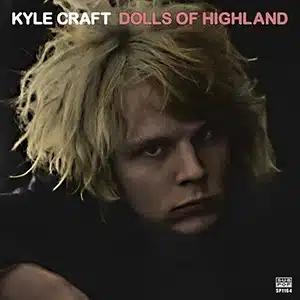
We wouldn’t be interested in the whereabouts of Craft if not for his sybaritic 2016 debut record, Dolls of Highland, which is a work of sullied beauty, wherein the drama—from a lover jumping out of a window to a burlesque dancer—is a spectacle. A spate of images to get lost in, to distract us, to reflect us without knowing it. Thus, we fail to ask a question the album poses: what is the driving force behind the wild behaviour?
On the record, Kyle Craft implicitly suggests that something that takes a lifetime to learn or unlearn lies at the root of human behaviour: destruction. It is as if he had taken a lesson from the French intellectual Georges Bataille, who saw humanity running on the fumes of oblivion. Of course, we are driven by sex, though, as Freud promulgated, the death drive is another potent factor.
There is an ever-evolving lacuna in Craft’s story to be filled in by whoever is thinking of him. Yet is anyone thinking of Craft? Remember him? Nah, I’m listening to Geese. Ten years ago, Craft was one of the most talented and exciting singer-songwriters around; ten years ago, we were, in one way, older. But, if you think in linear terms, that is a long time. Craft never did or appeared to. He belonged to the 1960s and the 1970s.
Yes, Kyle Craft was anachronistic, abundantly self-referential, a cypher of a zeitgeist he was too young to know first-hand but understood better than many people who lived through it. However, his music is neither pastiche nor cheap nostalgia—in fact, quite the opposite: his music speaks of the future, or the future speaks back to it. Either way, it’s alive.
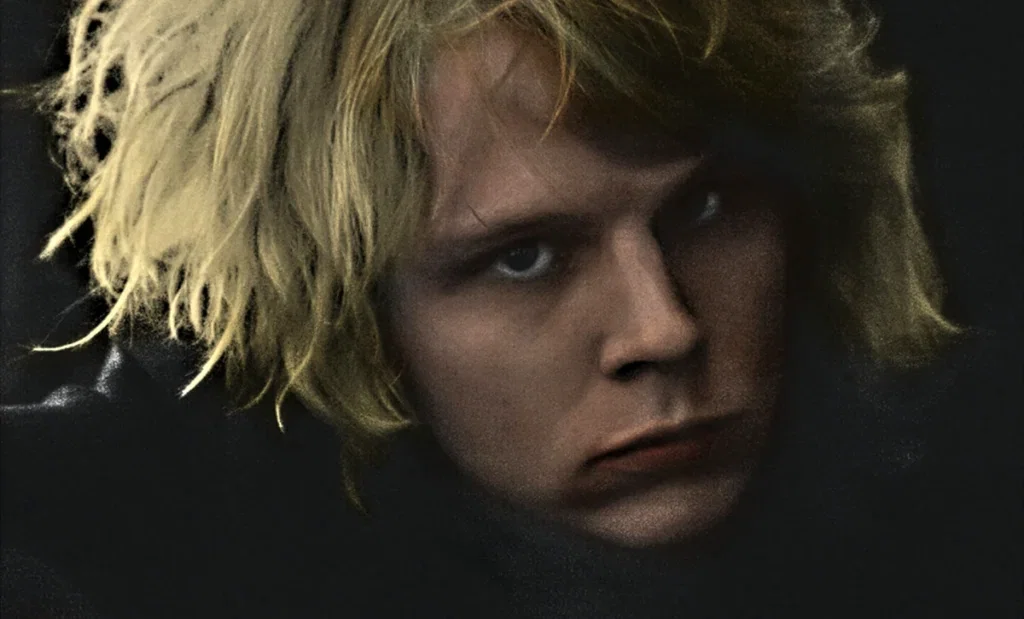
Like the United States’ grand narrative of self-invention, Craft was a creation. He never lost sight of the fact that he was singing through an all-American mask. You couldn’t look and hear him without thinking he was a love child of Dylan and Beck. With his outlandish hair and polka dot shirt, it was as if he knew we would fall for the image, an image embedded in our cultural memory: Dylan circa 1966. That said, Craft sidestepped his progenitors, leaving you staring into space and wondering if he existed at all.
The glam-rock opener, “Eye of a Hurricane”, strikes you with its decadent and slinky piano line. If you think you have heard it before, you probably have: Roxy Music‘s “Re-Make/Re-Model”. Then, as if Robbie Robertson had walked into the studio, a stinging bluesy guitar rends a hole in the song and the ceiling of the studio. Thereafter, Craft snarls, “She fed scraps to a six-headed hound at the table,” which makes the writings of the French proto-surrealist poet Comte de Lautréamont seem, well, prosaic. Soon, Craft belts out “Sometimes” like a full force gale; by the end, he howls like Warren Zevon in “Werewolves of London”.
Kyle Craft throws all these references in your face with an impish grin and swagger. Like an American artist, say, Jerry Lee Lewis, he swings punches with his back against the wall; he is not going down without a fight or an absurdist chortle. This swashbuckler has everything to prove, which is to say he wants to show what a bucketload of talent he has.
“Balmorhea” begins with a bouncy rhythm section and a crashing tambourine, before a keening harmonica punctuates a barrelhouse-like piano. In the first verse, a Calliope ascends, as if a carnival is taking place in the sky. Lyrically, the narrator laments the fact that his love interest’s stage performance is merely an act. He has been fooled or is a fool for believing in her. Yeah, we can laugh at him for his imprudent behaviour, but are we not doing the same for taking these songs to heart as a documentation of Craft himself? Or that we take Beck, Craft, whoever, to be real? That we do not view a musician as an actor? That we take ourselves to be real, when we perhaps should see ourselves as actors, like the Self to the Persona.
The stage is both literal and figurative. “Berlin” depicts a burlesque dancer whose Sunday night performances the narrator attends; each dance could be the death of him, and despite this, he keeps returning. Again, Kyle Craft delineates self-destructive behaviour. The narrator wants to be her only lover. However, she wants the touch of all, which Craft elongates to the point of exaggeration to mask the pain the narrator is feeling—that we all feel when the object of our desire is unattainable, or, accurately, partly attainable.
“Berlin” captures another motif of the record: voyeurism. We project ourselves onto others, as in how, in the song, the women want to be her, and the men want her. Musically, “Berlin” is imbued with a Velvet Underground-like, drone-esque piano by way of a Bertolt Brecht/Kurt Weill cabaret. Obsessed by mystique, Craft wrote about alluring characters and focused on the absolute in places you would not expect: dive bars, burlesque, and ballrooms. Big voice. Big scenes. Big ideas. Craft saw music as theatre. We bought the ticket.
“Lady of the Ark”, beginning with the muted, chugging of an acoustic guitar, is about a woman walking out on a man, complete with a Tex-Mex accordion in the bridge. Craft switches from first person to third person in the fourth verse, as if the memory would be too painful to recall in first person, not unlike how Dylan used first and third persons interchangeably, a way to distance himself from the subject matter and, perhaps, himself. “Gloom Girl” depicts a failed romance with an enigmatic and gloomy girl. Craft doubles down not only on the distance but also on the theatre between people, as the narrator realises, “it’s a sad show”, effectively coupled with martial drumming and elegiac horns.
With Dolls of Highland, Kyle Craft kicked destiny down the road and watched it roll like a ball. His infernal voice blasted you like an open fire; it felt as if he was sticking his hand down your throat and ripping your heart out while blowing you a kiss. Really, though, his fiery voice had nothing to do with what made Craft stand out. What did? His churlish attitude, the same attitude that made Dylan a punk in 1965. In his songs, you hear his Shreveport, Louisiana, upbringing; you hear the susurration of the Mississippi River; you feel Huckleberry Finn floating in the ether.
The only misstep is the ersatz John Lennon-esque, double-tracked vocals, “Trinidad Beach (Before I Ride)”. The jaunty “Future Midcity Massacre” could be Dylan’s “I Want You”, while the spunky “Black Mary” starts with a single piano key repeatedly struck before the track erupts into punchy, bluesy rock, complete with a screeching, stop-start organ. Also, Craft throws in another howl like Zevon. It worked the first time, so why not try it again?
Dolls of Highland is high-drama with high-stakes, a Freudian fantasy, wherein sex and death interweave, or, rather, Thanatos (the death drive) and Eros (the life drive) commingle, like a seductive dance. It is a fantasy to the point of realism, that is to say, a realism of the unconscious. Put differently, Kyle Craft depicts the desires that lurk in our unconscious yet guide our daily lives, as articulated by the co-founder of surrealism, André Breton.
The brief and piano-led “Dolls of Highland” segues into “Jane Beat the Reaper”, where a bluesy guitar shoots a fiendish riff upwards like a geyser. The subject of the song is the elusive and strung-out Jane, who Craft depicts through imagery of Catholicism—medallions and purgatory—as if the Hold Steady were singing about Holly, one of the main characters on their album Separation Sunday.
In the gentle, snare-shuffled “Three Candles”, Craft intones, “Three hundred miles between me and Orleans.” The geographical distance works as a metaphor for the internal distance between the narrator and the subject. The album ends on the line, “But he’ll never kiss you the way that I did”, which, fittingly, echoes Dylan’s, “You say my kisses aren’t like his / I’m not gonna tell you this time why that is” in “Most Likely You Go Your Way (And I’ll Go Mine)”.
Dolls of Highland is a breakup album, told through kaleidoscopic, surreal imagery, though that does not capture its majestic beauty. Whereas some musicians wouldn’t know what mystique is if it walloped them in their narcissistic faces, Craft courted mystery like a lover—gingerly, excitedly, tentatively. Kyle Craft was 27 when Dolls of Highland was released, and, dare I say it, it is one of the greatest debut records of all time. Yes, the rest of the text was a preamble to the previous sentence.