
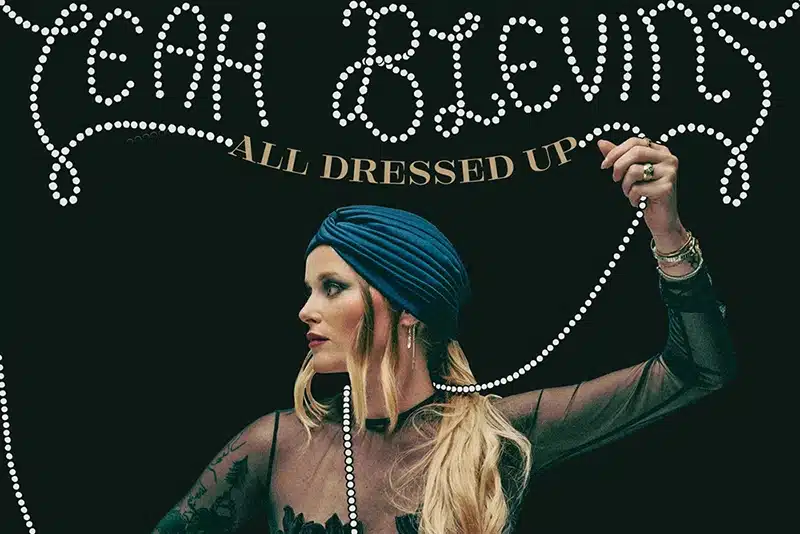
Leah Blevins begins her new album with the title track, “All Dressed Up”. She ends the record (presumably) naked with the cut “Centerfold”. One could see the eight tracks in the middle as a sort of striptease. Blevins sings her first-person confessional songs as she sheds layers of self-deception in search of her authentic self.
Blevins is serious but not afraid to be funny in her vulnerability. Despite her resolute concerns, she can’t help but smirk at her own failures and smile at her successes. The Kentucky-born singer-songwriter addresses the Lord as “Hey God” and wryly asks, “Do You really love me like they say You do?” On “Tequila Mockingbird”, she puns off the title, which refers to a type of alcohol, her Southern roots (“To Kill a Mockingbird”), and jibes (re: mocks) her own bad behavior. Her insights on this song and others are often suggested through wordplay and an expressive voice.
The twang in Blevin’s singing captures her emotional truths. She can be hurt (“Lonely”), downhearted (“Below the Belt”) or grateful (“Diggin’ in the Coal”) in her pursuit of personal honesty. Her singing captures the mood; one moment in Patsy Cline style operatics, another in a Dolly Parton-esque simplicity. The album coheres regardless of the individual songs’ subjects through Blevins distinctive intonations. Like Patsy and Dolly, one can easily recognize her articulations. Her voice is idiosyncratic in a positive way.
Dan Auerbach produced the record (it is Blevins’ debut on Easy Eye). It features his signature style: rich, analogue textures that blend the blues with steel guitar sounds on one song and then dig deep into roots rock the next. Fans of the Auerbach-produced classic album, Yola’s Walk Through Fire, would find many similarities here.
Auerbach employs top-notch instrumentalists to accompany Blevin, including guitarists David Rawlings and Pat McLaughlin, steel guitarists Paul Franklin and Russ Pahl, pianist Jim Moose Brown, organist Billy Swan, and upright bassist Steve Mackie. Auerbach himself is credited as a co-writer on all ten songs, with Blevins’ name appearing as the lead composer. The producer also invited some of Americana music’s best-regarded songwriters to contribute to the process, including Paul Overstreet, Daniel Tashian, and the recently deceased Ronnie Bowman.
One might think that so many co-writers would clutter the songs, but somehow the opposite is true. The material is lean and seamless. Blevins sings from the heart. The listener may not know who wrote what line, but she delivers the lyrics so authentically that one believes she’s sincere and true. She talks to herself, offers self-affirming advice and makes promises to others, such as “This world can drive you crazy, I can help you see the light”, “Knock me down, but you won’t break my spirit”, and “Every dream you’ve ever had, I’m gonna make come true”. Blevins sees the positive and presumes honest expressions provide their own reward.
The title phrase “all dressed up” suggests a person who has gone to great lengths and planned for something that never happens (“nowhere to go”). The ten songs on this album showcase Leah Blevins’ reflections. She may not have resolved her internal issues. Life is not that simple. The singer-songwriter understands that when things get too heavy, one needs to divest oneself of one’s baggage. Dressing up only brings one down. She’s willing to take it all off.