

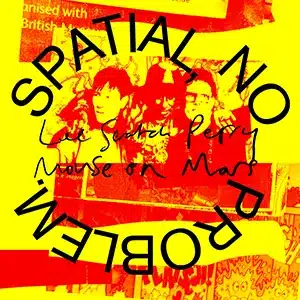
Lee “Scratch” Perry became a legend for his production and the influence it had on reggae, dub, electronic music, and more. Ironically, though, for the last 40-odd years of his life, he was known for something else. Of course, many albums bearing his name were released. Since the dissolution of his Black Ark Studio at the turn of the 1980s, however, Perry for the most part backed off of production, to the extent that, when he was persuaded to get back behind the mixing desk for Back on the Controls (2014), it was presented as something of a novelty.
Instead, the music was made under the guidance of a succession of talented collaborators, from Adrian Sherwood and Yello’s Dieter Meier to Mad Professor and the Orb. It was Perry’s presence, his mystical, shamanic aura, that these producers sought to capture. When the German electronic duo Mars on Mars found themselves in the studio with Perry in late 2019, they didn’t realize they were getting the last chance to capture Perry’s essence on tape. Perry died in 2021, and thus Spatial, No Problem becomes his final (official) recorded testament.
Why did Spatial, No Problem linger for six years between recording and release? No answer has been given, but it wouldn’t be surprising to learn the project struggled to find a label, especially before Perry’s death. He had become unpredictable and if not exactly a self-caricature then an amusing, oft-mumbling guest star on the records that bore his name. Truth be told, that is the case on Spatial, No Problem as well. In his soft voice, Perry peppers each of the eight songs with declarations like, “I’m the reggae-man / I got stung in de bum,” rhymes “peep” with “sheep”, and is generally his usual goofy, charismatic self.
With Lee “Scratch” Perry’s role quite well-established, Spatial, No Problem, like so many latter-day Perry albums, ultimately comes down to how effectively his collaborators complement him. Mouse on Mars and the session musicians they employ acquit themselves fairly well. The colorful, electronics-driven backing they create is just varied enough, just dubby enough, and just clever enough to keep the listener engaged, regardless of what Perry is up to.
In a few cases the music really jells with Perry, and the result is greater than the sum of its parts. Invariably, these are the more moody, ominous-sounding tracks. On these occasions, Spatial, No Problem is almost special. Beneath Perry’s fuzzy, lovable uncle persona, some darkness still lurks. It’s there on “Economic Train”, amid tribal percussion, eerie flute loops, and angry Afrobeat horns. It’s there on “Spatialee” as well, as Perry moans over a sparse, cavernous Arabic drone, as sound effects ripple into the distance.
The closing, eight-minute “State of Emergency” is most effective, though. Perry bemoans a “state of emergency in Jamaica” as horns tune up and swell in the background. A slow, crushing beat drives the song onward until it reaches a crescendo of wailing and cacophony. That Perry is absent from this harrowing final movement is immaterial; he has already cast his spell over the proceedings, as if he were a priest presiding over the most haunting of voodoo funerals. Or, perhaps he is giving a final warning to the living. On these highlights, the detached, almost incidental nature of Perry’s voice only adds to the feeling of portent.
Alas, none of the other five tracks on Spatial, No Problem can attain such an enveloping atmosphere. “Rockcurry” puts an incessant krautrock rhythm into play, and the more ramshackle “To the Rescue” evokes Island Records-era Tom Waits. A few other tracks easily fall into the category of inoffensive filler.
Who knows exactly what or how much material Mouse on Mars were left out of which to concoct Spatial, No Problem. Had the entire record matched the bewitching quality of the few standouts, it might have been a true late-period masterpiece. At its best, it is still a reminder that, even in his final decades, Lee “Scratch” Perry was a more serious and complex figure than his image might have suggested. Maybe the Upsetter was always at the controls after all.