
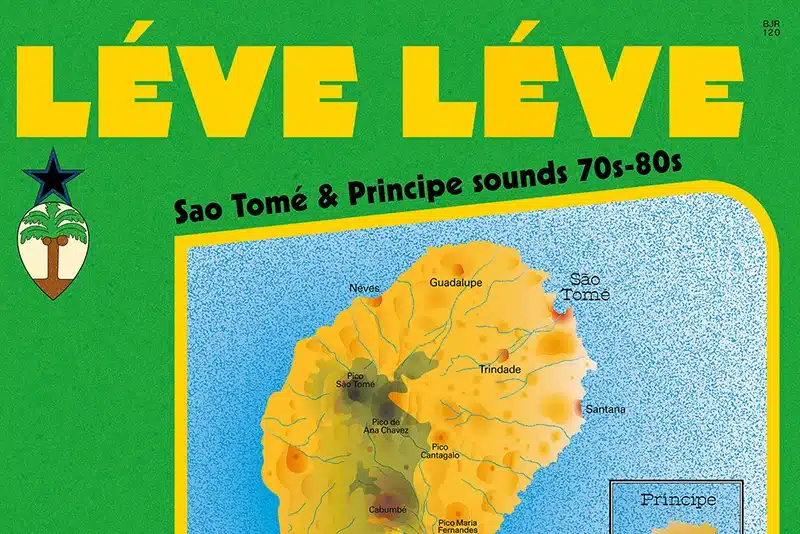

Swiss label Bongo Joe continues to dig into the early years of an independent São Tomé and Príncipe on the second volume of Léve Léve, a compilation of popular music from the 1970s and 1980s. With a focus on puxa, a musical scene drawing from Haitian, Congolese, Angolan, Cabo Verdean, and Brazilian styles, it offers a lively sonic exploration of liberation across the Black Atlantic, with an emphasis on building coalitions among Lusophone nations. It’s music made to stir and uplift the hearts, minds, and bodies of a country charting its own path after hundreds of years of colonization.
In detailed liner notes, Thomas Bignon, aka DJ Tom B., gives us an historical overview of the nation at hand. The islands of São Tomé and Príncipe were uninhabited before Portuguese colonization; accordingly, Tom B. initially focuses on European imperialism in the area, beginning in the 15th century. Settlement leads to exploitation, both of São Tomé’s rich soil and its location near the western African coast, as Portuguese agents use the archipelago as a key location in the transatlantic slave trade. It’s an atrocious start that makes stories of the nation’s movement for self-determination all the more important, including those of the “golden age” of São Toméan music, which began in the late 1960s.
Many such groups are included here. Longtime followers of Bongo Joe’s archival releases will certainly recognize África Negra, one of São Tomé’s foremost 20th-century bands. Léve Léve Vol. 2 features two of their tracks, the first of which, “Apoiámos a luta dos nossos irmãos” (“We support the struggle of our brothers”), is a public show of solidarity with other African nations working against Portuguese rule. With breezy percussion and guitars backing calls of support for comrades seeking freedom and justice in Namibia, Zimbabwe, Sahrawi, Angola, Mozambique, Guinea, and Cabo Verde, the song stands as something of an ideological and musical anchor for the album. Later, the group’s track “Simoa” makes for an even brighter dance tune.
There are, though, a multitude of voices on Léve Léve Vol. 2. Four of the album’s most sprightly tracks are by Sangazuza, who have been making music continuously with varying lineups since 1969. Tiny das Neves and his group Sol d’África contribute the album’s biggest earworm, “África é”. Pedro Lima and group Os Leonenses bring smooth and soulful vocal harmonies to the table on “Sossegado” and “Mêm de mina mue.” Conjunto Equador’s “Maia da môle” and “Pecado dy mundo” are especially sunny group pieces.
The second volume of the Léve Léve series is just as vibrant a celebration of São Tomé and Príncipe’s early independence as the first. Its focus on the revolutionary aspects of São Toméan popular music makes it vital to understanding the nation within broader formations of the Black Atlantic and pan-Africanism. In his liner notes to the album, DJ Tom B. notes that the Lusophone world today consists of more than 200 million people across South America, Europe, Africa, and Southeast Asia. Listening to this installment of Léve Léve sheds light on some of the many musical flows that have crossed this vast community.