
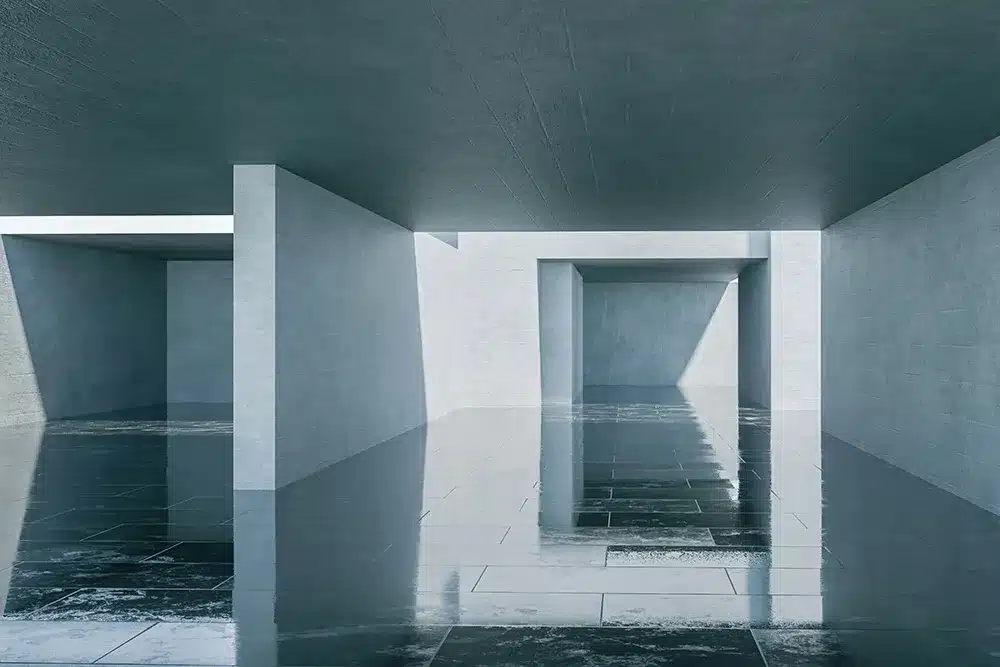
Imagine you are in a place called the Poolrooms: an infinite complex of white-tiled floors and corridors, covered in a few feet of lukewarm, blue-green water. Save for you, no living things inhabit this place. You hear no sound besides your own footfalls and your breath in the humid, chlorine-scented air. What would you feel in this liminal space? Trepidation, unease, horror?
Or would you find yourself… strangely calm?
With countless “found footage” compilations on YouTube depicting this space, alongside the works of visual artists such as Jared Pike, the Poolrooms are a viral example of a liminal space, one that carries a complex emotional resonance. While some viewers report feeling terrified by the space, others find themselves longing to exist there. “Idk if I’m crazy, but I feel this to be oddly comforting,” wrote one commenter in a response to a Poolrooms video. With 1.3k upvotes, many others seem to agree.
The Poolrooms are one popular example of a broader phenomenon you may have encountered under the descriptor of images that feel “off” or “strangely familiar”. These are liminal spaces, and for a certain corner of the internet, they constitute a cultural meme, a shared emotional language. Through the creation and circulation of liminal space media, fans are collectively shaping a modern horror genre defined by its ability to both comfort and unsettle.
When so many liminal space images seem uncanny or even eerie, why do we still find comfort in them? Why do we long for liminal spaces?
Many feel drawn to liminal spaces for their ability to simultaneously evoke both comfort and unease. They signal a complete unknown, yet feel almost recognizable, as if recalled from a dream or a long-forgotten memory. They render environments once familiar to us strange.
For many in the liminal space community, this uncanny eeriness actually enhances their comfort. It sparks a desire that burns right alongside trepidation, what YouTuber Connor McGrath calls “a longing, a subconscious call to come home” – not to any home that exists in the real world, but to one we might discover in the dimly lit corridors and endlessly rippling waters of a liminal space.
This comfort partially stems from recognition; many fans view liminal spaces as emotional and psychological landscapes, mirrors reflecting the inner self. They capture a state of uncertainty and limbo that many relate to, especially after the COVID-19 pandemic thrust much of the world into a prolonged state of in-betweenness.
As YouTuber Scrabbl notes, “sometimes we see in art a reflection of ourselves and what we’re going through,” and liminal spaces offer precisely that: a space to process the complexity of living in transition. We feel safe imagining ourselves in these spaces because they allow us to confront uncertainty without consequence, embracing the in-between as familiar rather than frightening.
Yet these spaces are not simply transitional; their comfort and relatability are also rooted in their internal contradictions. Our modern, chronically online understanding of liminality has diverged from the term’s original use in anthropology, making what counts as a “liminal space” today slippery and diverse. While traditionally, liminality describes something in an intermediate, transitional, or “in-between” state, internet users today also define liminal spaces by their impossibility or “wrongness”.
Remember “spaces that just feel ‘off’”? Liminal spaces feel this way because they function as what feminist writer Sara Ahmed calls a “disorientation device”: they take a familiar object and make it strange. They strip a place of context and purpose until it becomes impossible to understand why or how it exists.
Liminal spaces embrace the ambiguity of the “both/and” and reject the certainty of the “either/or”. Opposites coexist here, and what was formerly impossible becomes possible: unfamiliar spaces turn familiar, beauty thrives alongside horror, transience becomes endless. Liminal spaces refuse to be comprehensible within the context of normal life. They comfortably inhabit contradiction and are purposefully disoriented away from expectation.
Have you ever felt as though you don’t fit into the “box” laid out for you, unable to reconcile your own contradictions, stuck in a constant state of flux? We often attempt to categorize ourselves to define our experiences, but recognizing ourselves within liminal spaces suggests that the self is liminal, fluid, and shifting; contradictory, and resistant to classification. By accepting that multiple contradictory things can be true simultaneously, we open new avenues for alternative forms of existence.
Circulating video links and screenshots of liminal spaces allow us, as fans, to identify what resonates with us and, metaphorically, come home to the type of existence we long for. By becoming theorists of liminality ourselves, we make the impossible imaginable.
When we use liminality to explore the seemingly incomprehensible, liminal spaces begin to feel queer: not fixed, not categorical, and outside of normal conventions. They suspend the rules of day-to-day life, celebrating ambiguity and embracing fluidity. Seen expansively, queerness is a mode of being that resists systems like heteronormativity or the gender binary. It challenges the idea that the self can be meaningfully restricted to a category.
The queer self exemplifies the both/and, comfortably inhabiting multitudes, contradictions, and absence. Like liminal spaces, queerness reveals the restrictions of binary distinctions and the lived reality of in-betweenness. As Ahmed suggests in her work on queer disorientation, deviating from the norm to disorient familiar objects can be a source of pleasure, allowing other possibilities to “dance with renewed life”.
Liminal spaces offer a clear example of this process. An abandoned office building is no longer governed by the expectations and rules that once defined it, so it becomes anything and nothing at once, a site of potential and experimentation.
This is precisely what YouTuber Kryptid Kiwi longs for: without norms, “I make my norm,” free to do anything or be anyone because “I’m not bound to what ties our roles in reality.” Liminal spaces allow the self to exist without expectation, posing a quiet but radical question: who would you become if you didn’t have to be anyone at all?
Seen this way, liminal spaces function as rehearsal rooms for alternative ways of being–sites of expansive potential for the self. Viewing these images allows us to take a breath, step back from the pressures of modern life, and, as EP Studios puts it, “linger in the unknown, finding meaning in the transition itself.” It’s here that we can confront the paradoxes of the self and embrace the messy process of becoming.
Though we cannot physically enter most liminal spaces we see online, cultural theorist Tania Zittoun asserts that engaging with liminality enables the mind to reconfigure itself, prompting lasting transformations that persist even after we return to daily life. Longing for a reality different from our own becomes an invitation to imagine how our present might change.
Liminal spaces encourage us to face the unknown within ourselves and to honor one another’s contradictions and multitudes. They mirror the indeterminacies of a self that cannot be neatly categorized and affirm the ambiguity of the in-between. By approaching liminal spaces through the lens of queer liminality, we can imagine alternatives to the constraints of modern life–– and perhaps even carry this sensibility beyond our screens, into the world itself.
Works Cited
Ahmed, Sara. “Conclusion: Disorientation and Queer Objects”. Queer Phenomenology: Orientations, Objects, Others. Duke University Press. 2006.
Broogli. “The Sad Happy Reality of Liminal Spaces”. YouTube. 24 July 2023.
EP Studios. “The Comfort of Liminal Space.” YouTube. 23 March 2025.
Jeffrey, Amy. “Introduction.” Space and Irish Lesbian Fiction. Routledge. 2022.
Kryptid Kiwi. “Liminal Spaces and Questions of Our Existence”. YouTube. 29 August 2025.
Matt Studios. “Poolrooms – Don’t Get Lost (Exploration Footage #2)”. YouTube. 28 May 2022.
McGrath, Connor. “I Long for Liminal Spaces.” YouTube. 3 March 2025.
Pike, Jared. “Dream Pools”. Jared Pike. Accessed 1 January 2025.
Scrabbl. “The Comfort of Liminal Spaces (and The Desire to Disappear)”. YouTube. 4 September 2022.
Stenner, Paul. “Introduction: Throwing Psychosocial Studies in at the Deep End.” Liminality and Experience: Studies in the Psychosocial. Palgrave MacMillan. 2017.
Turner, Victor. “Liminality and Communitas.” The Ritual Process, edited by Roger D. Abrahams. Routledge. 1969.
Zittoun, Tania. “From Liminalities to Limbo: Thinking through Semiotic Elaboration.” Experience on the Edge: Theorizing Liminality. eds Brady Wagoner and Tania Zittoun. Springer. 2021