
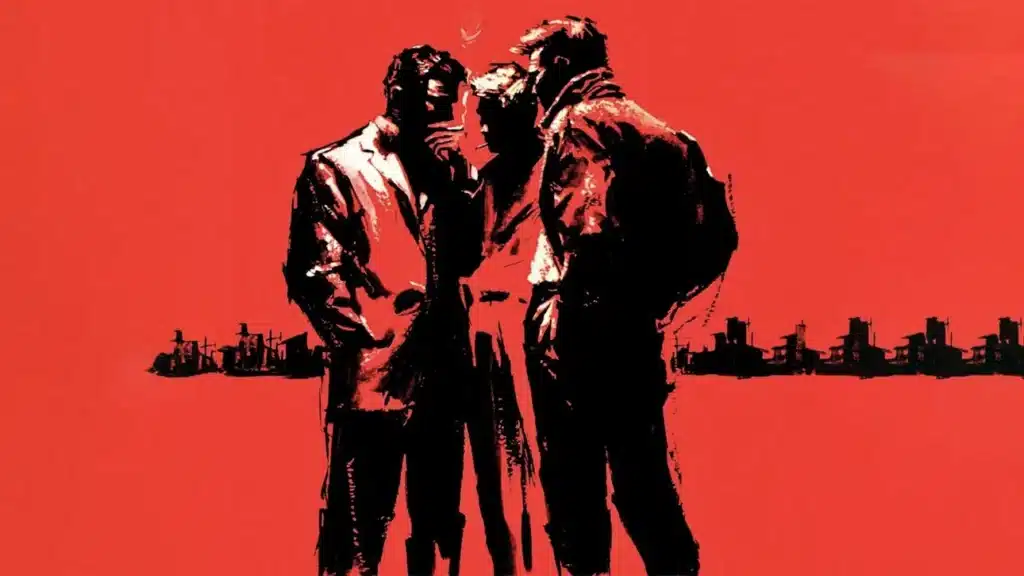
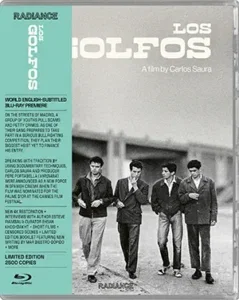
Los Golfos lives! It took 65 years, but filmmaker Carlos Saura has finally bested General Francisco Franco, whose regime censored that debut picture in 1960. Now, Los Golfos (or “The Delinquents”) is available for the first time on Blu-ray courtesy of Radiance Films, meticulously restored in 4K from the 35mm acetate negative.
Like much of Saura’s early work, his first feature is overly indebted to Luis Buñuel‘s Mexican period, but it’s nonetheless an important film. In terms of cinematic evolution, Los Golfos bridges the gap between European neorealism and cine quinqui, the “delinquent cinema” that would become so popular in Spain.
Los Golfos is a misleading introduction to Saura’s filmography, which includes Cría Cuervos (1976), Carmen (1983), and Tango (1998), as it initially bears little resemblance to his colorful, often fanciful, and deeply psychological later work. It’s a gritty, black-and-white slice-of-life, a study of youth on the streets that’s reminiscent of Buñuel’s Los Olvidados (1952) and Federico Fellini’s I Vitelloni (1953).
There is no hallucinatory allegory, psychosexual probing, or vibrant musical moments, as one can expect in later Saura films. Instead, Los Golfos finds a future master flexing his moviemaking muscles, engaging in trial and error, and getting his influences out of his system.
Carlos Saura’s debut follows several of the titular delinquents as they steal to survive, sometimes brutally beating innocents in the process. Eventually, a collective purpose forms as they band together to criminally raise the money needed for Juan (Óscar Cruz), a wannabe torero who needs cash to become a bona fide matador.
One could argue that their organizational efforts to rob the Spanish bourgeois and actually climb out of poverty (and literally kill the bull) is a reflection of socialist resistance against Francois Spain, but Los Golfos is really just a matter-of-fact realist melodrama by way of “youth in revolt” cinema.
While Los Golfos was the first feature film to be entirely filmed on location in Madrid, it mostly exists on the literal fringe, in the poverty-stricken margins of the city. It’s a supremely tactile film in that regard, hot and dirty, where even the most beautiful people have flies on their arms and grease in their hair.
Composed of mostly non-actors, Los Golfos is perfectly cast, with everyone looking just like themselves, their faces accurately reflecting their attitudes. There’s a sympathetic mixture of meanness and innocence strewn across each young visage, all except for the softer, more sentimental bullfighter, Juan.
Luis Marín, who went on to become a reliable actor in Spain, has a permanently aged face like Charles Bukowski’s and a jaw that could probably bench press. He’s phenomenal as Ramón, the de facto leader of the gang, and he somehow warrants compassion despite his crimes and cruelties.
With help from the pitch-perfect casting, Saura engenders empathy toward his young performers by including tiny moments that humanize them without any narrative necessity. Case in point: watching Ramón walk into a nightclub, his tough demeanor fading into awkward insecurity as he waits for a dancing couple to move out of the way, fills in more details than minutes of expository dialogue could have.
That said, Los Golfos is lacking in connective narrative tissue. The film was originally censored in Spain (with ten minutes cut when it was finally distributed three years after its Cannes premiere), and while this release restores Saura’s uncut debut, it sometimes seems like pieces are still missing.
There is little in the way of emotional establishment, and a randomly emerging romantic subplot seems to have been lifted from a different film to inject more drama into the third act. As such, the script (from Saura, Mario Camus, and Daniel Sueiro) exists in a purgatorial space between the relatively plot-less freedom of some neorealist films and the excesses of delinquent youth melodrama.
Carlos Saura could take any script and translate it into interesting cinema, though. The director’s penchant for graceful camera movements and tight, exciting editing is already on full display in his first film, with enough stylistic confidence to separate Los Golfos from the pure neorealism of its continental peers.
The nightclub scenes are wonderfully staged, and a chase through the streets is gripping in its fluidity. The finalé is exquisite, appropriately anti-climactic in a sadly deflating way that reflects the only true trajectory of the poor, especially under fascism – they want to be the matador, but maybe they’re the bull.
The Radiance release of Los Golfos comes with two invaluable interviews that provide detailed context for the film, its political atmosphere, and the careers of both Carlos Saura and his incredible producer, Pere Portabella. Even more exciting are Saura’s early short films included on the disc: 1955’s brief but thematically prophetic La Llamada and 1957’s La tarde del domingo. The latter is a powerful piece of proletariat cinema, a 35-minute study of a live-in maid that cleverly focuses on labor and fascism by existing within the character’s very brief time off.
Combined with the gorgeous restoration (and incredible sound), Los Golfos is a strong release from Radiance, even if the film itself is more a historically important prelude to an auteur’s career than a masterpiece in its own regard.