
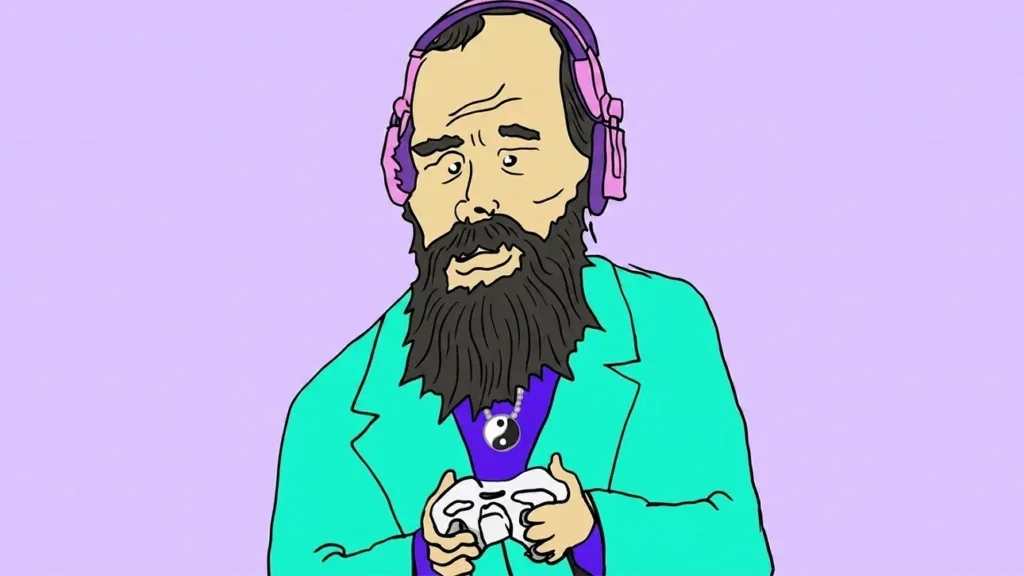

When I first heard the music of LOSTBOYEVSKY, I was weeks away from my first real encounter with collegiate philosophy. The hyper-referential “Herd to Ubermensch” reminded me throughout that semester that philosophy, at its core, can be extremely fun when in the right circles. I just needed to find those circles.
In addition to his music, which can be heard on Bandcamp and Soundcloud, he tweets as LOSTBOYEVSKY, and runs the website Refine the Mind. New music is on the way, but in this conversation, the man behind the moniker, Jordan Bates, discusses his debut full-length project.
I tracked down the mastermind behind the song and found he’d released a full-length project, Rhymes ‘N’ Puns ‘N’ Shit. After listening to it, I realized I’d found the rapper to fill the void left by Das Racist, as well as my favorite rap project of the year. Via email, LOSTBOYEVSKY chatted with me about the album, art rap, and performing in South Korea.
I had two main objectives with the project: 1. to try to characterize the modern world (this is more where the technology stuff fits in), and 2. to touch on more universal/not-period-specific themes, i.e., the general existential predicament of being a human being.
What’s your background, and how did the LOSTBOYEVSKY project get started?
Well, I guess I loved rap music from a young age and started making goofy, parody-type songs with friends in late high school. Then I ended up getting pretty into freestyling and would just practice at random times.
Eventually, I just started writing down a bunch of the lyrics and focusing more on writing. Then I taught English in South Korea, and while I was over there, I had a lot of time on my hands, so I bought a mic and just started recording in my apartment.
So all of Rhymes ‘N’ Puns ‘N’ Shit comes from South Korea?
Yeah, the majority of Rhymes ‘N’ Puns ‘N’ Shit was written and recorded in South Korea.
What’s breaking out in your philosophically dense art-rap, like in South Korea?
I don’t think anyone over there had much knowledge of art rap, and most people seemed kind of bemused and baffled by what I was doing, but also kind of interested because it stood out as distinctly different from other rap people had been exposed to. But these were small, local shows, usually maybe 30-40 people in a bar. The biggest show had maybe 100 people.
Please explain what “art rap” is.
I’d love to teach a class on rap, focusing more on the avant-garde, experimental, “art rap”-type stuff I’ve encountered. I honestly don’t draw much of a distinction between “art rap,” “experimental rap,” or “alt rap.” I think I wrote in a blog post that art rap seems more conscious of itself as a divergent movement in the history of rap or art more generally, and tends to draw on a broader array of cultural knowledge/lenses that may have been historically underrepresented in rap or art more generally.
I’ve noticed a lot of the lyrics [in art rap] being especially grounded and practical with regard to discussions about life. How much do you think that commentary on the average millennial experience has to do with the current state of the genre?
Rappers like Open Mike Eagle and Milo stand out as guys who are really grounding their lyrics in day-to-day lived human experience. That’s part of what they, specifically, are trying to do: take rappers and celebrities, generally, down from this pedestal in the sky and unveil them as what they truly are: human beings. I’m reminded of Milo’s lyric “I want to redefine what stunting is” and Open Mike Eagle’s song “Celebrity Reduction Prayer”.
A big part of what those guys are doing seems to be trying to avoid the traditional divide between the heroic, all-star rapper and the roaring masses, and instead connect with people on a human level, being vulnerable and sincere. It reminds me of how David Foster Wallace thought that a ‘New Sincerity’ might be the replacement for the ironic detachment that dominated art during the late 20th century. I know Milo was heavily influenced by DFW, and so I see a lot of what those guys are doing in terms of DFW’s prediction.
It’s interesting because rap has always been about “keep it real”, and there’s this huge emphasis on authenticity. It’s actually been a relatively small number of rappers throughout the history of the genre who have shown the vulnerability necessary for a truly authentic connection.
Yeah, and in the LOSTBOYEVSKY project, do you think you manifested that well, where the fears are coded within all these technological absurdities, or was it more reference-based only?
It’s there to an extent as an underlying current about the state of the world, about mankind’s shortcomings, about existence in general, death, etc. But that aspect of the project is not the main focus and is probably, to some extent, obscured by the silliness/jokiness, the overwhelming amount of abstract content, and the project’s overall tone.
This first project was more influenced by Das Racist and specifically KOOL A.D., but I’m actually working on some music that is moving in a more melancholy, sincere direction because I’m interested in exploring that space. What did you think about that aspect?
I have a skewed perspective because I share the same fears; maybe I projected mine onto them. One of the songs that struck me was “Dragonball Z on a Macbook”, and like, here’s my Macbook. If you’re not aware of hearing all the possibilities of this machine, not just tacitly “Yes, I know, I can do things with my Macbook”, then you can be afraid of technology.
I think I see what you’re saying.
Also, the line you’ve got about Candy Crush, that geeks me out, too. It’s Bejeweled [the game]. But these people have made money from Bejeweled in various ways. What does that say about the ability to actually progress?
Right, yeah, I think the unconscious use of technology scares me the most. The sheer mass of people who will spend their lives bathing in the surface-level diversions technology offers and never consider how it could be used more meaningfully, or the dangers of using it unconsciously. Dangers, i.e., handing over large amounts of data to corporations, not understanding that your Facebook feed is algorithmically selected to reinforce your pre-existing biases and assumptions, etc.
I certainly don’t claim to grasp all of the implications, but you’re right to intimate, if this is what you’re saying, that a couple of those songs on Rhymes ‘N’ Puns ‘N’ Shit were very much about expressing anxiety about the present tech-saturation and just generally making people more aware of how these devices and apps and corporations have infiltrated our lives.