

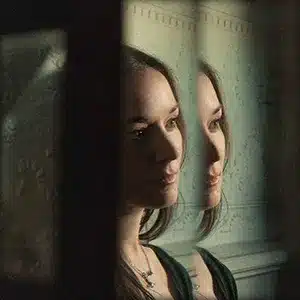
Margaret Glaspy’s latest album, I Am Both, is a low-key masterwork of observational wisdom, lilting melodies, and sharp wit. She delivers her stinging lines with a conversational ease, wielding the authority of hard-won experience over ringing guitar licks that echo the guilelessness of her storytelling. Her intimacy compels us to immediately identify with the singer, even when she is singing about people other than herself. In her world, we are all fucked up, but we don’t have to be. You and I are not inherently complex, even in our contradictions.
On songs such as the dreamy “Common Ground” and the more somber “Petty”, the singer bites off lyrics about mutual disappointments. She keeps the lyrics simple to show how basic and trivial spitefulness can be, and at the same time so complex and inflammatory: “I thought we were on the same page / Apparently not / I am in a silent rage / I am sorry,” she sings. We are hypocrites who blame others for our own faults. We refuse to speak, yet blame others for not hearing.
Glaspy can get bitter on other tracks, such as “Sharp Knife” and “Wildest Dreams”. We know reality can be cruel, other people mean, and life can suck. One needs to be protective but not cynical. There is always a hopeful edge even on the darkest material. Hence, the album’s title song, “I Am Both”, describes our internal inconsistencies. She notes that we can always change our minds about who we are, who we love, and who we want to be. More importantly, we do not have to choose. As Walt Whitman famously noted, we contain multitudes.
The album is full of these beautiful dualities, from the city-versus-country vibes of “Michigan”, the sensual love story of opposites “That Rose”, and the struggling couple “James and Marie”. Glaspy leaves these dichotomies unresolved. Her singing captures the yearnings, pleasures, and pain through small intonations. A sigh here. A rush of words there. She strums her guitar to further her narratives and then makes abrupt shifts in tempo to reveal a throbbing heart or a quiet moment of contemplation,
Joe Henry (Bonnie Raitt, Aimee Mann) produced the record. He employed a small combo of top-notch session players (Jay Bellerose: drums and percussion, Patrick Warren: keyboards, Ross Gallagher: upright and electric bass) to provide a sparse, comfy backdrop. The album sounds personal and familiar without studio gimmickry. There are times when it is just Glaspy’s voice singing in a void, before the brush of a drum skims the skins or the pluck of a string changes the mood.
While I Am Both mostly addresses one-on-one relationships, Glaspy looks outward on the softly compelling “Martin Luther King Jr.” It tells stories of the victims of poverty and cruelty. The world can be a harsh place and kick you when you are down. But the singer urges us to remember the words of the Reverend King: “Darkness cannot drive out darkness / Only light can do that / Hate cannot drive out hate / Only love can do that.”
Margaret Glaspy delivers these words of wisdom warmly. They are important to remember when one gets discouraged by the current state of the world. This song hits in the middle of the album when it might seem more appropriate at the end, but I guess that many listeners will put the track on repeat after the record is over. The song’s beautiful message lingers long past its playing time.