
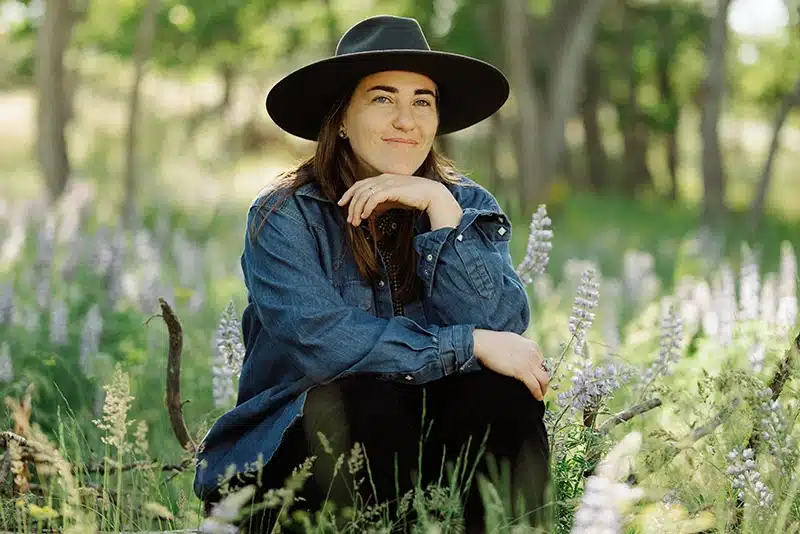

Margo Cilker describes her third album, Little White Cross, as a concept record whose premise is “essentially that she got really sad and went to Texas”. That’s a bit of an overstatement. Several of the songs are bleak. Cilker addresses the personal costs of violence, the loneliness of grief, and what happens when love does not just work out, and other somber topics. Yet her performance has a hopeful edge. She sings as a witness, not a victim.
Six of the ten tracks are covers and four are originals, but they fit together thematically. Her friend and songwriter Christy Hays wrote the title cut. The “Little White Cross” referred to is one of those homemade memorials on the side of the road devoted to someone who died in a car crash. The lyrics celebrate that the plastic flowers and other items remain undamaged, except by nature, after a year has passed. Life may be fleeting, but grief endures, embodied in the weathered objects left by the roadside.
Then there’s Cilker‘s self-penned slow waltz, “Pauline”, about a waitress and single mother who had an exuberant spirit and a hard life. The title character liked to party, and maybe her death was an accident. Or it could be suicide. The singer observed Pauline’s behavior over time but kept her distance. She now feels complicit because she never befriended Pauline. The singer feels guilty because she doesn’t feel guilty. Much of the meaning comes across in the way Cilker enunciates the lyrics. Her understated delivery suggests a weary acceptance: life is often sad, and suffering remains an unavoidable part of the human condition.
Her country rock version of Tom Petty‘s “Walls” offers a more positive take on dealing with life’s obstacles. The music is led by the rhythm section of Lisa Pankratz on drums and bassist Scott Davis, who take a big bang and clang approach to the melody. One could easily march in time to the music and knock down the “Walls” that separate us from each other and our desires.
Texan Bruce Robison (Charley Crockett, Flatland Cavalry) produced the album (with Cilker) live to analog tape at The Bunker in Lockhart with an all-Texas backing band that included pedal steel player Eric Heywood, guitarist Geoff Queen, and fiddler Beth Chrisman. Cilker is a Pacific Northwest-based Americana artist with deep California roots. Robison makes her music sound like it comes from Austin. The results are not without drawbacks.
In songs such as Ian Tyson‘s “Road to Los Cruces” and Cilker’s own “State Line”, the music is imbued with a Western sensibility of wide-open spaces. The instrumental tempos suggest a cinematic landscape that fits the material. As a vocalist, however, Cilker is less distinctive than she is as a songwriter. She could be any competent vocalist with a slight drawl. Cilker does not have a conventionally great voice. She rarely strays far from the middle of her vocal range, favoring nuance over technical display.
Cilker’s expressiveness makes her special. In songs such as Kevin Carducci’s The Money, her compositions “Maryhill Peaches, Goodnoe Pairs” (co-written with Forrest VanTuyl) and “Molly and Me”, the Northwesterner in her emerges. Robison keeps the instrumentation minimal to imply the singer’s loneliness and the hard-earned joys of the songs’ narrators. As a result, these songs are more effective.
Ultimately, Little White Cross succeeds not because it dwells on sadness but because it finds meaning within it. Margo Cilker’s voice may not be conventionally commanding, but her gifts as an interpreter and storyteller give these songs weight.