
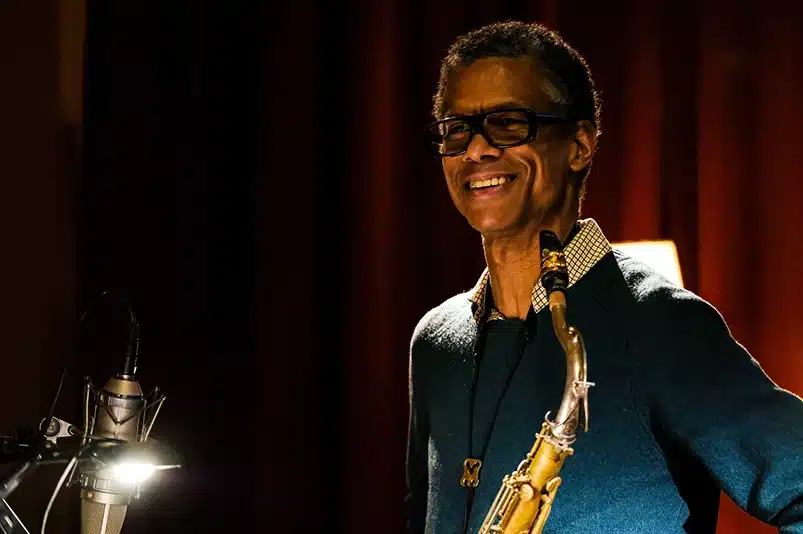
Tenor saxophonist Mark Turner is an improviser’s improviser—other musicians speak of him with great respect, and his playing is often cited as an influence. His associations with a group of musicians from his generation, such as guitarist Kurt Rosenwinkel and the cooperative trio Sky (with bassist Larry Grenadier and drummer Jeff Ballard), have aged very well—he was part of a scene that made thoughtful, serious jazz for a new era. Turner has always been collaborative and wise, playing with elders like drummer Billy Hart and adding brilliance to new bands such as Linda May Han Oh‘s ensemble.
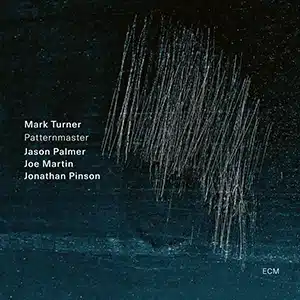
As a leader, Turner rarely shouts from the mountaintop. His new album, the self-consciously titled Patternmaster on ECM, is quiet but intense. The band are made up of Turner’s tenor, trumpeter Jason Palmer, bassist Joe Martin, and Jonathan Pinson on drums. The choice to work without a chordal instrument makes sense for Turner and his music, which is elegantly defined on the new album by the interplay of melodic and rhythmic patterns woven by the quartet.
If that sounds somewhat dry, fear not. Yes, this is an ECM recording, with a slight coolness in the way the instruments are recorded. The music is seldom fiery or aggressive, but the writing and playing are defined by democratic interplay. It’s a riveting conversation that doesn’t get stale.
“Supersister”, for example, starts with a complex hi-hat pattern from Pinson that interlocks with a sycopated, funky bass line. The horns play in parallel harmonies that wind up and down with a sense of surprise, a theme that keeps unspooling with increasing excitement. After Palmer and Turner start collectively improvising, you are that much more surprised by the outbreak of a drum solo for Pinson. Can you be more pleased when the whole performance slows to a funky version of 6/8 at the mid-point, setting up a solo for Martin’s bass? The sensual, slow second theme finally brings the band back to the opening groove, melding it all. Patterns, indeed.
A favorite tune here is “Lehman’s Lair”, presumably written for alto saxophonist Steve Lehman, with whom Turner has often performed. It is built on a groove that puts three against four, time always surging and then floating in the air. Palmer’s cool trumpet melody is harmonized by Mark Turner, but with a contrapuntal rhythm. The two lines are constantly falling behind and catching up to each other.
As the horns begin improvising, they similarly intertwine, trading licks but also overlapping, never respecting too much some rule you might get bored with. They are chattering and gossiping, and I hear it as music with some lineage back to Charles Mingus‘ group with Ted Curson and Eric Dolphy. The connection is not sonic but more an attitude: the band are here to play, to talk, to fool you a little, but they are doing it in mid-air like trapeze artists, and it grooves.
The title track, “Patternmaster”, finds the horns playing a snaking unison melody against a parade groove in a time signature that shifts and hides, a New Orleans feel on acid. This kind of music is not avant-garde or unpleasant, for all its challenges. The melody is, indeed, made up of patterns that wheel about in tonal variety but harmonic logic. Your toe taps, but maybe irregularly. It’s music that dances, most certainly, but it has a whirling quality rather than the butt thrust of funk music.
Most notably, this track and all of Patternmaster have a light quality. The quartet play assertively, and there are surely specific lines that the musicians attack with precision and fire, but the overall quality of the music is something like levitation. Without a guitar or piano constantly feeding harmonic changes, the players whir and tap dance, spinning up into invention. That may sound too poetic to make sense, but that is the feeling of this band.
“It Very Well May Be” uses a stoptime approach from the rhythm section in support of a melody that hopscotches like bebop, alternating sections of four-on-the-floor swing (both fast and slow) with surprise halts, sudden patterns of groove, you name it. Mark Turner, Palmer, and Martin seem to be jumping across a rushing stream, stone to stone, as they solo.
Even on songs with a moderate pace, such as “The Happiest Man on Earth”, Turner writes melodies that enchant. This tune uses a slow triple meter and, ironically, is draped in blue tonalities and minor chords. Still, when Turner takes the featured solo, he manages to elevate your mood—working the full range of his horn and chattering with the drums. Palmer then uses his trumpet to enchant, dashing into moments of double-time, then pulling back and finding the blues.
Patternmaster is quietly playful, subtly thrilling. While Turner and Palmer are the “front line”, Martin’s bass and Pinson’s percussion are never in the background, and the quartet sounds particularly balanced and democratic in a recording that doesn’t favor any instrument over another.
The concept of this kind of quartet in jazz—two horns, bass, and drums—goes way back to Gerry Mulligan, at least, up through Ornette Coleman and Mingus, and neatly zigs through John Zorn‘s Masada group and many others since. Mark Turner uses the form in a modern, up-to-the-minute way, harnessing complex time signatures and forms, but he also pulls the past up into the present. As with his own playing on tenor saxophone, the history co-exists with the present in Turner’s music.