
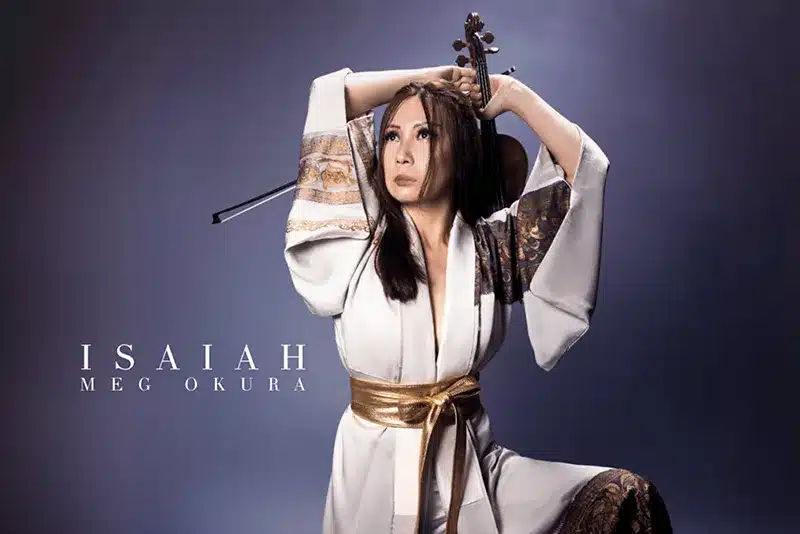
Violinist and composer Meg Okura occupies a space between classical music, world music, and jazz. Which is to say, she plays just about anything — she leads the Pan Asian Chamber Jazz Ensemble and has worked widely across stylistic boundaries. Born in Tokyo and trained in classical music, she can produce a pure, precise sound, but she isn’t shy about using electronics.
Hers is a unique blend, and her new album with the Pan Asian Chamber Jazz Ensemble, Isaiah, is ambitious and lushly accessible. Honestly, there isn’t much music made in this style these days. The recording reminds me of projects from the 1970s, when jazz musicians were reaching toward both popular music and toward orchestral music to find ways to reach upward.
In 2024, Meg Okura released Lingering, an impressive album of duets with jazz pianist Kevin Hays. There, she plays blues violin, relishes passages of Americana music that touch on folk and bluegrass technique, and there is plenty of straight jazz phrasing. Okura lives in New York, where so many of these streams overlap. It is who she is. There, you could hear her span of styles in her own playing.
Isaiah is a large ensemble version of that reach and ambition.
Okura’s beautiful “Blessing” begins as an orchestral fantasia, with the band’s harp (Riza Printup), strings (Okura, overdubbing), flute (Anne Drummond), bass clarinet (Sam Sadigursky), and brass (David Smith on trumpet and Rebecca Patterson’s trombone) creating a lush opening theme. Smith then plays a relaxed solo on muted trumpet over waltz time from the elegant rhythm section (Brian Marsella, Evan Gregor, and Peter Konreif on piano/bass/drums) as the bass clarinet, strings, and wordless vocals creep in around the edges.
Similarly, “Will You Hear My Voice” is a gentle melody that places the leader’s violin atop a guitar from John Lee and, eventually, a cannily employed full band. Lee plays an acoustic solo before the ensemble returns to feature flugelhorn, then violin, then the warm-toned alto saxophone of Remy Le Boeuf. The effect of both these performances, to my ears, is not unlike the best large ensemble work of Chuck Mangione in the 1970s or the hip orchestrations Burt Bacharach used.
Meg Okura gets after tougher stuff as well. The opening track, “Sushi Gadol”, uses a stuttering bass line familiar to any Led Zeppelin fan, but it then bursts into a burst of sunshine, followed by a samba groove beneath a flute solo. Okura’s band loves a Latin groove, and she threads it through a kaleidoscopic arrangement—handclaps, traded phrases, stop-time that lets the bass clarinet peek through, even a melodic but overdriven guitar. Again, the reference is to a 1970s recording that improves with age: Chick Corea‘s My Spanish Heart.
Isaiah is that kind of “fusion” album, not jazz-rock or jazz-funk but music that shimmies across styles with delicious but not over-sweet gloss. “Rice Country” is the perfect example. The name of this Okura original comes from the Japanese term for America, and she explains that it takes a fragment of a Japanese pop song from (when else?) the 1970s and puts it through a series of changes that often hint at the very “American” music of Aaron Copland.
There is a ho-down feeling at times, but there is a dramatic blues section for Marsella’s piano, a slice of New Orleans-style collective improvisation, and even a quick quote of the piano lick that introduces Duke Ellington‘s “A Train” that bridges a section of atonal playing to a Gershwin-esque piano cadenza.
The center of the record, however, is Meg Okura’s interpretation of “African Skies”, composed by saxophone icon Michael Brecker from his 1996 album Tales of the Hudson. Okura takes the muscular theme that Brecker played in unison with Pat Metheny and finds a whole set of new colors and textures. She composed the “Afrasian Intro”, which sets the piece with pastels and bird calls, then introduces the theme as a delicate dancing figure. Soprano saxophone specialist Sam Newsome (also Okura’s husband) plays the figure in the first pass. Then trumpeter Randy Brecker gets it the second time around, leading to his heraldic solo over throbbing pulse and shimmering, shifting harmonies.
Okura’s use of her full ensemble is astonishing on this Brecker composition. She has composed a series of accompanying grooves, counter-melodies, and highly detailed connecting sections that remake the tune as fully (more fully?) than any one great improvisation. Riza Printup gets in a cool harp interlude, Brian Marsella gets in a free and furry piano solo, and the traded licks between Brecker and Okura toward the end offer more wonderful improvising. Still, the true strength of “African Skies” (and the great bulk of Isaiah) lies in the breadth and richness of the leader’s imagination in using her band’s sounds in fresh ways.
Okura’s best moment on Isaiah as a soloist on violin is on “Jubberish”, which is her slant take on an Eastern European melody. She not only takes an adventurous solo over a deep and funky bass line, generating melodic ideas that reference the blues, the melody, and even a touch of the new thing jazz. She then plays an unaccompanied cadenza to set up the second half of the arrangement, which is highlighted by Newsome’s upper-register soprano solo. Her solo on “Isaiah” is somewhat reminiscent of the still resonant jazz-fusion violin of Jean-Luc Ponty; the song sets up a surging groove.
She is also the primary voice within the beautiful arrangement of her song “Sunset Bells”. After that, as is largely typical on the album, she grants most of the solo space to others: Brecker, playing with whiskey wisdom, and Lee’s powerful guitar.
As a whole, Meg Ikura’s new Isaiah offers both a focused individual vision and a diffuse range of musical styles and influences. Okura uses her band in a way that is not particularly hip these days — it shifts styles so easily that it can sound like a show band. At other moments, it can achieve a modernist intensity, taking a melodic motif and turning it into a pulsing accompaniment to improvisation that verges on the abstract. There aren’t many jazz musicians today who are trying to sweep Aaron Copland-esque Americana, tender jazz balladry, and earnestly accessible large band sophistication into one package.
I remember hearing Chase the Clouds Away by Chuck Mangione in 1975—a time when the flugelhorn specialist was making accessible jazz with a large band of four horns, cello, a fluid rhythm section, and some tasteful vocals. The arrangements were inventive and hip, but they had a lushness that I feared my mom might like a little too much. Well, today I am older than my mom was back then, and I still adore Chase the Clouds Away and the live The Land of Make Believe—albums that dare to present strong jazz content with a large, exciting band that connects the music to several musical styles.
Meg Okura’s Isaiah is more daring, pancultural, and modern than those albums, but it similarly creates a jazz sound that should get straight through to any set of ears.