
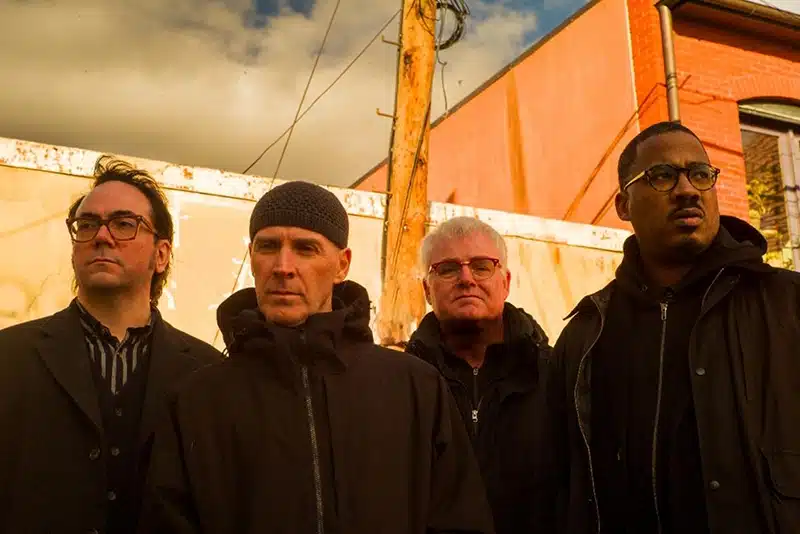

The Messthetics, a trio from Washington, DC, are a perfect example of the meaninglessness of genre distinctions in 21st-century creative music. Their fourth album, Deface the Currency—their second with the saxophonist James Brandon Lewis—is an exciting and mature blend of jazz, funk, and rock that puts the hair up on the back of your neck.
The Messthetics come from “post-hardcore” punk, but this description falls short. Bassist Joe Lally and drummer Brendan Canty are members of Fugazi, and Anthony Pirog, a generation younger, is an improvising guitarist whose style and influences are wildly diverse and free—only the category “jazz” captures him, and barely. The Messthetics‘ first two albums, from 2018 and 2019, came out on Fugazi’s Dischord Records, so maybe the description “punk jazz” should have applied.
However, if you listen to “The Inner Ocean” from their debut album, you hear atmospheric guitar jazz that John Abercrombie could have recorded on ECM Records. “Mythomania” layers electronic thrills and heroic rock guitar atop a funk groove, as if inspired by the band that Billy Cobham and George Duke once played in. “Because the Mountain Says So” from the band’s second album, Anthropocosmic Nest, has the impressionistic Americana vibe of a strong Bill Frisell recording.
With the addition of premier tenor saxophonist on 2024’s The Messthetics and James Brandon Lewis, the group pushed further into, well, actual jazz, whatever that might mean. To most ears, the group were not only using a pliant rhythm section that creates the push-pull syncopation of a classic (if not traditionally “swinging”) jazz band but also putting two masterful improvising voices in conversation. Lewis sounded like he had grown up jamming with these guys in Fort Reno Park—but with everyone’s eye on a future gig at the Village Vanguard.
A seasoned jazz fan was surely thinking: this group reminds me of the astonishing jazz/free guitar album by Sonny Sharrock, Ask the Ages (1991), featuring saxophonist Pharaoh Sanders. This wild and woolly album married punk-toned abandon and jazz sophistication. Sure enough, Lewis and the Messthetics performed that record in concert in late 2025. They know exactly what they are about.
The quartet’s new recording, Deface the Currency, is titled to suggest defiance, and the musicians are aware that their instrumental music has political resonance at this moment in history. On the opening title track, they come out of the gates not with a written theme but a wailing half-minute of freedom. Soon enough, Lewis’s tenor sax and Pirog’s guitar lock into unison lines that have the speed and clean melodic detail of 1970s jazz fusion.
If some of punk’s sense of rebellion was fueled by the fussy progressive-fusion of bands like the Mahavishnu Orchestra and Chick Corea‘s Return to Forever, this track marries Mahavishnu precision to skronky abandon. Pirog is wild and distorted, most certainly, as Lewis brings the brawny madness of free jazz predecessors, but the two also trade short phrases in jazz stop-time sections that recall Blue Note jazz sessions more than Never Mind the Bollocks, Here’s the Sex Pistols.
“Gestations” has more funk or R&B in its DNA than rock. The snaking guitar/sax unison is a blues line that unleashes into bebop right before Lewis’ solo. The whole tune is lifted by Lally’s funk pattern on electric bass, while Canty goes from a tight hi-hat pattern to splashes and accents. Here, as throughout the album, Lewis and Pirog keep their improvisations concise, but the performance ends with a mad rave-up with punkish textures.
“Rules of the Game” is similarly pocket-oriented. The short bursts of hooky melody, which alternate with delicious bits of guitar comping, would make this tune at home on a classic John Scofield album. I like to think that the Messthetics with James Brandon Lewis owes as much, probably more, to the Scofiend/Joe Lovano quartet dates of the early 1990s as it does to Fugazi. Not because Fugazi’s music isn’t just as good, but because the delicious push-pull of the Scofield-Lovano ensemble was married to immediately accessible melodies that 21st-century jazz too often undervalues.
“30 Years of Knowing” is one of Deface the Currency’s most lyrical tracks, with harmonies built of Pirog Lewis playing soaring twin lines. While Canty’s drum accompaniment is more like a messy bit of jazz drumming from Dave King (of the Bad Plus) than a polite wash of atmospherics, the composition itself seems worthy of fine guitar albums on the Nordic ECM label.
“Universal Security” is the skronkiest track, even though it begins with a quietly contemplative statement of theme. Lally and Canty create a loping groove in 3/4 that never lets up, but once the theme is completed, Pirog digs deep into the electronic effects to unleash a tsunami of bracing atmosphere. Lewis doesn’t shy away, finding strange intervals and vocal tonalities to match the guitar onslaught. The theme never returns, as the whole band eases back into quiet.
The most anthemic song, “Clutch”, immediately follows. Pirog plays a contemplative, reverb-rich introduction, unaccompanied. When the full group enter, we get their most overt blend of John Coltrane atop Fugazi. Power chords lift the saxophone to the sky, they play the melody in lock-step, and then Lewis blows a thrilling solo over a soulful rock progression. When it is Pirog’s turn to improvise, he uses a molten tone reminiscent of Jeff Beck.
The closing track, “Serpent Tongue (Slight Return)”, also employs satisfying fusion unison passages for saxophone and guitar, alternating them with collective energy. Pirog and Lewis trade lead bits during the jam, but here the conversation is much messier than what we tend to hear in jazz. They jump all over each other as the rhythm section pushes and pushes. As the groove gets quieter, the lead voices meander and collectively improvise in free counterpoint.
This portion of the album’s longest performance may be the very best of this group. Jam band fans might reasonably argue that this is what they love about their favorite music, as the group discovers new sonorities and harmonics that weren’t planned. However, when the theme cracks back for the ending, this band’s amazing intentionality creates the biggest buzz of all.
The Messthetics, particularly in partnership with such a gifted and forceful jazz player, are making music like very few others. Deface the Currency continues, revives, and intensifies a strain of the music that, in a sense, got lost. Pressing rock energy (and a bit of rock anarchy) up against jazz melody and improvisation goes back to the 1960s, but somewhere the marriage hit the rocks. The daring of Miles Davis‘ 1970s bands—with dual overdriven guitars, funk grooves, and freewheeling improvisation with few boundaries—was largely misunderstood at the time, and more approachable “fusion” tended to slide into smooth jazz.
The Messthetics and James Brandon Lewis are making fearless and unsmooth fusion again—updated and refreshed with the clarity and dynamism of the “post-hardcore” music that wasn’t around in the 1970s. It works, and it displays power and intelligence in equal measure. Never mind the bollocks, here it is.