
An outsider who, through sheer hard work, rose to the top of his industry and became a magical bringer of joy for thousands of children while giving tirelessly for charity and befriending all in high society…Only for the world to learn that his outlandish public image was a mask hiding someone who leveraged connections and financial resources to crush victims and law enforcement alike beneath a legal juggernaut, giving them the ability to abuse children and then intimidate victims into silence. Oh, you thought I was talking about Michael Jackson?
I’m talking, of course, about Sir Jimmy Savile, the British media personality to whom King Charles III used to write for advice, and Margaret Thatcher ensured that he was given a Knighthood. Maybe from this small island, in light of the unravelling of Savile’s lies and a nationwide questioning of how so many could fall for this vast grooming exercise, it’s easier to imagine someone so demonically cunning they could hoodwink millions into thinking they were a latter-day saint.
When it comes to Michael Jackson, however, I have only slim hope that a comprehensive answer to the riddles of his life will ever emerge. There are two possibilities: on the one hand, he was an innocent man who gifted hundreds of millions to charity and wished nothing more than to be a beacon of light in our troubled world. On the other hand, he was a severely damaged human so insulated from reality by money, fame, and ranks of fixers that he could indulge his ego and appetites without imagining he might be held to account for his crimes.
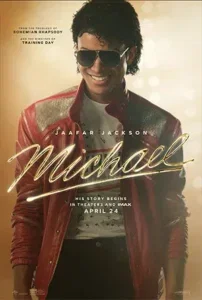
Either way, there’s more money to be made for his estate, so we welcome the inevitable film of his life, Michael. The latest product to drop off the past decade’s conveyor belt of posthumous high-budget, low wattage music biopics, expectations were subdued in light of the limited standard of quality achieved by Bryan Singer’s Bohemian Rhapsody (2018), Kasi Lemmons’ Whitney Houston: I Wanna Dance with Somebody (2022), and Sam Taylor-Johnson’s Back to Black (2024) — only Baz Luhrmann’s Elvis, from 2022, hit a compelling creative high.
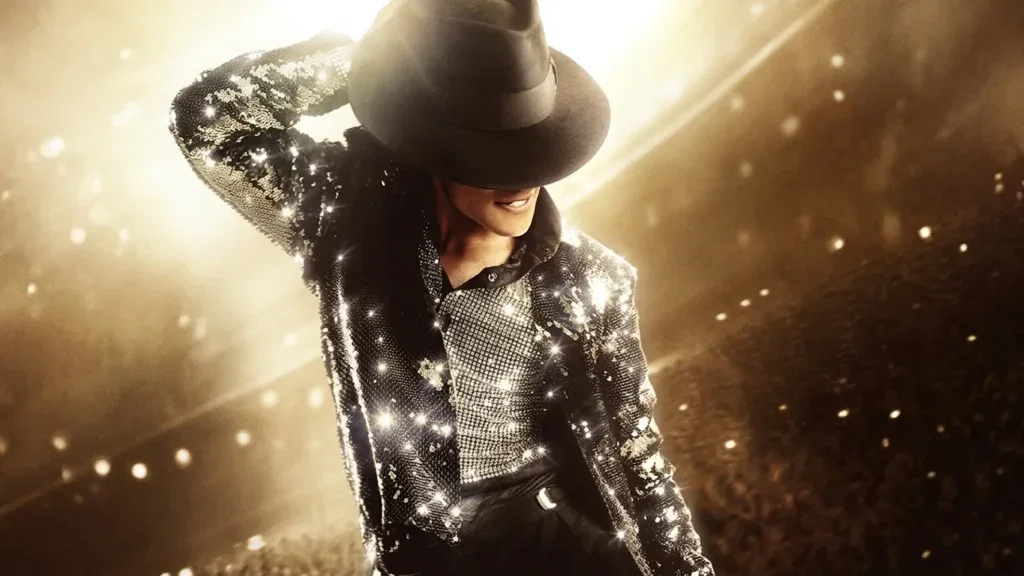
Positively, it must be said that Juliano Krue Valdi and Jaafar Jackson do fine work impersonating young and adult Michael Jackson, respectively. That only leaves every other aspect of Michael’s 127-minute runtime a concern at the cinematic, dramatic, and documentary levels. It would be possible to make a film that parked the soap opera and controversy at the door, allowing audiences to luxuriate in some of the finest pop music, dance, and concert spectacle ever forged, but this is not that film.
Where Is the Art of This Artist?
My hope was for a film that would awe us by showing how Michael Jackson sacrificed his entire physical well-being for his art, his determination to reach levels no other performer had achieved, and the drive that made him legitimately feted as the “king of pop”. In that far more gritty but imagined film, we would see the Michael Jackson who blooded and bruised his toes to perfect the ability to support his body weight on tiptoes; who cut painstaking take after take, refusing to leave a studio or to sleep until each line of every song was a baroque spray of stylings, signatures and surprises; who holed up in hotel rooms between shows but, instead of resting, welcomed in a city’s finest dancers to demonstrate their moves so that, by dawn, he would absorb their techniques into his repertoire.
Sadly, the people involved in the making of Michael seem incapable of seeing beyond units moved and revenue generated. They don’t understand art as anything other than product; therefore, they don’t respect Michael Jackson’s talent sufficiently to make a film with that kind of integrity. What we’re left with is a glossy botch job focused entirely on glitz n’ glamour celebrity with less insight than Jackson’s Wikipedia entry. It’s nothing but a soap opera, start to finish.
The giraffe in the room (yes, there’s a giraffe in the movie) is that, having decided to make this a straight biography of a showbiz celebrity, not an artist, Michael cannot come close to a truly honest consideration of Jackson as a person. For starters, the filmmakers began the work, then only later discovered that legal undertakings meant they could not name Jordan Chandler, Jackson’s 1993 accuser.
This necessitated a rewrite that leaves the film ticking off made-for-TV-level tropes before clattering to a messy finish, conflating the Jackson Five’s Victory tour of 1984, 1983’s Motown 25 celebration, and then making an abrupt and incongruous leap to London’s Wembley Stadium gigs of 1988. We’re robbed of the pleasure of so many killer singles from his mid-1980s to mid-90s run of chart toppers, with the film leaning too heavily on music made with his family in a very different era; it ignores his important 1979 album Off the Wall, and is over-reliant on Thriller (1982).
The hero’s journey, devised to give Michael its emotional core, involves Jackson achieving emancipation from his father’s overbearing influence. The film’s refusal to go beyond the mid-1980s automatically deflates any sense of exultation it attempts to generate because it highlights that Jackson achieved his greatest successes while his father was holding the reins, and ends on the sour note that, having achieved total control, his career and reputation would only descend from this moment on. By making the man rather than his art the centre of the story, the film ends not with triumph but with foreshadowing of ultimate failure.
Curiously, the filmmakers seem to be emphasising this deliberately. They include a scene in which Joe Jackson presciently asks his son whether he truly desires a life surrounded only by yes-men and people he cannot trust to tell him the truth. It’s a strange feeling watching a film made by Michael Jackson’s supposed defenders that wants to tell us that, yes, in their view, he really was that foolish and egotistical.
Michael is stuffed full of these bizarre, sometimes actively cruel touches that do nothing for the narrative and draw us back again and again to the less savoury aspects of Michael Jackson’s story. An old horror movie plays in which the damsel in distress cracks the false face of the man looming above her to reveal the monster lurking beneath; Jackson speaks while standing in front of a wall that has “he’s crazy” written on it; the only time he comes even close to sensuality is having his mum draped next to him on the couch in a silky nightgown.
In Michael, other human beings only exist as useful props, speaking mostly to tell Michael Jackson how special he is, that he’s always been special, that they knew from the moment they set eyes on him that he was better than everyone else. The world conjured by the film is an emotionally flattened realm of veneration and idolisation that would make Stalin blush and ask for his courtiers to tone it down.
Suddenly, Michael Jackson’s taste for uniforms, statues, and dictator-chic makes more sense. Cardboard cutout characters flit in and out, facilitating him, then disappearing; it’s not even possible to tell the difference between his siblings. Even Jackson’s mum, Katherine Jackson, is nothing more than a pained, woeful monotone.
Even more disturbingly, the script has Berry Gordy giving young Michael Jackson guidance that amounts to telling him that in the world he will become a part of, there’s no such thing as truth, that Jackson can create any facade he wishes, live inside any lie he cares to conjure. Again, the suspicion is that this is meant to enhance the sense of Jackson’s specialness, but instead it just lumps him in with all the distasteful tech bros one-percenters who don’t believe humanity’s collective reality applies to them.
Cynics might have felt that the filmmakers would try to quiet audiences’ doubts about Michael Jackson. Au contraire! Instead, they ram images of him with children down the audience’s throats every 15 minutes for two hours: here’s Jackson in a toy shop with awestruck kids, then he’s visiting hospitals, now he’s popping into children’s rooms after his own treatment. While intended to show us his public charity and kindness, it merely reminds viewers constantly that, even for a celebrity, Jackson had vast access to children.
Unwilling to broach the accusations that dogged Michael Jackson (and continue to this day with a new lawsuit arriving this year), halting in the mid-1980s, and waving vaguely toward a likely illusory sequel, Michael was already a queasy proposition that its makers have made positively seasick. In a reimagining of his adoption of Bubbles, a chimpanzee wearing a child’s diaper is delivered with the Jackson family looking on, but no one asks, “Is this normal?” It’s meant to be cute, but we’re talking about a man in his 20s, we’re talking about an animal, not a toy, an animal he then leaves alone in a room full of choke hazards, a room that looks like the gaudy, gross hoarder’s lair visible in police footage of Neverland ranch.
Then there’s the llama. The giraffe. Thousands of kids’ toys. Why is no one thinking this shopaholic needs help? At least, it’s hard to think of his charity splurging as a separate phenomenon from his compulsive purchasing.
The Artist, Diminished
Director Antoine Fuqua‘s film cannot give Michael Jackson credit as a mature, competent adult, because doing so would devastate the line constructed over decades by his legal and PR teams. Instead, it hammers away at the idea of him as a child in a man’s body, repeatedly waving a copy of Peter Pan for emphasis. Hobbled by this disrespectful image, Michael leaves the impression that this was someone with a mental handicap, who had no interest in treatment, surrounded by enablers who were blasé about his well-being or sacked if they dared suggest it.
It is a fact that Michael Jackson was a child performer exposed to a life unsuitable for someone so young. It’s also a fact that he felt physically and emotionally abused by his father. The film is honest about his many obvious rhinoplasties, drawing a direct line to his father calling him “big nose”. Michael Jackson seems to have suffered from Body Dysmorphic Disorder, leading, tragically, from the preternaturally handsome man on the cover of 1979’s Off the Wall to the bone-white cadaver announcing his This Is It tour, the utterly unrealistic plan for 50 comeback dates in London in 2009.
However, it is equally true that his siblings dispute their father’s abusiveness and that the predominant approach to child-rearing in the 1960s was, sadly, far more accepting of physical chastisement and emotional aggression. The film swerves so swiftly into the Jacksons’ rise to glory that it fails to illuminate how Michael Jackson’s childhood was rougher than that of millions of kids whose fathers didn’t steer them out of poverty to limitless life potential. While childhood experiences spark awful consequences, I’m hard-pressed to think of a recognised psychiatric condition in which an adult tries to live as and impersonates the life of an imaginary child.
Michael ping-pongs from making him look like “whacko Jacko” one moment, to a high-performing professional the next. Mike Myers’ turn as record-industry VP Walter Yetnikoff amounts to being intimidated by Jackson into deploying the label’s corporate might to help the star get what he wants from MTV. The result in real life was an end to the channel’s racist programming.
This was not, however, because it was a dignity owed to every artist of colour, but because Jackson wanted the boost to his sales. He didn’t feel that MTV’s colour bar should apply to him, given his life in the company of rich white people. Like O.J. Simpson, Michael Jackson claimed publicly to be above such parochial concerns as race.
This hints at how Michael Jackson served a long apprenticeship under his father, learning the ins and outs of running a business. The change highlighted by Michael was his assumption of the mantle of all-powerful mogul with a subservient barrier of lawyers and managers focused on the monetisation of his image via endorsements, products, licenses, and appearances.
As ever, Michael isn’t willing to lean into any less familiar presentation of Michael Jackson’s achievements. Thus, it leaves us with this uninteresting CliffsNotes rendition that, perhaps unwittingly, keeps everyone’s gaze focused on the controversy.