
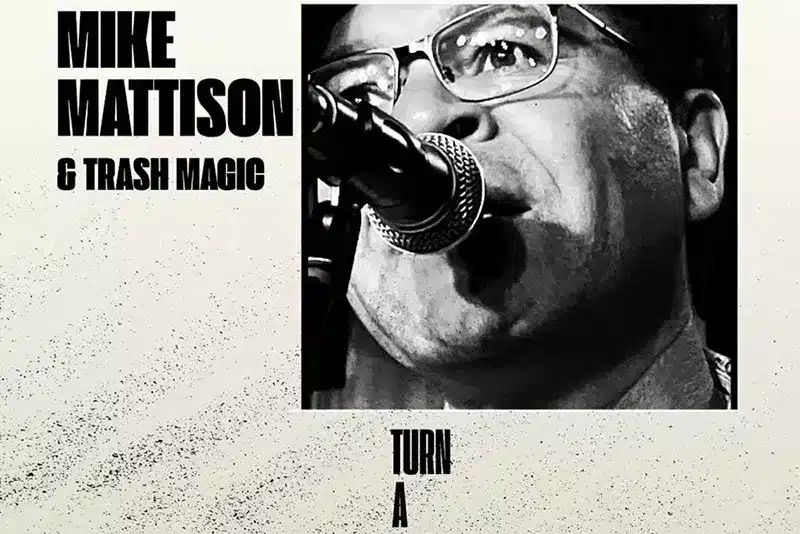

Singer-songwriter Mike Mattison is best known as the lead vocalist for both the Derek Trucks Band and Tedeschi Trucks Band for more than 20 years. His third release as a band leader is a concept album based upon a novella he wrote about a fictional 1930s country blues act, Ted ‘n’ Turk. Mattison, who has earned an English and American literature degree from Harvard University, rediscovered Ted’ n’ Turk in the 1970s and reunited. The duo decide to re-record their original 78 rpm sides. The resulting album mixes old and new styles, with references to unresolved issues around race, money, and more.
Instrumentally, the record is a groove fest. The individual songs initially begin with repeated riffs that steadily roll on like a freight train. The replication is purposeful to show how little the music has changed from an era when transformation happened slowly. The music doesn’t speed up or slow down much; it just keeps moving. Dave Yoke’s guitarwork is front and center aided by Tyler “Falcon” Greenwell on drums and percussion. The two keep the sound chugging along while bandmates Greg Spradin (guitars) and Wesley Flowers (bass, keyboards) fill in the gaps.
Considering Mike Mattison’s literary background, the song’s lyrics are simple in their vocabulary and, like the music, purposely repetitive. For example, the phrase “And I’m Gone” from the 2:47 second song of that title is sung 30 times before the singer has left. Other tracks employ similar strategies with a key phrase (i.e., “when I was hopeless”, “be like a train”, “get it back”, etc.) repeated for emphasis. This is part of the country blues tradition and adds emotional weight to the sentiments expressed as well as musical rhythm to the lyrics.
Mattison wrote all the songs. The plain language itself is meant to convey Ted’ n’ Turk’s limited lexicon as itinerant troubadours. Mattison has a leathery voice that suggests the toll life as a musician has had on the protagonist. There is a throatiness to the singing that hints at what he used to sound like as well as what his experiences have cost him. He sings lyrics that hint at past injustices without being specific. We know things have changed, and the once-forgotten duo have re-emerged, but we really don’t know how successful they once were or exactly what has happened. The clandestine nature of the particulars is a large part of the narrative’s charm.
The title Turn a Midnight Corner is never defined in context. There is something poetic and enigmatic about the phrase that mixes time and space in a single dimension. It was inspired by a line from the poem “Blue Dementia” by the Louisiana-born poet Yusef Komunyakaa. Mike Mattison has said the line represents the idea that if you aren’t careful, you might “smack up right into yourself”. That implies that Ted ‘n’ Turk are right back where they started from. That makes sense in terms of the timeless quality of blues music, but it seems unearned in relation to the album’s story arc. Take the listening experience for what it is–a dozen bluesy tracks full of mystery and groove.