

May 26th would’ve been the 100th birthday of jazz’s greatest stylistic chameleon and band leader, Miles Davis. To mark the milestone in an adventurous way that would’ve surely appealed to the Dark Prince of Jazz himself, National Sawdust in Williamsburg, Brooklyn, hosted the world premiere of a singular multimedia event, The Voice of Miles: A Symphonic Celebration.
Produced in concert with the Miles Davis Estate and Park Avenue Artists, The Voice of Miles transforms the Emmy Award-winning 2019 documentary Miles Davis: Birth of the Cool into an immersive, live orchestral event that brings renewed life to his music and legend.
On the musical front, this production pairs Davis’ original, isolated live trumpet performances from the film with new orchestrations by a 12-piece ensemble performed as the film screens. The cinematic excerpts and live performance interlock in real time, creating a concert experience that places Davis himself—heard and seen in the film and performance—at the center of a newly expanded landscape, with his unmistakable trumpet voice surrounded by the power and sweep of an orchestra. According to Park Avenue Management’s Ross Michaels, it took three years to develop this ambitious project, which they will bring to numerous cities nationwide this year.
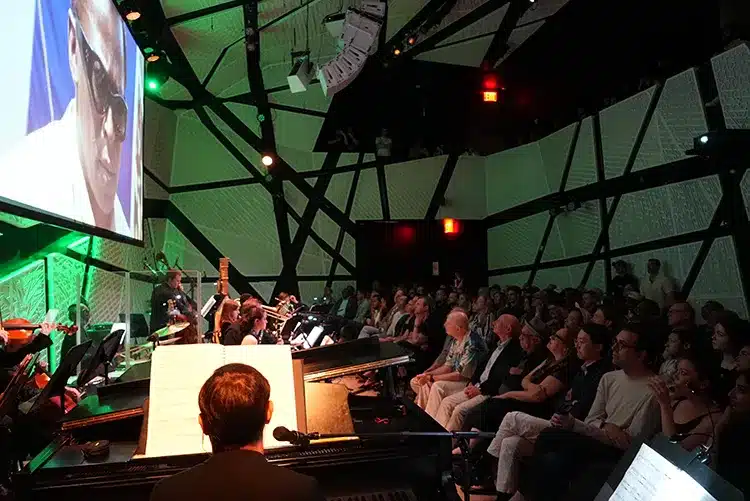
The sellout crowd at National Sawdust included many of the notable musicians and music historians featured in the film, along with members of Miles’ family. Among them were Davis’ son, Erin Davis, and his nephew Vince Wilburn Jr., who worked with him as a drummer in the 1980s and now plays a central role in managing his estate.
Stanley Nelson Jr.’s powerful documentary chronicles the entirety of Davis’ life, from his upbringing in East St. Louis to his many eras of musical innovation, his renaissance in the late 1980s, and his passing in 1991. The audience at National Sawdust was delighted by the memories of Miles Davis featured in the film, drawn from interviews with his musical associates and admirers, including Wayne Shorter, Herbie Hancock, Percy Heath, Jimmy Cobb, and Carlos Santana; intimates like his ex-wife, Frances Taylor, and final partner, painter Jo Gelbard; producer George Wein; and many others. Davis was featured, along with a host of his wise, confrontational, and downright hilarious quotes from many print interviews, voiced by actor Carl Lumbly.
Of course, the true highlight here was the music, the fusion of Miles Davis’ isolated trumpet and some classic band recordings with these new arrangements.

These orchestrations by Jason Brauer were very much in the mode of the intricate and atmospheric work of Davis’ favorite arranger, Gil Evans. Led by musical director/pianist Joe Block, the 13-piece ensemble was composed of Juilliard alumni. Juilliard, the prestigious music college, is where Davis attended for three semesters before dropping out to join Charlie Parker‘s band in 1945.
The ensemble’s additions to “It Never Entered My Mind” were among the evening’s most sublime. Recorded in 1956 and released in 1959 on the album Working with the Miles Davis Quintet, it is one of Davis’ most haunting and lonely-sounding performances, a Rodgers and Hart standard made even more desolate by the orchestra’s woodwind, string, and harp counterpoint. The subtle brass embellishments on other classics like “‘ Round Midnight”, “Stella By Starlight”, and the soundtrack to “Elevator to the Gallows” also offered a new perspective on recordings I have heard hundreds of times.
Again, the orchestral arrangements and performances were always tasteful and never overpowered the music and dialogue emanating from the screen. The orchestral colorings to Davis’ staples like “Aranjuez”, “Blue in Green”, and “Someday My Prince Will Come” often sounded like they were part of the original recording—floating, caressing atmospheres that Gil Evans himself might have conjured. The trombone-heavy riffs on the outro of “So What” added a warm thump to the punchiest offering on jazz’s best-selling album, Davis’ Kind of Blue.

One would think Davis’ fusion-era output would’ve been a challenge to embellish, but the Juilliard crew managed to add fresh sounds and musical insight to even the densest offerings from albums like On the Corner. Another favorite was their take on the 1986 tune, “Tutu”. This bluesy blast is anchored by Marcus Miller’s creepy-crawly bass, punctuated by some very of-its-time, synth-heavy orchestral hits. The live arrangement added an almost Dixieland bounce, with some swift black stick (clarinet to the uninitiated) from one of the evening’s standout performers, reed man Justin Vance. Also of note were the drum solo intros to a few tunes, including the knotty “Freedom Jazz Dance” by percussionist Ulysses Owens, Jr.
The next scheduled performance of The Voice of Miles: A Symphonic Celebration will be held on August 21st at Marcus Garvey Park in New York, in partnership with Jazzmobile SUMMERFEST and Summerstage.
This National Sawdust premiere served as the centerpiece of Miles Davis 100, an ambitious global celebration spearheaded by the Davis Estate and the independent music company Reservoir to honor the visionary artist’s ever-expanding impact on music, fashion, and global culture.
The centennial project will include the forthcoming feature film Miles & Juliette, starring Damson Idris and Anamaria Vartolomei, and a new Centennial edition of Miles: The Autobiography, published by Simon & Schuster. Archival milestones include landmark reissues such as the first physical release of The Complete Live at the Plugged Nickel 1965 in three decades. This global tribute will further bring his legacy to life through international tours by M.E.B. (Miles Electric Band) and curated programming at premier institutions, including the Montreux Jazz Festival (Switzerland), Montreux Jazz Festival (Miami), Big Ears Festival, SFJAZZ, and more.
