
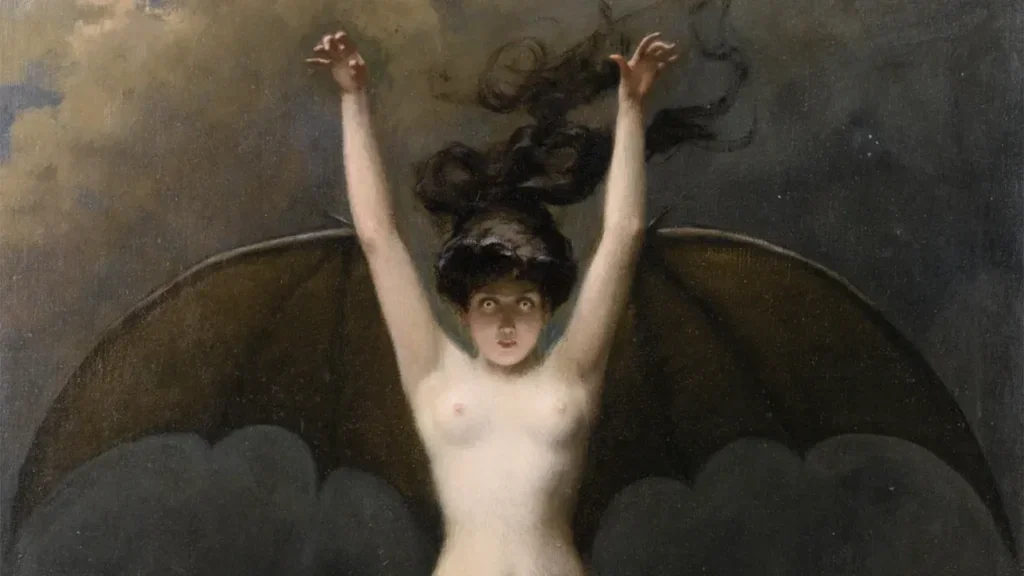

Scholar Eleanor Johnson’s Monstrous Bitch: A History of Terrifying Women begins with a historical reversal. In the aftermath of the U.S. Supreme Court’s 2022 decision to overturn Roe v. Wade, Johnson looks backward, searching literature and popular culture for the long history behind what she sees as a recurring phenomenon: the tendency of patriarchal societies to represent women who transgress their prescribed roles as monstrous.
Her subjects range from the ancient Mesopotamian goddesses Tiamat and Lamashtu through Greek tragedy, Roman literature, Christian demonology, Jacobean drama and Gothic fiction to 20th- and 21st-century Hollywood horror. Across this extraordinary span, Johnson finds a remarkably persistent figure: the woman whose voice, sexuality, agency or refusal to conform makes her dangerous.
The book’s title announces its argument with deliberate provocation. Its monstrous bitches are not simply evil women; they are women whom stories have made monstrous, often to the point where female behaviour ceases to conform to the expectations of the society producing the story. Johnson is particularly interested in the fact that many of these stories were written by men, and in the ways the androcentric assumptions of their cultures shape the dramatic function of their female antagonists.
The pattern is established almost immediately with Lamashtu, the Mesopotamian goddess who becomes a foundational example of the monstrous bitch. Banished from heaven after angering her father, Lamashtu is transformed into a wild and frightening presence in the mortal world, her increasingly animalistic depiction making the description of her as a “bitch” almost literal.
Johnson identifies several characteristics here that recur throughout her history of female monstrosity: the woman’s troublesome voice, her sexuality, her physical wildness and, most horrifyingly, her capacity for infanticide. Lamashtu threatens not only men or social order but other women and their children. She is therefore a revealing prototype: female power becomes frightening when it is no longer confined to prescribed roles.
From there, Monstrous Bitch traces a transformation in the nature of the monstrous woman. In Greek tragedies, female antagonism remains closely associated with the supernatural: the Furies are goddesses, while Medea, though mortal, possesses divine ancestry and magical powers. In Roman literature, by contrast, the monstrous woman becomes increasingly mortal and recognisably human, reflecting a society in which women’s social subordination was particularly pronounced.
Christianity then introduces a curious reversal. The women themselves remain mortal, but their wickedness is attributed to supernatural power, as supposedly ordinary women become witches through their pacts with the Devil. By the Jacobean period, the supernatural and the human have become still more entangled, from the Witch of Edmonton to Lady Macbeth, whose murderous ambition makes a mortal woman herself the source of the horror.
The movement is not simply chronological. What changes is what women are imagined as threatening. The infanticidal woman of antiquity and the Middle Ages eventually gives way to another kind of female monster: the woman whose sexuality itself becomes frightening. In Gothic literature, the female vampire no longer primarily embodies a threat to motherhood and lineage. Instead, she embodies erotic appetite.
Sheridan Le Fanu’s 1872 novella Carmilla is the most obvious example, her predatory attraction to women turning female sexuality into both fascination and horror. Le Fanu’s relative marginality within the traditional Western literary canon also allows Johnson to expand her history beyond the most familiar names, suggesting that the story of female monstrosity has not been confined to the canonical works most often taught in literature courses.
The Monstrous Predator
This is one of the book’s most interesting transitions. The monstrous woman has moved from threatening the patriarchal family to threatening the boundaries of permissible female desire. The vampire can be alluring precisely because she is transgressive. Sexuality becomes inseparable from danger.
Yet Monstrous Bitch is at its most provocative when its women are not simply victims of patriarchal representation but agents whose actions are genuinely disturbing. Medea is not merely a woman oppressed by men; she is also a murderer. Lady Macbeth is not merely punished for wanting power; she participates in political violence. Carmilla is not simply a sexually liberated woman misunderstood by Victorian society; she is a predator.
This creates tension at the heart of the book. To show that a culture has represented a woman as monstrous for patriarchal reasons is not necessarily to show that the woman herself is innocent. The two questions are different: why does a culture find this woman frightening, and should we find what she does frightening? Monstrous Bitch is strongest when it keeps both questions in view.
The history becomes still more complicated in Johnson’s treatment of 20th-century Hollywood. Here the female body itself increasingly becomes the site of monstrosity. Women acquire beastly or grotesque forms through the interventions of modern science, medicine and psychiatry—often institutions controlled by educated and powerful men who seek to manipulate the female body according to their own fantasies.
This is an important development because responsibility begins to move. The monstrous woman is no longer simply a woman who has mysteriously become evil. Sometimes men have quite literally helped create the monster. Johnson is also persuasive in treating cinema as a significant historical development rather than simply another collection of examples. Film radically expanded the potential audience for cultural representations, allowing ideas about female bodies, sexuality and behaviour to reach people on a scale that earlier literary forms did not.
There is something particularly apt about horror as the medium through which this argument emerges. Horror has traditionally been belittled within cultural hierarchies, and many of the Hollywood examples come from films that have themselves occupied the margins of the cinematic canon. Their very marginality may make them useful evidence: genres dismissed as sensational or disreputable are often unusually frank about cultural anxieties that more respectable art prefers to disguise.
At the same time, these selections raise an interesting question about the relationship between marginality and representation. Is horror especially interested in monstrous women because it is uniquely misogynistic, or because horror is a genre in which anxieties about sex, reproduction, bodily transformation and loss of control can be made literal? The answer may be some combination of the two.
By the 1970s and beyond, the female monster has become increasingly familiar as a cinematic figure.
William Friedkin’s The Exorcist (1973) and Dario Argento‘s Suspiria (1977) occupy an important position in this history, but the story eventually reaches films in which women increasingly become participants in their own representation. Ginger Snaps (John Fawcett, 2000), Jennifer’s Body (Karyn Kusama, 2009) and The Witch (Robert Eggers, 2015) mark a further shift toward what might be called a female-centred horror tradition.
Johnson’s enthusiasm for The Witch is particularly revealing. Anya Taylor-Joy’s Thomasin is caught between two interpretations of female monstrosity. On one level, she is a victim: a teenage girl trapped inside a repressive fundamentalist family whose religious worldview leaves almost no legitimate space for female sexuality or independence. On another, she becomes a formidable agent of her own transformation. The “monstrous bitch” is no longer simply a woman upon whom monstrosity has been imposed. She may choose it.
This is arguably the most consequential change in the book’s historical trajectory. If earlier women become monsters because men represent them as such, what happens when women begin to participate in creating, directing, and reclaiming their own monstrosity? The rise of female auteurs therefore matters for reasons that go beyond representation. It changes the question of authorship itself. The history that begins with stories told about women increasingly becomes a history of women telling stories about women.
That makes Monstrous Bitch‘s concluding movement especially satisfying. Johnson brings her history back to ancient Mesopotamia by invoking the high priestess Enheduanna, whom she identifies as the earliest recorded author in human history. The structural symmetry is striking. The book begins with women such as Lamashtu being represented and judged by others and ends with a woman whose own voice has survived from antiquity.
There is an almost paradoxical progression here: from the woman whose voice is itself dangerous to the woman whose voice becomes the evidence of her historical existence. Johnson’s achievement is to make this long history feel coherent. Her central category of patriarchy provides a powerful thread through otherwise radically different cultures, allowing her to connect the ancient goddess, the tragic heroine, the witch, the vampire and the cinematic monster. Yet that same coherence is also where the book occasionally becomes less convincing.
Coded Behaviour’s Limitations
“Patriarchy” is such a broad explanatory category that it can risk obscuring the enormous differences between the societies Monstrous Bitch examines. Mesopotamian mythology, classical Greece, Imperial Rome, Christian Europe, Jacobean England, Victorian Gothic fiction and modern Hollywood did not share a single conception of womanhood, sexuality, reproduction or individual agency. Nor did they necessarily make women monstrous for identical reasons.
There is a danger, however, that the ubiquity of patriarchy in this analysis begins to make the dramatic structure of the works themselves disappear. Literature requires antagonists, and the fact that an antagonist is female is certainly worthy of analysis; but it does not in itself establish that her antagonistic function is an expression of patriarchal oppression.
Medea, Lady Macbeth and Carmilla do not merely occupy the opposing side of their respective narratives because their authors needed women to be punished for transgressing feminine norms. They are also dramatically effective antagonists precisely because they possess desires, powers, and capacities that bring them into conflict with other characters. The question of why those qualities are coded as monstrous is more interesting than the assumption that their monstrosity is itself evidence of patriarchy.
At times, Johnson’s repeated return to the patriarchal explanation risks becoming circular: women are made monstrous because patriarchal societies fear female agency, while the evidence for that fear is the repeated appearance of monstrous women. The historical continuities she identifies are often illuminating, but the differences between the stories can be just as revealing.
Not every female antagonist is necessarily a feminist victim in disguise, and not every culture that produces a monstrous woman is necessarily making the same ideological statement about women. The question, then, is not whether Johnson is right that patriarchal assumptions matter. They plainly do. The more difficult question is whether patriarchy can explain the full range of meanings attached to female monstrosity across thousands of years.
The development of the monstrous bitch suggests that something more complicated is taking place. The monster changes because the anxieties change. Infanticide gives way to sexual predation; sexual predation gives way to bodily transformation; male scientific intervention becomes part of the horror; and eventually women begin to reclaim monstrosity as a form of identity or power. This is therefore not simply oppression repeating itself. It is also a history of changing ideas about female bodies, sexuality, agency and authorship.
This distinction is particularly relevant to the contemporary political context in which I read Monstrous Bitch. Johnson’s immediate political inspiration is American: the reversal of Roe v. Wade and what she understands it to signify about the fragility of women’s rights. While reading, I was conscious of a rather different argument taking place in Britain, where one of the most contentious questions surrounding womanhood has concerned the legal and social meaning of sex itself, particularly following the Supreme Court’s 2025 ruling concerning the meaning of “woman”, “man” and “sex” under the Equality Act.
It would be misleading to suggest that Britain is undergoing a shift equivalent to the American reversal of Roe v. Wade. However, the British debate does make one aspect of Johnson’s history unexpectedly contemporary: the category of woman has rarely been as self-evident in cultural representation as it may appear in political language.
Johnson’s women repeatedly find themselves defined by boundaries—between respectable and promiscuous, maternal and murderous, civilised and wild, victim and predator. What makes them monstrous is often their movement across those boundaries. Reading the book now, one is reminded that the boundaries themselves are historical constructions, and that cultures periodically become intensely preoccupied with deciding where they should lie.
This is where Monstrous Bitch becomes more interesting than its straightforwardly polemical premise might suggest. It begins with an urgent political concern about the reversal of progress, but the historical evidence points toward a less reassuring conclusion: there has never been a single, settled definition of what women are supposed to be. The monstrous woman is produced precisely because cultures keep trying to establish one.
The book is therefore at its strongest when it makes us suspicious of the categories through which women have been judged. Its recurring appeal to patriarchy can sometimes make millennia of radically different stories appear variations on a single explanation, and some of its individual readings would benefit from allowing more competing interpretations to survive alongside the feminist one. Yet the historical pattern Johnson uncovers remains compelling.
From Lamashtu to Medea, from Lady Macbeth to Carmilla, from the witches of early modern Europe to the possessed girl of The Exorcist, and finally to the women who write, direct and inhabit their own monstrousness, the question remains remarkably persistent: what happens when a woman refuses to remain within the boundaries her culture has drawn around her? Johnson’s answer is that we have historically called her a monster. The more unsettling possibility is that we may still be doing so, even as the boundaries themselves continue to change.