
Of the many things Western culture has lost of late—the dominance of print media, quality middlebrow cinema—one will not be lamented: big public debates over the possibly blasphemous nature of some book, film, or song. A subset of the publishing imbroglios about obscenity and censorship that popped up in the early and mid-20th century, these controversies were, like most arguments hashed out on TV, loud, polarizing, and unrewarding.
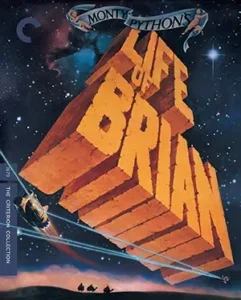
The 1979 release of Monty Python’s Life of Brian, a diligently researched yet sincerely unserious bit of japery partially about Jesus Christ but more broadly about the laughable illogic of religious dogma—just released in a spectacular new 4K edition from Criterion—was greeted with waves of shocked agitation. This was a precursor to similar fights that broke out years later with Martin Scorsese’s faith-driven The Last Temptation of Christ (1988) and Kevin Smith’s scatological yet scripturally investigative Dogma (1999).
All three films were charged with mocking or misrepresenting Christianity. Theaters were picketed, talking heads talked, and op-eds were generated. Defenders correctly pointed out that Scorsese and Smith were cradle Catholics who questioned but never renounced their faiths. In fact, Scorsese went on to make Silence (2016), one of the most haunting and impassioned films about the Catholic faith ever put to celluloid, and to produce a docudrama series about the saints for Fox.
The Python boys didn’t want to wrestle with theology, or delve into Jesus’ internal struggle, or assault Christianity. Like many well-educated Brits, their schooling included religion, but it was an anodyne Church of England Anglicanism that students and teachers paid lip service to. (Their sole American member, Terry Gilliam, had a strict Presbyterian upbringing, but he was tasked more with visuals than story ideas or writing.)
Indeed, without the grander torments brought by artists with deeper religious backgrounds, the Monty Pythons didn’t have axes to grind or questions to pursue. That distance helped the group, as they almost didn’t seem to know which cows were the most sacred and just went after them all.
Fittingly, Life of Brian was conceived on a pub crawl. The standard origin story, as told in one of the documentaries on Criterion’s packed special features disc, is that while they were boozing around Amsterdam during the press tour for Monty Python and the Holy Grail, Eric Idle had an idea for a project called Jesus Christ: Lust for Glory. It stirs the imagination to think of the possibilities that title conjures: a send-up of muscly epics ala Mel Gibson; a glitzy musical packed with song-and-dance numbers; or a down-and-dirty melodrama about an ambitious, slightly schizoid kid from Galilee with a dream.
What resulted after the Pythons dove into books on early Christianity and spent a few weeks writing at a beachside villa in Barbados (somebody had to do it) was closer to Holy Grail, only with sand rather than mud. Like that film, Life of Brian is a string of “what if?” set pieces glued onto a rickety bit of plot about a clueless, semi-innocent, baffled, and knocked about by a strange, cruel world spiderwebbed with arcane rules and daffy characters.
Though it is a proper film, the Python troupe—Graham Chapman, John Cleese, Terry Gillian, Eric Idle, Terry Jones, Michael Palin—kept to their sketch-show habits, each playing multiple poorly-disguised characters designed around each of their specific strengths; Cleese for the more rapid-fire verbal skits, Idle as the cheeky one, and so on.
No Belief System Is Safe from the Monty Pythons
Instead of going right at Christianity’s source material, Life of Brian’s story runs mostly in tandem. An opening scene imitating the placid grandeur and soporific choir music common in the sword-and-sandal epics studied by the Monty Pythons (Quo Vadis and the like) shows the Three Wise Men coming to the wrong stable in Judea and almost worshipping baby Brian Cohen as the messiah before realizing Jesus was just down the alley.
Jesus himself is seen only once, at a distance, while preaching the Sermon on the Mount. In the crowd is grown-up Brian (Graham Chapman), a barely sketched-in failure-to-launch character mostly there to be confused, petulant, and sniped at by his overbearing prostitute mother (director Terry Jones, doing his classic yodel-y vaudeville-style man-in-a-dress shtick).
The joke in the Sermon on the Mount scene is not the message itself but how hard it is for people in the far back of a crowd to hear. One onlooker thinks Jesus said, “blessed are the cheesemakers” instead of “peacemakers”, leading to commentary that he is making a general, not literal, comment about the blessed state of “any manufacturers of cheese products”, neatly prefiguring future debates over literal and allegorical readings of the gospels.
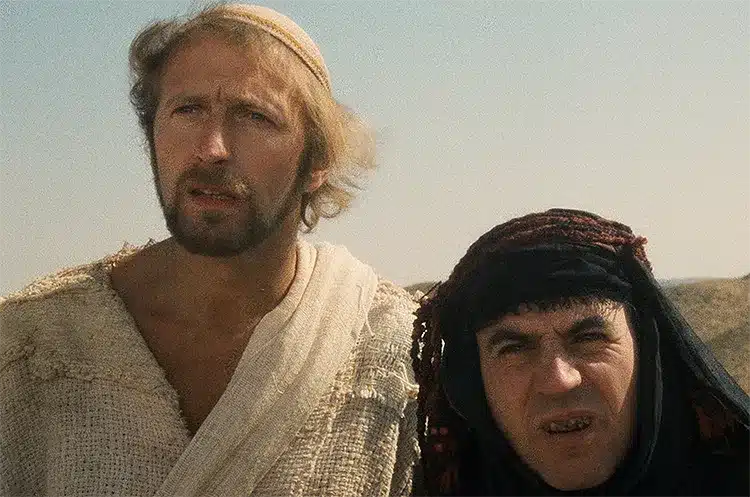
During a 1979 televised debate included in the Criterion edition’s special features, where Cleese and Palin squared off against a pair of dogmatists—conservative writer Malcolm Muggeridge, wreathed in pompous grievance, and Bishop Mervyn Stockwood, sporting a comedically large cross necklace—the Monty Pythons gamely try to explain they were not mocking Jesus and were presenting the Sermon straight, to no avail.
If Life of Brian had actually been a narrowly targeted satire, it may ironically have inspired less controversy. The Monty Pythons just refused to take religion—not just Christianity, but any belief system that depends on interpreting sayings supposedly handed down with perfect fidelity from antiquity, yet that resembles a comedic game of telephone with divine stakes—seriously. They preferred to spatter the film with frame-shattering non-sequiturs typical of their other work. A more earnest satire wouldn’t have included the sequence where Brian is briefly zoomed out of Judea by tentacled aliens in a spaceship, which then crashes, after which things carry on without explanation.
Rather than delving into complex scriptural exegesis, Life of Brian follows Brian, agitated after discovering that his father was actually a Roman centurion, as he seeks an outlet for his anger and bumbles into an accidental crucifixion. He falls in briefly with a band of anti-Roman rebels, the People’s Front of Judea, leading to a couple of the film’s most enduring set pieces.
One has the group’s leader, Reg (Cleese), denouncing the rival Judean People’s Front with more venom than the Romans both are ostensibly fighting, riffing on the arcane hair-splitting endemic to 1970s leftist factions. While trying to write anti-Roman graffiti, Brian has his ear yanked by a centurion; the joke, resonant for British public school survivors, is that the headmaster-like centurion cares more about correcting Brian’s Latin grammar (“conjugate the verb…”) than about the content of what he’s writing. For a film supposedly so determined to antagonize Christians, it spends a lot of its time on myriad other subjects.
A good point of comparison with Life of Brian is Denys Arcand’s Jesus of Montreal (1989). In that film, an actor hired to stage a church passion play goes well past his remit by presenting an Elaine Pagels-style historiographic dive into the “real” Jesus, which infuriates religious conservatives by illustrating how far the modern church departed from his teachings. While the Monty Pythons also had fun with that gulf of interpretation, they painted on a bigger canvas to depict the fulminating manias and bloody violence of a time and place suffused by what Idle called “messiah fever.”
A segment hewing closer in spirit to the historical record starts with Brian accidentally joining a street of ranting forgotten preachers competing for followers (“Yea, it is written in the book of Cyril”). After an uninspired stab at preaching (“Don’t pass judgment on other people or else you might get judged, too”), Brian is accidentally branded a messiah.
The gap between Brian’s haplessness and the instant fanaticism of his new followers (any object he touches is declared a divine relic) provides some of the film’s best laughs. However, the comedy stems not from theological satire about worshippers diverging from a messiah’s “true” message but the eagerness of people to follow a new leader or system. Just minutes after declaring Brian their savior, his followers are enthusiastically stoning a “heretic”.
The Monty Pythons Speak Fundamental Silliness to Power
The trick the Monty Pythons deftly pulled off with Life of Brian was bringing a light touch to material that doesn’t lend itself easily to such treatment. Matching the pre-modern violence of Holy Grail with scourgings, stonings, large-scale crucifixions, and a mass suicide (a nod to the anti-Roman Zealots which also features one of the film’s better lines, coming after they all stab themselves to death: “That’ll show ‘em”), it still maintains a bouncy spirit that avoids the dourness of the Monty Pythons’ next and last film The Meaning of Life (1983) and the flattened cynicism of Gilliam’s solo work.
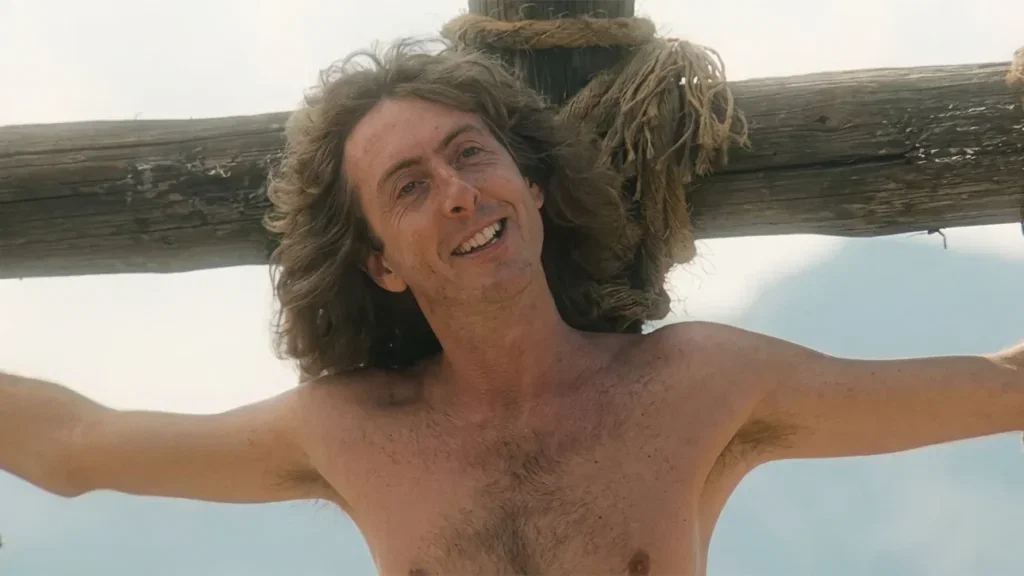
The justifiably famous conclusion, where a line of crucified convicts including Brian singing the whistly anthem “Always Look on the Bright Side of Life”, is not exactly upbeat, what with all the crosses and arbitrary dispensing of capital punishment. The tone is more Mel Brooksian, in the vein of History of the World, Part I, from 1981, though it’s actually funny and even features some handsome desert cinematography, which the 4K transfer shows off nicely.
It is difficult to leave Life of Brian without a grin. Though the film’s jokes bristle with ideas about the absurdity of dogma, political and religious, and obedience to power and class, ultimately, the Monty Pythons did not care about making audiences angry over the state of religious hypocrisy. Doing that would have meant giving something so fundamentally silly far too much power.