

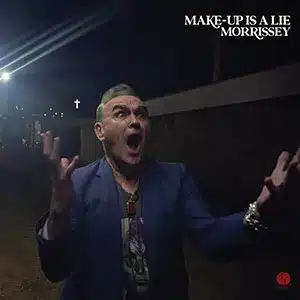
Morrissey’s latest album, Make-Up Is a Lie, invites us to view the singer’s remarkable life through a new lens. Its storyline follows a lonely boy from a Manchester bedroom, the inspirations that shaped him, the miracles forged in an extraordinary musical partnership, of the masks he’s worn — and their cost. In an attempt to get as close to the artist as is allowed, let’s look at the connections between Morrissey’s more obscure passions and this material.
Down cobblestone streets under gray northern skies, the album traces the singer’s childhood, adolescence, musical awakenings, fame, persona, heartbreak, his ill-fated heroes, and the parallels between their lives and his own, and at its core, becomes a meditation on the breakup of the Smiths and the failure of reunion. By highlighting the key symbols and references, we’ll reveal their meanings.
At the best moments in his 43-year songwriting career, Morrissey has relied extensively on wordplay, double entendre, and malapropism to add wit, irony, and absurdity to his work. On his more recent offerings, that wordplay recedes in favor of a more direct approach. The interpretation of the tracks on Low in High School (2017) and I Am Not a Dog on a Chain (2020) is straightforward. In Make-Up Is a Lie, Morrissey returns to the more intricate art form to the delight of symbolists and logophiles.
Morrissey’s Embrace of Oscar Wilde
When the lead single for Make-Up Is A Lie was released via streaming services in February 2026, several anomalies stood out. The lyric seemed uncharacteristic, the music unlike anything Morrissey had made before, and the album art is vaguely disturbing. In retrospect, it seems obvious: he is making sure we are paying attention.
The title track sustains a hypnotically repetitive, laconic rhythm, pausing before a counted “1,..2,..3,4,5!” launches the final refrain. In footage from his recent Zaragoza appearance, Morrissey bends at the waist and gestures to an imaginary tombstone on the stage after singing “I read the words in granite”, then points at each of the five words on the imaginary stone, highlighting each one while counting in a deliberate and staccato manner, before emphatically reiterating the refrain. The pantomime is repeated at his next appearance in Seville two days later.
This reads as a subtle invitation to participate in Wildean-style wordplay, where a shift from four words (Make-Up Is a Lie) to five words (Make Up Is a Lie) suggests a double entendre. This is a device Morrissey has employed throughout his career: the play between artifice and reconciliation, highlighting both Wildean masks and Wildean failed reunions. The full album was released 25 days later. While this is quite short in terms of lead time, it’s still a painfully long wait, given the curiosity generated by the strong new sound and imagery.
It had been six years since Morrissey’s last album, I Am Not a Dog on a Chain, and skepticism took root. The wider reaction to the single seems to be a mixture of lukewarm praise, incredulity, and accusations of AI-altered album art, peppered with a minority of glowing commendations. Some even imagine he might be telling us a horrible joke, like the one about taking our girlfriends swimming on the first date to see how they really look.
The Artists’ Powerful Masks
When Make-Up Is a Lie finally arrived on my stoop and I dropped the needle onto the smoky red disc, it was slow to divulge its secrets. I studied the songs, but only two things were immediately clear: the voice sounded just as evocative and lovely as ever, and the result of his new band’s first studio venture neatly dispels all doubtful chatter. It is less guitar-driven and leans toward dreamy and surreal, at times even rococo — an apt mood for the ornate lyricist’s self-contemplation.
There seems to be a Parisian theme, the city of lights tied in one way or another to the title track, “The Monsters of Pig Alley” and “Boulevard”. The figure who looms largest in Morrissey’s pantheon is Oscar Wilde, who is buried in the famed Père Lachaise Cemetery. The subject, then, may well be Wilde. He would map perfectly onto the song, given his brief and contentious reconciliation with Lord Alfred Douglas following his release from prison, which culminated in their final break in Paris before Wilde’s ultimate reclusion and demise.
Following his release from prison, Wilde and Douglas reunited in August, but their relationship descended into a series of intense arguments, and they would stay together for only a few months, with the breakup occurring around Christmastime. That “Make-Up is a Lie” uses sleigh bells, and that the events of the reconciliation happen to fit every lyric perfectly, and this is Morrissey we’re talking about—it seems to fit. Furthermore, “Make-Up Is a Lie” is a song of deep meaning hidden in seemingly frivolous lyrics, combined with stylish, avant-garde instrumentation, all befitting this figure whom Morrissey has always adored.
In his 1891 essay The Critic as Artist, Oscar Wilde wrote: “Man is least himself when he talks in his own person. Give him a mask, and he will tell you the truth”. Wilde’s point was that those who treat persona as deception and claim that everything they do is authentically their true selves are being disingenuous. Wilde pointed out that unless you acknowledge the persona, you are denying what it means to exist in a social context. One meaning of the song’s title “Make-Up Is a Lie” would therefore seem to be dealing with projected image (make-up as in fabrication or cosmetics), a conceptual reversal of Wilde’s epigram — perhaps revealing that the mask has become the lie.
Historically, Morrissey has been a very private person; he doesn’t disclose his relationships publicly and seldom gives interviews. Early in his rise to fame, he cultivated a persona of accessibility, encouraging fans to join him and hug him on stage. He cultivated an image of outsider loneliness, using this mask to make the deepest of musical emotional confessions, and claimed that they were letters to nobody. In short, he invited fans to imagine a hole in his life that they might fill.
After the Smiths ended, Morrissey’s mask seemed to harden. He began leaning into themes of seediness and crime, singing about the Kray crime brothers in 1989’s “The Last of the Famous International Playboys” and Jack the Ripper in 1992. He still sang of loneliness and despair, but it became less existential and more accusatory, a bitter settling of scores with an adversary in mind. His audience shifted with that persona.
With these masks in mind and considering Make-Up Is a Lie’s theme, perhaps he is trading a mask that served him well for decades for another. His new mask will facilitate the communication of a new, contemporary truth, recognising that the former may have met needs he had before but no longer suffices.
The attempted reconciliation layer in this lyrical framework may also refer to Morrissey’s brief attempt to mend his relationship with Johnny Marr, as described in his 2013 memoir, Autobiography. This brief reunion ends in a shout he describes as bursting out after Marr informs him that he has come to realize that Morrissey probably doesn’t know what happened at the end of the Smiths. Morrissey yells “I KNOW NOTHING!”—a cry that, along with the arguments between Wilde and Douglas, is in keeping with the “outburst” described in the song as “louder than a cloudburst”. We will revisit this reading in “Headache” and “Many Icebergs Ago”.
With thoughts of the first meaning — makeup — and of the play between authenticity and persona in mind, looking idly at Make-Up Is a Lie‘s cover photo, another puzzle piece falls into place. Morrissey’s unsettling aura stems from more than his wild facial expression and pose. Is that smoky curl coming from the outer crease of the eye…makeup? Iseems intentional, the way the eyebrows are shaped into neat yet uncanny arches. The face is shiny like he’s wearing foundation.
This different look to Morrissey’s facade has been interpreted as possible AI manipulation, but it seems rather to be an illustration of that same double entendre: the message implied is both that reconciliation is impossible and that Morrissey is perhaps assuming a novel Wildean persona for this album. In this manner, he can tell his truth. That the “mask” of his face is mistaken for AI-generated only adds another layer of irony, which, I imagine, amuses Morrissey.
Considering these potential frameworks, Make-Up Is a Lie is beginning to appear to be an inspired and intricate work of art pop. I went from trepidation about whether the album would consist of some unrelated and shapeless songs with mismatching production, as claimed by the detractors, to wondering whether the album is a work of thematic cohesion, a synthesis of Morrissey’s original poetic artistry combined with the more complex subject matter of a later stage of life.
If the makeup is really Morrissey’s own, which it seems to be, based on the cover art, and apparently it horrifies him, then it would follow that the follies of Morrissey’s persona would be the subject of this album. The pitfalls, such as the vagaries of fame and materialism, may be each “she” mentioned in the lyrics, personifying Morrissey’s vices.
Make-Up Is a Lie Is Morrissey’s Truth
Make-Up Is a Lie‘s mood is contemplative and diffident. Morrissey has indeed decided to open up, becoming once again willing to be vulnerable to a degree unheard of since the Smiths. Compared to these missives from a private hell, the self-deprecating critiques from the rest of his solo career seem mild. As one infamous for his breathtaking lacerations of others at times, this album feels like a saving grace.
Fittingly, album opener “You’re Right, It’s Time” is a deceptive song. On the surface, it’s about liberation, he sings that he “wants to move away from those who stare at screens all day” and to “speak up and not be trapped by censorship”, and, most promisingly, to “let somebody love (him) if they can”. The next line, however, reveals that he “casts no shadows or reflection in the mirror now”.
Is the narrator dead? A monster? Or is he describing the point at which his persona loses cohesion, no longer revealing a truth? The album explores themes of loss and distortion of the self, which culminate on the album’s closing track. “You’re Right, It’s Time” conveys a sense of cautious hope borne of surrendered abandon.
It’s been widely reported by those formerly close to Morrissey that they only wanted to love him, but he couldn’t seem to accept it. I think perhaps the song’s concession is that they’re right, it’s time to be vulnerable and open, to let go and accept love. The song has the magic of the most inspired and melancholy songs in Morrissey’s catalogue, and stands out as an early underrated gem.
After the first track sets the intention, I hear “Make-Up Is a Lie” with new ears. If the subject of criticism is the singer, this song can be recognized for what it really is. Make-Up Is a Lie seems to be about Morrissey shedding his artifice and revealing his truths.
With “Notre-Dame”, Morrissey pulls the lens to the world stage. Even the largest political entities are entrenched in social masks. Singing dispassionately to a cool darkwave beat, he intones: “Notre-Dame, we know who / Tried to kill you”, and “Before investigation / They said there’s nothing to see here”, seemingly knowing not to expect any good to come of it, yet still he must sing his life. The fact that the song has stirred accusations of xenophobia seems to be the point. We find him characteristically comfortable in his role of the provocateur. Still, as is his nature, he remains adamant when the world won’t listen.
France employs many non-partisan think tanks to address the rise of terrorist violence. Fondation pour l’innovation politique (Fondapol) prominently displays information on its homepage illustrating the rise in attacks against French citizens from 1979–2024. The data is clear. Whether one agrees with Fondapol and Morrissey is beside the point; either way, his voice belongs in the discourse.
Voicing controversy has been a core feature of the image Morrissey builds from the very beginning of his career. In the preface to The Picture of Dorian Gray (1890), Oscar Wilde wrote, “There is no such thing as a moral or an immoral book. Books are well written, or badly written. That is all.” This could be argued to hold for music as well. Morrissey’s insistence on advancing a controversial viewpoint can be interpreted as an invitation to examine how persona shapes our political selves. If persona is necessary to build authenticity when compared to claims of authenticity without persona, it follows that claims of ideological purity without the acknowledgment of the social mask must also be false. Lyrics aside, the track is evocative of an ‘80’s Cold War thriller soundtrack.
I don’t know what Morrissey really believes, but often we stop listening to details once we hear an opinion that we may be wary to voice ourselves. The backlash can be scathing. Morrissey’s resolve to nonetheless create works with meanings not universally acceptable is a form of brave authenticity.
Morrissey, though, “was a boy before he became a man”. “Amazona” kicks off a multi-song exposition of young Steven’s teenage musical awakenings interlaced lovingly throughout Make-Up Is a Lie. The triptych of songs is dripping with 1970s swagger, and the musicality is impressively authentic and inspired. These songs can only be fully understood in unison after multiple listens and necessarily need to be looked at together, which is why they are discussed “out of order”, here.
“Lester Bangs” is, of course, the name of the rock critic whose beautiful writing inspired Morrissey’s own budding musical musings. Bangs’ work opened Morrissey’s imagination and perception to the mysteries and merits of music and music journalism. In this song, Morrissey sings in a mournful timbre about the pain experienced by Bangs due to an untenable level of sensitivity and brilliance, evoking familiarity and emotional understanding, producing genuine frisson.
“The Night Pop Dropped” seems to be once again about Oscar Wilde. The chorus, “remembering the night pop dropped” and the refrain, “He said the best thing you can do is be yourself” fits things Morrissey has said about Wilde in Autobiography, “As the world’s first populist figure (first pop figure), Oscar Wilde exploded with original wisdom, advocating freedom for heart and soul, and for all — regardless of how the soul swirled. He laughed at the squeezers and the benders and those born only to tell others what to do.”
It also fits certain biographical details about Wilde. Although it is not known when or even if he actually used the phrase, the famous quote “Be yourself, everyone else is already taken” is widely attributed to Wilde. This echoes the same sentiment he wrote of in De Profundis (1905), “Most people are other people. Their thoughts are someone else’s opinions, their lives a mimicry, their passions a quotation.” The secondary meaning of this song, based on its musical style, seems to be a loving devotional to a vital savior for those who were lucky enough to witness the short-lived, spectacularly bright candle that was the 1970s glam-rock pioneer, Marc Bolan.
Morrissey’s Monsters
The first concert Morrissey attended when he was 13 was T. Rex performing in Manchester. Make-Up Is a Lie‘s song, “The Night Pop Dropped”, could have been written by Bolan himself (see “Bang a Gong” by T. Rex). It’s an incredibly touching tribute to, and epitaph of, Bolan’s tragically shortened life. Its boisterous funk belies the message, creating a haunting effect. It is one of the best songs on the album, painting a picture of the young man who died at 29 years old, as witnessed by 18-year-old Morrissey at his crossroads to seeking fame, the “nerd hanging onto” Lester Bang’s “every word”.
We understand now that in Morrissey’s hands, mind, and throat, pop music is not a vapid form. Throughout his career, he has proven as much consistently through a level of artistic merit almost unheard of in pop, and certainly all but extinct there today. Music is a serious affair, to be relied upon heavily in dark times, and what times are darker than one’s teenage years? Roxy Music’s “Amazona”, which Morrissey covers in Make-Up Is a Lie, seems to be a misty ode to the mythical paradises that Morrissey began to hope are waiting beyond our own sad planet. “Well, there must be.”
The haunting melancholy of “Headache” is a portrait of Morrissey’s biggest heartbreak, which doesn’t bear public speculation, and yet this song seems to almost exhort its examination. It is languidly acerbic, with a beautifully rendered tremolo effect evocative of the eponymous ailment. At the bridge, Morrissey yells “Basta!”, Italian or Spanish for “enough!”. Perhaps he is banishing the culprit. It is excellent, and along with “You’re Right It’s Time”, “Kerching, Kerching”, “Boulevard”, and “The Monsters of Pig Alley”. It’s as if “Headache” is not a return to form, in terms of lyrical wordplay and consistent vulnerable openness, but a return to essence.
“Boulevard” finds Morrissey at his lowest. The song delves into a feeling of abject abandon and surrender to hopelessness, nihilism, and vulgar excesses, themes that run through this song and “Many Icebergs Ago”. In “Boulevard”, the muse is a dark and dirty boulevard of despair and regret. The boulevard violates him, and rather than protect himself, he encourages the destruction. He sings, “Some cradle the bottle, as I cradle you”. This is not simply about alcohol; it’s about masochism. At his most self-loathing, he has subjected himself to untold pain and humiliation.
“One more pass at a long cold glass” is another double entendre; a long cold glass is barware, but a “tall glass of water” is a slang term for an attractive woman or man, and to make a pass is to flirt. Given the way “Boulevard” ends, this may also be alluding to cruising for (dangerous) sex.
There’s another Oscar Wilde reference here when Morrissey sings, “People pass in Lamborghini cars, but we have the stars”, to the oft-quoted line “We are in the gutter, but some of us are gazing at the stars” from Wilde’s 1892 play, Lady Windermere’s Fan. It calls to mind an image of Wilde in a low state, haunting the Paris boulevards after his ruination.
Indeed, “Boulevard” is one amongst many songs on the album that possesses lyrical intricacies and openness in the vein of the Smiths, at a level of complexity they would naturally have evolved to had they stayed together. It’s Morrissey doing what only he can do: wittily combining literary references seamlessly with universal truths in pop songs without sounding clunky or pretentious. It’s a delightful thing.
Although “Boulevard” is among my three favorite tracks from Make-Up Is a Lie, the mood lift is sweet when the boisterous bass drum of “Zoom Zoom the Little Boy” kicks in. Due to its earnestness, it has been dismissed as a throwaway, but in reality, it is beautifully written. The song evokes a happier time in the author’s life, still energetic and hopeful in the Swinging Sixties, retaining a joyful childhood spirit and a preternatural sense of justice for all of earth’s creatures. This is the pure, unadulterated essence of Morrissey. “The squiggles of the deep” is a particularly delightful turn of phrase. If you love Morrissey’s music, this one will nonetheless be troubling. What happened to that boy? Well, listen, he’s telling us.
In the lamentation “Kerching, Kerching”, we meet the muse of money. Materialism is the lover that degrades but whom you can never leave, an adorer who undermines your sense of worthiness and blinds you with greed. The lyric describes a boy with a shy smile. The way Morrissey sings, “You need a good straight smack in the head / And by the way your beloved brother / Is dead” reminds me of the Smiths’ royalties court case in 1996 and the death of Andy Rourke, and then it seems possible that the subject is Mike Joyce. It reads as Morrissey confronting his own guilt while wondering how “it all went wrong” between him and Joyce. The anger has now passed, and in its place only sadness remains. Again, there is no pretense, and the regret is palpable.
Make-Up Is a Lie‘s penultimate song, “Many Icebergs Ago”, is another shocking Morrissey confession about self-harm via alcoholism and risky behaviour, as much as it is a dirge for the victims of notorious historical London serial criminals. It once again alludes to a star-crossed lover when Morrissey sings “I am different with you / Than with others I know / I was waiting for a light / Iceberg flow”. Notably, there is an old interview with Johnny Marr where he describes Morrissey: “He was different with me than he was with everybody else. I couldn’t have given my music to anybody—anybody else, and he appreciated it more, because he just fell in love with it, and that went on all the way through the band. In many ways he was my biggest fan really.”
It seems that Morrissey must be aware of how well-circulated this quote is. The line he sings in “Many Icebergs Ago” may not refer directly to this interview, but if it does, then he seems to be making relatively plain admissions where he would usually bury them in layers of obscurity and more plausible deniability. This also seems to draw a parallel between a contentious breakup and the one Wilde experienced. If this song is saying what I think it is, there seems to be a new urgency to say to this person what he feels needs to be heard.
Indeed, ignoring the pub names mentioned in “Many Icebergs Ago”, the song can be heard as the throughline of a relationship. The light referred to could be interpreted as the one celebrated in the most famous and widely revered Smiths song, “There Is a Light That Never Goes Out”, a title also referred to in a 2024 The Guardian headline about a failed Smiths reunion: “There is a light that never goes out: is a Smiths reunion genuinely impossible?”
Morrissey’s command of language is once again exemplified by weaving a second meaning into the song. The thread of the serial murderer stories is somehow more poignant when told from the perpetrator’s point of view; think of the Who’s “Behind Blue Eyes”. The imagery isn’t explicit, but by naming the procession of infamous bars and alluding to crimes taking place at each, such as murder and rape, it becomes clear that it’s about the wanton crime associated with each bar—mainly committed by the Kray Brothers but also Jack the Ripper. Morrissey wryly mentions “awaiting Rousseau”—Rousseau being the philosopher author of The Social Contract, the ideologically determined yardstick for the ruling class’s legitimacy based on the protection from harm it bestows. This criminal knew he need not worry about its effectiveness. It is chilling.
“The Monsters of Pig Alley” is the song being lauded as an instant classic. It is the final song of Make-Up Is a Lie proper. This song finds the artist fully metamorphosed. Celebrity has now transformed him into a monstrous echo of his former self and robbed him of a normal life with his loved ones. Being the final note on the vinyl format (to be followed by a two-song epilogue on the extended digital album), this song benefits from a deep dive. For context, Pigalle is a red-light district neighborhood within Paris.
The parts of the song sung in quotations are apparently spoken by the family back home, and on the surface, this line is a statement about how the family has become monsters to the star and are beckoning him back: The monsters of Pig Alley say, “Why don’t you give it a rest and come back home”. It seems the family has become grotesque to the star, embarrassingly gauche compared to his now-elevated life; he sees that they would not recognize pearls cast before them, and they live amongst others of their low-minded kind in Pig Alley. Yet, the family is not in Pigalle, or some figurative debauched place.
“The Monsters of Pig Alley” may also refer to the whoredom aspect of fame, that the risen star is the one who has been corrupted, and the “Salt of the Earth” family back home are not the monsters; rather, they are speaking to their famous kin who no longer resemble themselves. In that case, the lyric is being addressed to the monsters, i.e., the stars who are away, and “say” is an interjection meant to request the attention of the subject being spoken to: “The monsters of Pig Alley, say, why don’t you give it a rest and come back home?” The bell tolls in the distance; he is on his way. One hopes he stays a while yet.
The other layer of meaning in the closing track is the hero’s focus on Piere Paolo Pasolini, the Italian filmmaker and poet whom Morrissey has long admired. He directed the 1969 film Porcile (translated as Pigsty or Pig Alley). In 1975, Pasolini was found dead in a desolate field outside Rome—beaten, run over with his own car, and burned — or, as Morrissey sings, “Body found / On open ground”.
The official story framed Pasolini’s murder as a sordid encounter with a sex worker gone wrong, casting it as a homophobic cautionary tale. The man who was convicted eventually claimed the murder was carried out by state actors who could not allow Pasolini’s outspokenness in the corrupt remnants of a fascist society, and that he had been paid to take the fall.
Morrissey, who lived in Rome for many years and whose own controversial views have made him a few political enemies, undoubtedly would have identified with that persecution and been outraged by the outcome. In this case, the monsters would be the officials who murdered Pasolini to squelch his liberal ideas. The official video opens with the protagonist viewing Porcile on a retro television set and goes on to depict a combination of both meanings.
The Duality of Self in the Quagmire of Celebrity
Together, the admissions of the songs on Make-Up Is a Lie converge to create an intimate and candid portrait of the duality of self in the quagmire of celebrity. On one side, once you’ve tasted fame and adoration, who could ever voluntarily walk away? Also, when you can’t leave that lover, what do you lose?
We now see Morrissey in a mirror that reflects a different world, seeing in contrast to us a reflection of himself at a distance no longer feasible. The outcomes of his heroes’ lives, as shown in each vignette on this album, end in squalor, horror, or tragedy. He warns in “Boulevard” that he “just needs one more reason to give up on God”. Does the cross receding in the background of the cover photo signal that he has lost his faith?
The first album Morrissey released after the Smiths disbanded was 1988’s Viva Hate. Suddenly, Morrissey stopped being the vulnerable aesthete we had come to know. For 35 years, we have seen him play with personas and masks—we saw him act out his obsessions. He transformed into a detached sex symbol, a slick rockabilly idol, a boxer from the wrong side of the tracks. He seems to have changed his mind with Make-Up Is a Lie. Something has convinced him that an opaque mask has its uses, but many Smiths fans argue that he lost much of his appeal. He says nothing to them about their lives.
During the Smiths’ meteoric rise, Morrissey was asked about the meaning of their 1983 song “This Charming Man”. He said, “This Charming Man is about being charming, which so few people are these days. I think it’s nice to instill these words into people’s brains, and who knows, it might rub off on them.”
In another interview from the era, he was asked to explain Joy Division‘s wide appeal. He replied, “Joy Division were one group that I didn’t take to that much…I look upon Ian Curtis and certainly New Order not as singers or lyricists but as symbolists…they have the spirit of the times but I think it was totally false, it was like saying ‘well yes, this is how life is’, totally without emotion—which of course they weren’t, and, ‘we are totally hard people’, which of course they weren’t. It was like this complete affectation of people wanting to be something that they weren’t. I find it quite sad, but in a musical sense I hear nothing whatsoever”. This idea eventually crystallized into the Smith’s 1986 song, “Panic” with the lyric “Burn down the disco / hang the blessed DJ / Because the music that they constantly play / It says nothing to me about my life”.
Although the symbolic removal of the public persona, or mask, while being scrutinized in a public setting is, by definition, another performance, the portrait of the man Morrissey has revealed beneath the mask in the songs on Make-Up Is a Lie strikes me as authentic. Cliché though it may be, Make-Up Is a Lie is the story of Morrissey hitting bottom, facing the darkness and despair he found there, before turning back towards the light. On the back cover of Make-Up Is a Lie, there is another photo. The cross is still there, but now it is in front of Morrissey; has he turned around?
In addition to the return to vulnerability evident in the substance of the songcraft, on his tour in late 2025, Morrissey reintroduced a stylistic element he originally borrowed from his biggest inspiration: Oscar Wilde. He started dancing with the flowers again. Now, with Make-Up Is a Lie, the sensitive, vulnerable, and erudite poet we fell in love with from the Smiths is peeking out from behind the mask, and saying a thing or two about our lives, and his.
Works Cited
“This Charming Man”. Data Run. ITV. 7 April 1984.
“Explain the Appeal of Joy Division”. Eight Days a Week. BBC. 25 May 1984.
The Rise and Fall of the Smiths. BBC, 1999.