
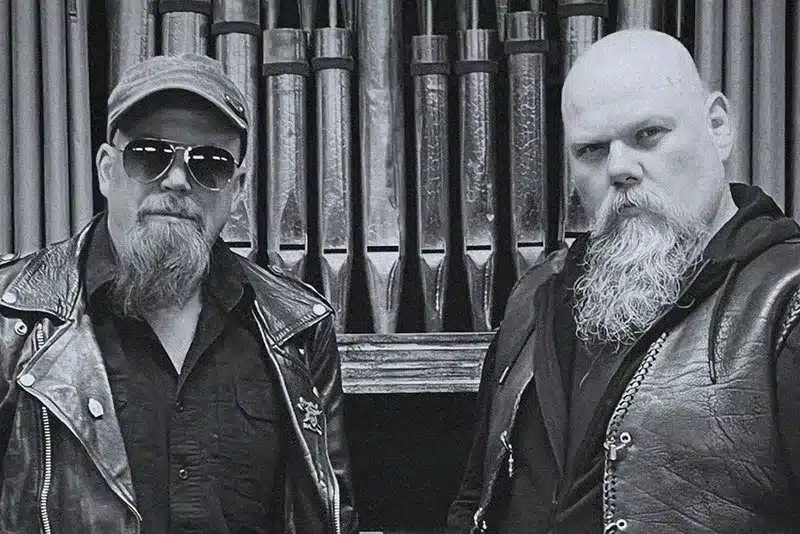

While Mortem were the precursor to Arcturus, they themselves never crossed over from death metal to black metal. So when they crawled back from obscurity with their 2019 debut, Ravnsvart, it was not so much a return but rather a new beginning. Instead of the lo-fi, death metal stench, Mortem returned with a work that stands proudly within the early black metal tradition while embracing its more majestic possibilities. In many ways, this is exactly the type of record that fits the pre-Aspera Hiemns Symfonia period of Arcturus, and now they return with a second chapter in Mørketid.
The foundation is of course the early Norwegian scene, with the tremolo-picked guitars radiating an icy presence. They provide a detached and grim demeanour through their sharp riffing that can be easily adjusted to fit both faster assaults and more mid-tempo grooves. Given the adventurous pedigree of its members, it is no surprise that Mortem frequently tamper with this recipe. The start to “Aftermath” suggests a Thorns-ian touch, where dissonance merges with the staccato rhythmic progression.
Still, Mortem combine it with an early Arcturian keyboard part, which gives the passage a surreal character. The drumming also escapes the confines of traditional black metal, with Hellhammer showcasing meticulous arrangements, making parts like the start of “The Mighty Odious” not only volatile but also unpredictable. These additions bring Mortem closer to the early Emperor works, and their attempt to escape the one-dimensional early nature of black metal and move toward something richer.
It is in this mould that Sverd makes the biggest difference. The keyboards are not supplementary material to the guitars, but a vital part of the record. They retain Arcturus’ sense of playfulness, though here it is deployed against a harsher backdrop. Within the traditional black metal mould, Sverd can twist the keyboards to provide a sentimental undercurrent, clashing against the more austere black metal riffing and Vold’s cutthroat vocals. This is especially effective when it takes a melancholic turn, further enhancing the latent melodic aspect of Mortem, but it can also become something darker and more harrowing. “Den Sanne Gud” exemplifies this, with the mid-paced structure recalling Celtic Frost, where the keyboards help build an asphyxiating atmosphere.
On the surface, these deviations might appear minimal, simple embellishments to a traditional black metal framework, but collectively they reshape the record’s emotional character. Mørketid can operate on the esoteric level while also allowing itself genuinely soaring moments. In the latter case, Mortem channel Bathory’s epic sensibility, with “Skyggeånd” leaving behind the elusive eeriness and instead producing a more in-your-face beatdown inspired by the great Swedish act. While Mortem can eloquently channel triumphant moments, they can also produce something far more oppressive. “Blodvassen Grunn” is such an example, its towering form still channeling an epic scope but in a bloodier, more gruesome fashion.
Mortem’s intricate songwriting and their balanced outlook between traditional and majestic black metal have a precise goal. That is not to create a work that is purely complex and daunting, but to reach a fragile equilibrium, the equilibrium that defined Emperor’s earliest works. Mørketid succeeds in that experiment, reconciling the genre’s exhilarating force with its atmospheric depth. While that does not necessarily produce novelty, it is an experiment that many have attempted and failed. Thankfully, Mortem are not among them.