

Monsters spawn from humanity’s appraisal of what it most fears. The lycanthrope wears the symbolic flesh and fur of animalistic appetites. Blood drinkers embody spiritual death and disease. Godzilla, whose cinematic existence traces back to American hydrogen bomb tests in the 1950s, is another such incarnation of terror. Mothra, in some ways, slots into the same lineage.
The graceful and benevolent moth kaiju who inhabits Godzilla’s world is decidedly virtuous, but she shares politically turbulent origin territory with the King of the Monsters. Her story emerged from a question of Japan’s standing on the postwar international stage.
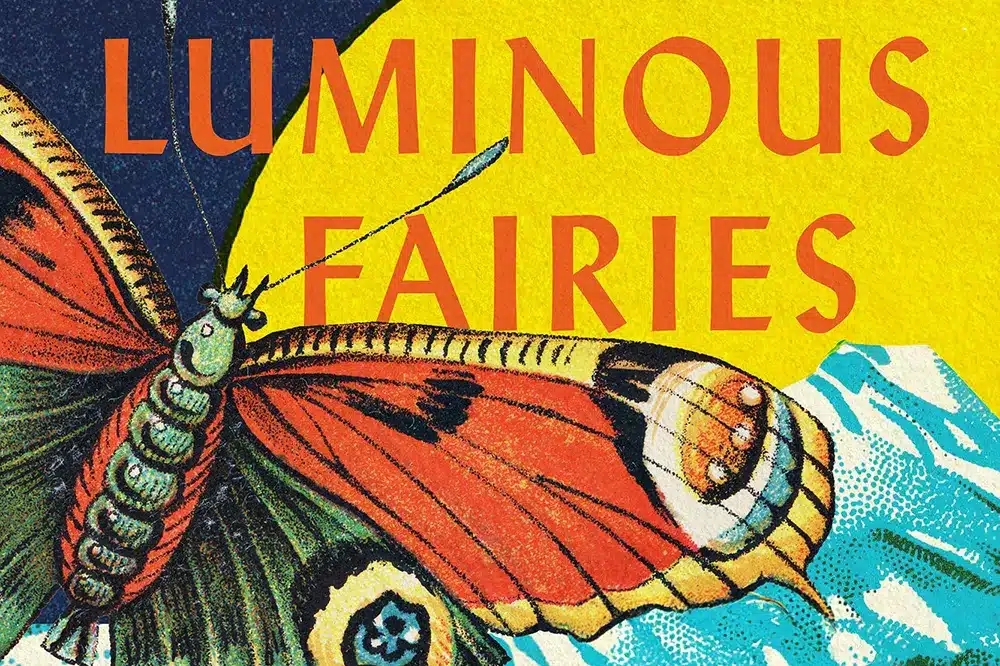
In the interest of developing their next kaiju picture, Toho Studios commissioned three Japanese writers to deliver a workable story for a film script: Shin’ichiro Nakamura, Takehiko Fukunaga, and Yoshie Hotta. Together, the trio of intellectuals conceived the politically conscious 1961 novella The Luminous Fairies and Mothra, which became Ishiro Honda’s Mothra (1961) film.
Originally published in the Japanese magazine Asahi Weekly Supplement, this foundational tale of indigenous exploitation and intervening love has recently been translated into English by Jeffrey Angles, professor of Japanese at Western Michigan University, and published by the University of Minnesota Press. Now, Western kaiju enthusiasts can finally examine Mothra’s historical roots and the source of the creature’s enduring identity across the Godzilla series.
Luminous Mothra
Mothra’s Progeny of Protests
Both The Luminous Fairies and Mothra and Honda’s Mothra center on the Shobijin (small beauties)—tiny women abducted from a South Pacific island for political and financial gain. The Shobijin, who attend to Infant Island’s god, Mothra, summon her with song to rescue them from their captors. Mothra then destroys multiple cities and is eventually reunited with her fairies.
One distinction between The Luminous Fairies and its film adaptation is that the novella emphasizes Mothra’s place among multiple kaiju inspired by social and political unrest. Godzilla marked Toho’s original allegorical monster; the smog monster from 1971’s Godzilla vs. Hedorah is another notable example. While Godzilla embodied both the perpetration and the victimization of nuclear energy, Hedorah was spawned in the mind of director Yoshimitsu Banno as an indictment of rampant industrial pollution. Both monsters echo the concerns of their times, acting as vessels of frustration and—Toho’s filmmakers no doubt hoped—vehicles for change.
Mothra is a monster-as-moral in her own right. In his substantial and insightful Luminous Fairies afterword, translator Jeffrey Angles explains the novella’s clear allusions to the Anpo Protests that erupted in Tokyo from 1959–1960, Japan’s unease with stationing a Cold War superpower on its soil, and the authors’ personal beliefs that Japan should be “empathizing with the developing and decolonizing world” instead of aligning with global juggernauts.
The Anpo Protests, particularly, play directly into Mothra’s story. These demonstrations—the largest in Japanese history—concerned the 1960 US-Japan Security Treaty and its mutual defense requirements, among other cooperative efforts, that Japanese citizens deemed destabilizing to neutrality and independence. Hundreds of thousands marched on Japan’s National Diet Building to object to the treaty’s ratification. In The Luminous Fairies, the fictional nation of Rosilica—a moniker conjoining “Russia” (Ro-shi-a ロシア) and “America” (A-me-ri-ka アメリカ)—signs a similarly unpopular treaty with Japan.
As Japanese citizens observe Mothra spinning a cocoon on the National Diet Building, knowing the Rosilican antagonist Nelson kidnapped her Shobijin, they shout, “Rosilica shouldn’t be interfering in the affairs of our country!” (Hotta 2026, 41) Outside the theater where the Shobijin are forced to sing, others cry, “Nelson, go home!” Angles connects this with statements like “Yankee, go home!” uttered during the Anpo Protests.
The Mothra film avoids certain political allusions. For example, the kaiju cocoons on Tokyo Tower instead of the Diet Building. Rosilica also lends Japan an “atomic heat-ray-emitting device” to use against Mothra. This prompts no reaction from a Japan that, in real life, dreaded how an alliance with the US might bring nuclear weapons into the country.
Angles includes an excerpt from Shin’ichiro Nakamura’s afterword to a 1994 reprint of The Luminous Fairies and Mothra, wherein Nakamura expresses his and his fellow authors’ explicit integration of the Security Treaty into their story. Tomoyuki Tanaka resisted their vision for the film, stating, “That sounds like an independent production.” In other words, their ideas were too political and might damage Mothra at the box office.
Mothra’s existence as a sociopolitical monster mirrors that of Godzilla. Both kaiju were, in Angles’ words, “born out of the headlines of their day.” The Godzilla series has continued to critique nuclear weapons, environmental destruction, and inefficient governments since Godzilla and Mothra first appeared. The newly translated Luminous Fairies and Mothra sheds further light on how seemingly fantastical concepts—monsters, giant moths—can coexist with and even amplify existential ones.
Mythos and the Maternal
Until The Luminous Fairies and Mothra‘s English translation, Mothra’s true origin remained nebulous to most Western fans. Across decades, films have presented Mothra as an ancient protector of Earth (in 1992’s Godzilla vs. Mothra); as the last of an ancient race of guardian moths, per the 1990s Rebirth of Mothra (1996-1998) trilogy; as one of three Guardian Monsters in Godzilla, Mothra, and King Ghidorah: Giant Monsters All-Out Attack (2001); and generally as the deity of her people on Infant Island.
The Luminous Fairies offers a definitive genesis for the kaiju rather than inconclusive background lore. Its creation myth is among its most intriguing revelations. Informed by his anthropological interests, the second author, Takehiko Fukunaga, introduces Mothra as the progeny of a god and goddess of creation. Ajima, the male god, governs nighttime and creates islands, the sky, and the sea. Once bored with his solitary existence, he splits himself in half, creating the goddess Ajigo, who rules daylight and breathes life into creation.
Together, the deities conceive the “Egg of the Infinite”—Mothra. After creating the first humans, the gods’ consummation spawns numerous tiny eggs, which Ajigo births as moths. An enraged Ajima lashes out against the sheer quantity of moths by obliterating half of everything living. Grief-stricken, Ajijo offers her body “as a living sacrifice to Mothra” (Fukunaga), splits herself into four tiny women called the Airena (the Shobijin), and dies. Ajigo declares this prophecy before perishing: “The Airena will serve Mothra, and Mothra will be sure to protect this island” (ibid).
Mothra’s origins, now fully illuminated, highlight her continuous role throughout the Godzilla series: as a divine and benevolent entity in a world of destructive (often male- or male-coded) kaiju. Most interesting is how Mothra’s attitude toward her planet, fairies, and offspring in the films mirrors Ajigo’s sacrificial actions toward her in the novella.
In both The Luminous Fairies and Mothra’s debut movie, Mothra attacks Japan and a fictionalized New York City to rescue her sacred attendants. Though her spirited retrieval causes damage, Mothra’s motivations stem from devotion rather than pure rage or chaotic impulses, like those exhibited by Godzilla. In Godzilla: Tokyo S.O.S. (2003), Mothra’s final moment comes when she lifts her wings to shield her children from Godzilla’s heat ray, which kills her instantly—an Ajigo-adjacent moment.
Mothra again acts as sacrificial savior in 2019’s Godzilla: King of the Monsters when she throws herself at King Ghidorah before he can murder Godzilla. She takes the full brunt of the hydra’s beam attack and combusts, her power raining down on the fallen Kaiju King and giving him the strength to finish his opponent.
Whether defending her eggs, the Earth, or the people and kaiju she values, Mothra has consistently demonstrated caregiving instincts that finally have a lucid source in her feminine creator, Ajigo. In some ways, Mothra is more mother than monster. This makes her a welcome outlier in Godzilla’s universe.
Another distinction is now deepened by the divine origin introduced in The Luminous Fairies: Mothra’s quasi-religious, even Christian, characteristics. Honda’s Mothra forgoes the creature’s Shinto-like creation myth and tethers her to a cross-shaped symbol that reappears in subsequent pictures. In Tokyo S.O.S., Mothra’s symbol is used to summon the monster to defend Japan against Godzilla, and a miniature version of it guides the film’s protagonist to his endangered family by illuminating the way.
That same film sees Mothra act as a cosmic judge against humanity for using the first Godzilla’s bones to construct their biomechanical titan, Kiryu. Should humans fail to return Godzilla’s bones to the sea so they can rest undisturbed, Mothra will declare war on mankind—a warning and ethical judgment akin to the Almighty’s throughout the Bible.
Indeed, Mothra’s very presence, augmented by her maternity, radiates a Messianic nature. Altruistic but holy, gentle but firm, the god of Infant Island in many ways epitomizes a sacrificial heart and concern for justice. Such traits distinguish her from her more single-minded, bellicose counterparts.
The Divine Feminine
Mothra’s femininity is the logical root of her maternal actions. In his afterword, Angles thoughtfully considers the creature’s technically ambiguous gender, having referred to Mothra throughout the Luminous Fairies primarily as an “it” until it hatches into its imago (adult) form. From there, Angles pivots to female pronouns.
”Until fairly late in the third and final section of the novella, no pronouns whatsoever are used to refer to Mothra,” Angles explains. “However, when Mothra begins spinning a cocoon on top of the National Diet Building, the masculine pronoun kare (“he/him”) suddenly appears. In the original Japanese, this word is used four times over a few consecutive sentences before all pronouns disappear again.” Angles adds that he “followed the tradition established in popular discourse and used female pronouns when talking about Mothra’s final form as a moth”.
This “popular discourse” includes Godzilla fan proclamations that Mothra is “Queen of the Monsters”, as well as film soundtrack music and comics that bestow the same title on her. Many fans relate to Mothra as a feminine symbol. That’s not surprising when considering Mothra’s delicacy and aesthetic appeal, her close connection to her tiny female servants, and her disposition. Mothra isn’t disproportionately hostile or dangerous. Her aggression is protective and dutiful. She also brings a “softer touch” to every screen she graces.
A few prominent female kaiju that embody different aspects of femininity from Mothra appear in the Godzilla series. Godzilla vs. Biollante (1989) introduced a plant monster possessing the consciousness of a young deceased girl. Biollante’s somber cries, twisted beauty, and violent streaks suggested female rage and suffering erupting against provocative forces.
In 2000, Megaguirus swooped onto the screen as a kind of anti-Mothra. Fierce and cunning, the insect engaged Godzilla in a heated dominance contest, dispatching minions to do her dirty work before toying with Godzilla in a final confrontation. If Biollante is female brokenness and Megaguirus an assertive queen bee (or dragonfly), Mothra represents a secure, wholesome femininity; one that cherishes and preserves, cares for vulnerable creatures and peoples, and acts from a higher will rather than the impulses of her id.
Importantly, Mothra isn’t passive, and opponents’ size or strength don’t deter her. Mothra has faced countless foes more powerful than her; she has risen to each occasion. She has died many times but is always reborn, each birth like a promise that goodness cannot be vanquished from the world. She has gifted her own power to other monsters in their time of need.
None of these traits is entirely absent from male monsters. Godzilla has paternal, protective moments, too. However, it’s the cluster of Mothra’s characteristics that causes fans to admire her as set apart from other kaiju. She transcends the chaos, often literally, as living proof of femininity’s inherent strength. Like Mothra, a delicate, purposeful woman needn’t copy masculinity to hold power. It already glows in the quiet fire of her being.