
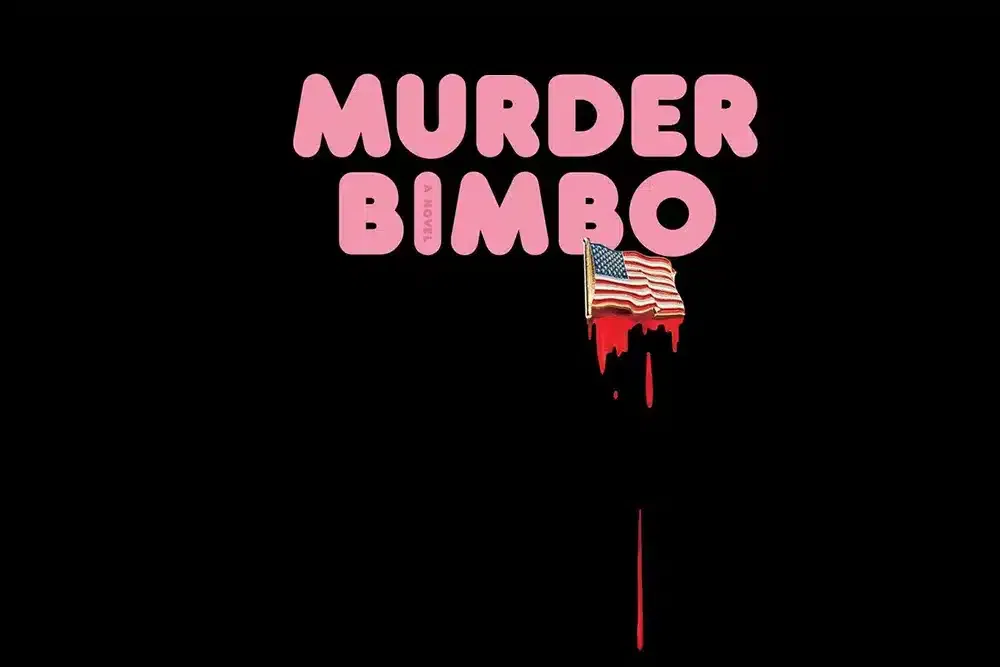

Rebecca Novack’s debut novel, Murder Bimbo, is difficult to categorize. It is a mélange of genres. Is it a political thriller? Yes, a political thriller wrapped around a story driven by both revenge and accident. Is it a love story? Yes, a love story wrapped around a tale of ideology, loss, and obsession. This sort of categorization difficulty is merely one of content; it is the common kind of “multiple genre” narrative that makes a novel complex and intriguing, even if it leaves a marketer wondering where on the bookstore shelves this book would reside.
Murder Bimbo presents a second type of difficulty, however. Not one of content but of structure. Novack presents her tale in three parts. This structure is also not inherently unusual or confusing; indeed, it has become a commonplace for the same story to be narrated from the point of view of different characters—an interesting device when, for example, the various narrators are privy to different sets of facts. In Murder Bimbo, however, the same story is told three times, each by the same character.
Murder Bimbo‘s narrator is a clever high-end sex worker who is also a lesbian whose lover has left her. She becomes involved with a group of men whose goal is to neutralize, through scandal or murder, a right-wing candidate for US president. The candidate might seem recognizable to followers of current events except that here he is a young, former athlete whose nickname is Meat Neck. The members of this group of men also have nicknames, and characters retain these nicknames across all three versions of the tale.
Novack’s narration is whip-smart, clever, and satirical in each of the three tellings. The first version consists of emails to a podcaster written while the narrator is in hiding in a derelict mountain cabin, on the run after her encounter with Meat Neck. She is trying to become the subject of the podcast Justice for Bimbos, tales of women who have become famous after being caught up in public events, where the media have come to hate them for the wrong reasons.
In the second telling, the narrative consists of emails to X, the narrator’s former lover, written while the narrator is in hiding at an ultra-posh mountain retreat. The narrator’s goal is to convince X, whose departure has been deeply traumatic, to leave her wife and come back to her. This is where the trouble with Murder Bimbo starts.
Proper dialogue is inherently a form of dramatic action; it gets something done. The use of one character’s dialogue for exposition, on the other hand – one character telling another what the other must already know, simply as a device for passing information to the reader – usually renders a narrative awkward and slow. The bulk of this second tranche of emails rehearses the story of the lovers’ past relationship and its break-up. X would be presumed to already know just about everything in these emails.
Finally, in the third telling, the “Get Meat Neck” story is narrated directly to the reader. Each of the three narrations is a different version of what is essentially the same throughline—the lead-up to and the performance of a political assassination. The narrator tells us:
“There are two stories. The story of X and the story of Meat Neck. And then there’s the third story about how I mounted both…before I knew where either was going and corralled them into one perfect, wild saga…”
The overall problem here is that the narrative structure leads not to a perfect saga but to uncertainty. What is the author’s intent in writing a novel comprising three distinct alternatives told by the same character working toward the same goal with a group of similarly named characters? The “unreliable narrator” is a customary and useful device. In this novel, it is a matter of a narrator who inhabits inconsistent alternative realities in conflict and never resolved.
This is not to say that Murder Bimbo is without merit. To the contrary, the narrator of the three versions, a prickly non-binary sex worker without a heart of gold, is uniquely funny, insightful, and sarcastic. The writing itself is smart, colloquial, and captivating, though it can be somewhat repetitive even within each version.
I believe that this debut author has the makings of an excellent novelist. In the end, though, the use of this experimental structure in Murder Bimbo renders the tale confusing and ultimately unsatisfying.
In the Acknowledgements section of the novel, the author, who has a Master’s Degree in Theological Studies from Harvard Divinity School, notes: “Most of this book was written on my phone in the grocery line, or in the front matter of novels in the daycare pickup line, in voice memos…and in emails to myself…”.
We should look forward to future novels by Rebecca Novack, written in more conventional ways.